
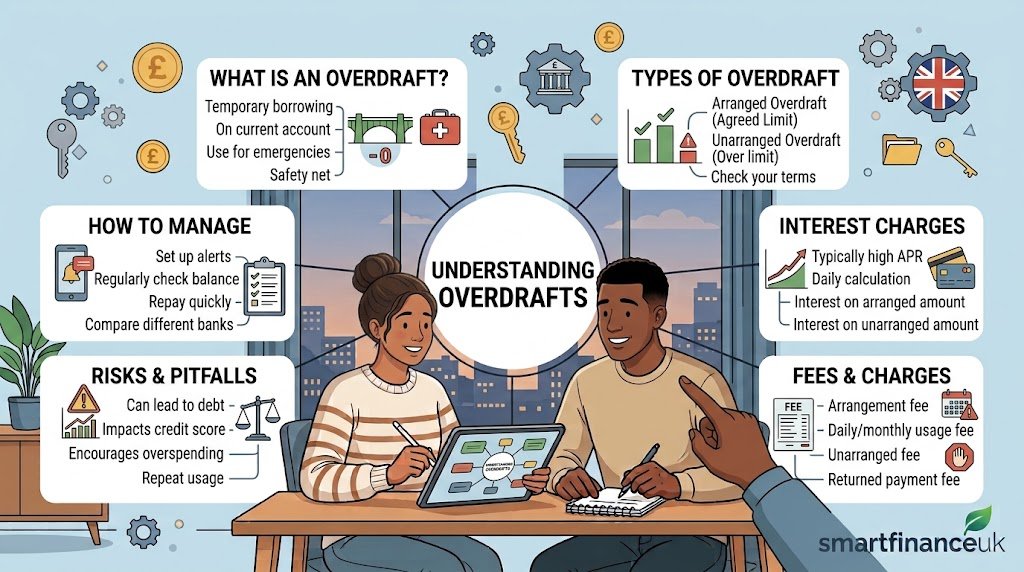
An overdraft allows you to spend more money from your current account than you actually have available. It can be useful when an unexpected payment arrives before your salary or other income, but an overdraft is still a form of borrowing.
The cost can be easy to underestimate because the borrowing is connected directly to your bank account. Instead of receiving a separate loan and making a fixed monthly repayment, you can move in and out of your overdraft as money enters and leaves your account.
For UK bank customers, understanding the difference between an arranged and unarranged overdraft, how interest is charged and what happens when you exceed your limit can help prevent an occasional shortfall from becoming long-term debt.
This guide explains how overdrafts work, how charges are calculated, what to check on your bank statement and what you can do if you are regularly relying on your overdraft.
What Is an Overdraft?
An overdraft is a borrowing facility linked to a current account.
If you have £100 in your account and spend £130, you have effectively borrowed £30 through your overdraft, assuming your bank allows the transaction.
An overdraft therefore differs from money you already have. Once your account moves below £0, you owe money to the bank.
MoneyHelper describes an overdraft as a way of borrowing through your current account and recommends treating it as a form of debt rather than as additional income.
Some current accounts offer an arranged overdraft that you apply for in advance. Other situations can result in an account becoming overdrawn without an agreed facility.
The exact terms vary between banks and accounts.
What Is an Arranged Overdraft?
An arranged overdraft is agreed with your bank before you use it.
For example, your current account might have an arranged overdraft limit of £1,000.
If your account balance reaches £0, you may be able to continue making payments up to the agreed limit, subject to your bank’s terms and any other restrictions.
If you use £300 of the overdraft, you have borrowed £300.
If your account later receives £1,000 in salary, the overdraft can be cleared automatically as money enters the account, leaving the remaining amount available in your current account.
This flexibility is one reason overdrafts can be useful for short-term borrowing.
However, the money still has to be repaid, and interest can be charged while you remain overdrawn.
What Is an Unarranged Overdraft?
An unarranged overdraft, sometimes called an unplanned overdraft, can occur when you spend more than you have available without having agreed an overdraft in advance.
It can also happen when you exceed the limit of an arranged overdraft.
For example, suppose your arranged overdraft limit is £500 and your account is already £450 overdrawn.
If another payment takes the account to £550 overdrawn, the extra £50 is beyond your agreed limit.
Whether a bank allows a particular payment to go through is not guaranteed. The payment could be declined instead.
MoneyHelper explains that an unarranged overdraft can arise when you spend more than you have without arranging an overdraft in advance, including going beyond an existing arranged limit.
How Do Overdraft Charges Work?
Overdraft costs are generally based on an interest rate applied to the amount you borrow.
UK rules changed significantly in April 2020. For personal current accounts covered by the relevant FCA rules, firms generally cannot impose separate arranged or unarranged overdraft charges outside the permitted interest-rate structure. The FCA rules require overdraft charges to take the form of an annual interest rate, subject to the rules and exceptions that apply.
This means you will often see an overdraft interest rate expressed as an annual percentage.
For example, imagine a hypothetical account with an overdraft rate of 30% a year.
That does not mean you will automatically pay 30% of your overdraft balance every month or every time you use it.
The actual cost depends on factors such as how much you borrow and how long you remain overdrawn.
MoneyHelper notes that overdraft interest is commonly charged daily.
This makes the length of time you remain overdrawn particularly important.
Why Daily Overdraft Interest Matters
An overdraft can feel different from a credit card because the borrowing changes as money enters and leaves your account.
Imagine a hypothetical situation where you go £300 overdrawn.
If your salary arrives two days later and brings the account back above £0, you may only have borrowed the £300 for a short period.
If you remain £300 overdrawn for several weeks, the borrowing lasts much longer and more interest can accumulate.
The exact amount charged depends on your bank’s calculation method and account terms.
This is why looking only at the annual interest rate is not enough. You should also consider how frequently interest is calculated and when it is applied to your account.
A Simple Example of Overdraft Interest
Suppose, purely as a hypothetical illustration, that a bank charges 30% annual interest on an arranged overdraft.
If you borrow £200 for a short period, the cost will be much lower than if you remain £200 overdrawn for many months.
The annual rate is simply a way of expressing the borrowing cost.
The actual amount appearing on your statement will depend on the balance and period for which you were overdrawn, together with the bank’s terms.
Do not use the example as a calculation of what your own bank will charge.
For your actual cost, check the interest rate and charging information provided by your bank.
Do Overdrafts Have Fees?
The way overdraft charges work in the UK has changed considerably.
For personal current accounts covered by the FCA’s overdraft pricing rules, banks generally charge overdraft borrowing through an annual interest rate rather than separate overdraft usage fees. The FCA introduced these rules to make overdraft pricing simpler and easier for customers to compare.
However, this does not mean that every event involving an overdrawn account is completely free of other possible consequences.
For example, if a payment cannot be made because there is not enough money available, the payment may be refused. There can also be consequences from the company you were trying to pay if a bill is missed.
MoneyHelper explains that unpaid transactions can sometimes result in fees and that customers should check their account terms.
This distinction matters.
An overdraft interest charge is not necessarily the same thing as a charge relating to an unpaid or rejected transaction.
What Happens If You Go Over Your Arranged Overdraft Limit?
Going beyond your agreed overdraft limit does not guarantee that payments will be accepted.
Your bank may decline a payment because there is not enough available money or credit.
If a Direct Debit or standing order cannot be paid, the organisation you owe may also have its own consequences for late or missed payment.
MoneyHelper says that if there is not enough money in an account, banks may contact customers and give them an opportunity to put money into the account before a payment is processed or rejected.
The exact process depends on the bank and type of payment.
If you regularly approach your overdraft limit, checking your account balance before scheduled payments can help you identify a problem early.
What Is an Overdraft Limit?
Your overdraft limit is the maximum amount your bank has agreed that you can borrow through the account.
For example, if your current account has an arranged overdraft limit of £1,000, that does not mean you have £1,000 of additional income.
It means the bank has agreed to allow borrowing up to that amount, subject to the account’s terms.
You remain responsible for repaying the amount borrowed and any applicable interest.
It is therefore better to think of the overdraft limit as a borrowing limit, not as part of your monthly budget.
Can an Overdraft Be Interest-Free?
Some current accounts may offer an interest-free overdraft or interest-free buffer up to a specified amount.
The terms vary between accounts and can change.
For example, an account might provide a £100 interest-free overdraft buffer while charging interest on borrowing above that amount.
If you are considering an account because of its overdraft, check:
- the size of the interest-free amount
- the interest rate above the buffer
- whether the offer is temporary
- eligibility requirements
- what happens if you exceed the agreed limit
Do not assume that an interest-free overdraft means all overdraft borrowing is permanently free.
Is an Overdraft the Same as a Loan?
Both involve borrowing, but they work differently.
A personal loan normally gives you a specific amount of money upfront, followed by scheduled repayments over an agreed period.
An overdraft is attached to your current account and can generally be used and repaid flexibly within the agreed limit.
This flexibility can be convenient, but it can also make an overdraft harder to track.
With a loan, you can normally see the repayment schedule.
With an overdraft, your account may move from positive to negative repeatedly.
That can make it easier to think of the overdraft as available money rather than borrowing.
MoneyHelper recommends using overdrafts mainly for short-term borrowing or emergencies rather than treating them as a long-term source of credit.
Why Can an Overdraft Become Difficult to Clear?
An overdraft can become a cycle.
Imagine your salary is £2,000.
Your regular expenses are £2,200.
You therefore finish the month £200 overdrawn.
When your next salary arrives, the £200 overdraft is automatically cleared first, leaving you with £1,800.
If your expenses are still £2,200, you finish the next month £400 overdrawn.
The cycle can continue.
The problem is not necessarily the overdraft itself. The underlying issue is that regular spending is greater than available income.
Interest then adds another cost.
If you are regularly using your overdraft simply to reach the end of the month, it may be worth reviewing your household budget and seeking help if you cannot close the gap.
How to Check What Your Overdraft Is Costing
Your bank statement should help you understand how much the overdraft is costing.
Look for:
Overdraft interest
Check the amount charged during the statement period.
Your overdraft rate
Look at the annual interest rate that applies to your account.
Your lowest balance
This can help you understand how far into the overdraft you went.
How long you remained overdrawn
A short period and a long period can have very different costs.
Other account charges
Check whether any separate account or transaction charges have been applied.
If you cannot understand a charge, contact your bank and ask them to explain it.
A Simple UK Example
Consider a hypothetical household whose current account normally receives a salary of £2,500 each month.
Near the end of the month, the account falls to £250 overdrawn because several household bills are paid before the next salary arrives.
The salary then enters the account, clearing the £250 overdraft.
If this happens occasionally, the borrowing period may be short.
Now imagine the same household remains £250 overdrawn for most of every month.
The overdraft is no longer simply helping with timing. It has become part of the household’s regular finances.
Interest can accumulate, and the salary is partly used to clear borrowing before the household starts the month again.
This example is hypothetical, but it illustrates an important distinction: temporary overdraft use and permanent reliance on an overdraft are very different situations.
Common Overdraft Mistakes
Treating an Overdraft as Extra Income
An overdraft can make your bank balance look more flexible than it really is.
If you have £500 available and a £1,000 overdraft limit, you do not have £1,500 of income.
The extra £1,000 is borrowing.
Ignoring the Interest Rate
An overdraft can be expensive if used for a long period.
Check the actual rate attached to your account instead of assuming all overdrafts cost the same.
Staying Permanently Overdrawn
If your salary arrives and immediately clears the overdraft, only for you to become overdrawn again shortly afterwards, your overdraft may have become a structural part of your budget.
That can be a sign that your regular expenses need reviewing.
Going Over the Agreed Limit
An arranged limit does not guarantee that transactions beyond it will be accepted.
A rejected payment can create problems with the organisation you were trying to pay.
Forgetting About Scheduled Payments
Direct Debits, standing orders and other automatic payments can take money from your account without you actively thinking about them.
MoneyHelper recommends regularly reviewing scheduled payments and checking your balance.
Assuming the Bank Will Always Keep the Overdraft Available
An overdraft is not necessarily permanent.
MoneyHelper notes that a bank may withdraw an overdraft facility, particularly if it believes the account is being overused or the customer is experiencing financial difficulty.
This is another reason not to build essential monthly spending around an overdraft limit.
How to Reduce Overdraft Costs
The first step is to understand how often you use the overdraft.
Check your statements over several months.
If you only use it occasionally, you may simply need to monitor your balance and scheduled payments more closely.
If you are regularly overdrawn, look at your monthly budget.
Identify which expenses are essential, which can be reduced and whether the timing of income and bills is creating a temporary problem.
You may also want to compare current accounts if another account could offer more suitable overdraft terms. The Current Account Switch Service allows customers to switch participating current accounts, including transferring regular payments and incoming payments under the service’s rules.
Do not switch accounts purely because another provider advertises a lower rate. Check the complete account terms and whether you are eligible.
Could a Different Form of Borrowing Be Cheaper?
If you are permanently using an overdraft, it is worth comparing the cost with other borrowing options.
MoneyHelper notes that overdrafts can be expensive for long-term borrowing and that other forms of credit may sometimes be cheaper.
That does not mean a personal loan or credit card is automatically the right answer.
A new form of borrowing could extend the repayment period or create additional costs.
The important comparison is the total cost, repayment period, interest rate and whether the repayment fits your budget.
If the underlying problem is that your household expenses exceed your income, replacing the overdraft with another loan may not solve the problem.
What If You Cannot Get Out of Your Overdraft?
If you are constantly at or near your overdraft limit and cannot reduce it, take the situation seriously.
Start by reviewing your income and essential expenses.
Then contact your bank and explain that you are struggling.
Banks may have support options for customers experiencing financial difficulty. MoneyHelper recommends contacting your bank as soon as possible if overdraft borrowing is becoming difficult to manage.
You can also seek free debt advice.
MoneyHelper provides information about dealing with debt and finding appropriate support.
Avoid taking out additional borrowing simply to hide the overdraft unless you have properly considered the cost and have a realistic plan for repayment.
What Happens to Your Credit Record?
An overdraft is a form of borrowing, so its use can be relevant when lenders assess your financial circumstances.
However, there is no simple rule saying that having an overdraft automatically damages your credit score.
MoneyHelper explains that responsible overdraft use can be treated differently from repeatedly exceeding an agreed limit or failing to make meaningful repayments.
Credit reference agencies calculate scores using the information on your credit report, while lenders use their own criteria.
If you are concerned about your credit record, check your credit report rather than relying on assumptions about how an overdraft will affect it.
Questions to Ask Before Using an Overdraft
Before relying on your overdraft, consider these questions:
What is my arranged overdraft limit?
Know exactly how much the bank has agreed to lend.
What interest rate applies?
Check the current rate rather than relying on what you remember.
Is there an interest-free buffer?
If so, find out how much it covers and whether conditions apply.
How often am I using the overdraft?
Occasional use is different from relying on it every month.
How quickly can I repay it?
Consider when your next income will arrive and whether it will clear the borrowing.
Could a payment take me beyond my limit?
Check upcoming Direct Debits, standing orders and other payments.
Would another borrowing option actually be cheaper?
Compare the total cost rather than focusing only on the monthly payment.
Frequently Asked Questions
Is an overdraft a type of debt?
Yes. When your current account goes below £0, you are borrowing money from the bank. An overdraft should therefore be treated as debt rather than additional income. The borrowing can usually be repaid when money enters your account, but interest may apply while you remain overdrawn. MoneyHelper recommends using an overdraft mainly for short-term borrowing or emergencies.
What is the difference between an arranged and unarranged overdraft?
An arranged overdraft is agreed with your bank in advance and normally has a specified limit. An unarranged overdraft can occur when you spend more than the money available without an agreed overdraft or go beyond your arranged limit. A bank may decline transactions that would take you beyond the available amount. The terms and treatment depend on the account.
How much does an overdraft cost?
The cost depends on your bank account and how much and how long you borrow. For personal current accounts covered by the FCA’s overdraft pricing rules, overdraft charges generally take the form of an annual interest rate. The interest may be calculated based on the amount you are overdrawn and the time you remain overdrawn. Check your bank’s current terms for the exact rate and charging method.
Can I use an overdraft every month?
You can have an arranged overdraft that you use regularly, but relying on it every month can indicate that your income and regular expenses are not balancing. It can also make borrowing costs accumulate. If your salary repeatedly clears the overdraft only for you to become overdrawn again, review your budget and consider seeking advice if you cannot reduce the reliance.
Can a bank remove my overdraft?
An overdraft is not necessarily a permanent facility. A bank can review an overdraft and may reduce or withdraw it in certain circumstances. MoneyHelper specifically warns that overdrafts can be taken away, which is another reason not to depend on an overdraft to fund regular essential spending.
Can an overdraft affect my credit score?
Overdraft use can form part of the information considered in credit assessments, but there is no universal rule that simply using an overdraft will damage your credit score. Factors such as whether you stay within the agreed limit and whether you make repayments can matter. Credit reference agencies and lenders use their own methods, so individual outcomes can differ.
What should I do if I am constantly overdrawn?
Start by checking your income, essential spending and overdraft interest. If the account is permanently overdrawn, contact your bank and explain your circumstances. You can also seek free debt advice through MoneyHelper or another reputable service. Avoid automatically replacing the overdraft with another form of borrowing without checking the total cost and whether you can afford the repayments.
Final Thoughts
An overdraft can be useful when there is a temporary gap between money coming into your current account and money going out. But it is still borrowing, and the costs can become significant when you remain overdrawn for long periods.
The most important things to understand are your arranged limit, the interest rate, how interest is calculated and what happens if you exceed the agreed limit.
If you use your overdraft occasionally and clear it quickly, keeping track of your balance may be enough to prevent unnecessary costs. If you are relying on it every month, however, it is worth looking beyond the overdraft itself and examining whether your household budget is consistently running short.
If you cannot afford to clear the overdraft or are struggling with other debts and bills, seek help early. Your bank and free debt-advice services may be able to help you understand your options.
This article provides general educational information and is not personalised financial advice.
Sources and Further Reading
- MoneyHelper — Overdrafts explained — Covers arranged and unarranged overdrafts, interest, charges and practical ways to manage overdraft borrowing.
- Financial Conduct Authority — Overdraft pricing rules — Explains the FCA rules governing overdraft charging structures.
- Financial Conduct Authority — Changes to overdraft charges — Provides background on the UK overdraft pricing changes introduced from April 2020.
- MoneyHelper — The best way to borrow money — Compares overdrafts with other forms of borrowing.
- MoneyHelper — Help if you’re struggling with debt — Guidance for people finding it difficult to manage borrowing and household debts.