
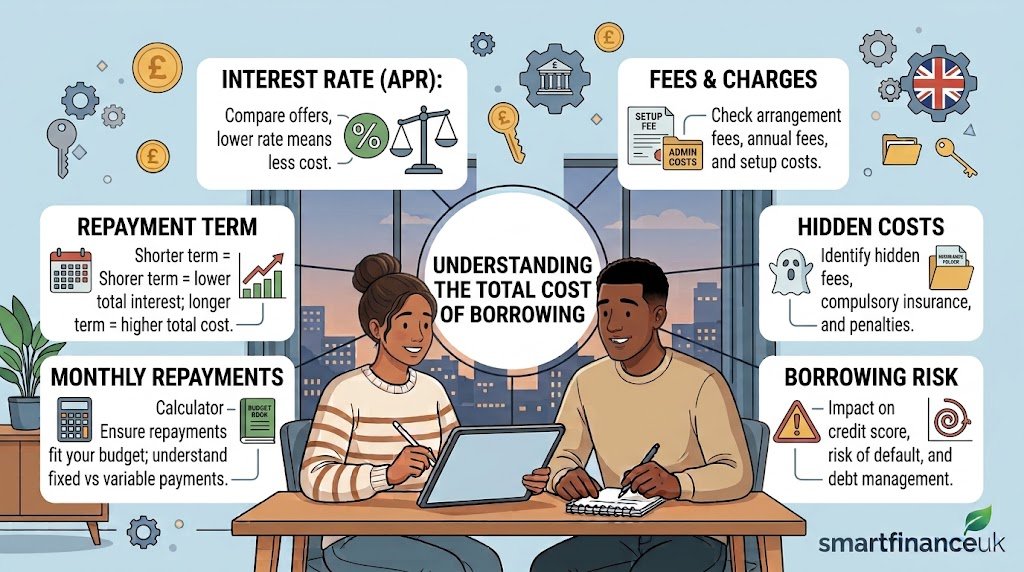
Borrowing can make a large expense easier to manage, but the amount you borrow is rarely the amount you eventually repay. Interest, arrangement fees, charges and the length of the agreement can all affect the final cost.
A loan advertised with a low monthly payment may therefore cost more overall than another option with a higher monthly payment. Similarly, a low interest rate does not always tell you the complete story.
For UK borrowers, lenders provide information designed to help you understand the cost of credit before entering an agreement. MoneyHelper says borrowers should look at the interest rate and APR, total amount repayable, fees, penalties and whether repayments could change.
Understanding these figures before signing an agreement can help you compare borrowing more sensibly and avoid focusing on a single attractive number.
This article provides general educational information and is not personalised financial advice.
What Does the Total Cost of Borrowing Mean?
The total cost of borrowing is the overall financial cost of obtaining credit.
At its simplest, think of it as:
Total amount repaid − amount originally borrowed = cost of borrowing
For example, imagine you borrow a hypothetical £5,000 and eventually repay £6,200.
The £1,200 difference represents the borrowing cost in this simplified example.
That difference could include interest and applicable fees, depending on the type of credit and how the figures are presented.
The Financial Conduct Authority defines the total cost of credit for relevant regulated credit agreements as including costs such as interest, commissions, taxes and other fees connected with the credit, subject to specific regulatory rules and exclusions.
The important point is that the amount you borrow and the amount you repay are not necessarily the same.
Why the Monthly Payment Does Not Tell You Everything
Monthly repayments are useful because they help you assess affordability.
But they should not be the only figure you consider.
Imagine two hypothetical loans:
Loan A: £180 per month for 24 months
Loan B: £120 per month for 48 months
Loan B looks cheaper because the monthly payment is lower.
But you would make twice as many monthly payments.
This is why MoneyHelper advises borrowers to consider how much they will repay in total rather than focusing only on the monthly amount.
A longer repayment period can make monthly payments easier to manage while increasing the overall amount of interest paid.
Before borrowing, look at both:
“Can I afford this payment each month?”
and
“How much will I repay altogether?”
You need both answers.
What Is APR and Why Does It Matter?
APR stands for Annual Percentage Rate.
It is intended to give borrowers a standardised way of understanding the annual cost of borrowing, taking account of interest and certain fees.
MoneyHelper explains that APR includes the interest rate plus applicable arrangement fees, making it useful when comparing credit products.
For example, if one personal loan has an APR of 8% and another has an APR of 14%, the first may appear cheaper on this measure.
However, APR should not be treated as the only number that matters.
The FCA reported in April 2026 that its research found consumers can struggle to understand APR and the effect that repayment duration has on the total cost of credit. The FCA also noted that total repayment information can help consumers compare borrowing costs.
That makes the following approach useful:
Check the APR, then check the total amount repayable.
What Is the Total Amount Repayable?
The total amount repayable tells you how much you are expected to pay back under the agreement, based on the assumptions and repayment schedule that apply.
For a straightforward fixed-rate loan, it can make the cost much easier to understand.
Imagine a hypothetical loan where you borrow £8,000 and the agreement states that the total amount repayable is £9,500.
You can immediately see that the financing will cost £1,500 under those terms.
The monthly payment might be £395.83 over 24 months, for example, but the total figure tells you what the borrowing costs over the whole agreement.
Always check the assumptions behind the figure. Your actual cost can differ if you change the repayment schedule, miss payments, settle early or otherwise depart from the agreed terms.
Interest Is Usually the Main Cost of Borrowing
Interest is the price you pay for using someone else’s money.
If you borrow £10,000, you normally repay the original £10,000 plus interest and any applicable costs.
The interest rate can therefore have a substantial effect on the total amount repaid.
MoneyHelper explains that borrowing less over a shorter period will generally result in lower interest costs than borrowing more over a longer period, assuming comparable terms.
This does not mean the shortest repayment period is automatically suitable.
A shorter term can mean higher monthly payments.
The sensible comparison is between overall cost and affordability, rather than simply choosing whichever term produces the smallest total interest.
How the Length of the Agreement Affects Cost
The repayment period is one of the easiest factors to overlook.
Suppose you borrow £10,000 at the same hypothetical interest rate.
If you repay it over three years, you make payments for 36 months.
If you repay it over six years, you make payments for 72 months.
The longer arrangement may have lower monthly payments, but interest can be charged over a much longer period.
This is why two loans with similar advertised rates can still have different total costs.
Before agreeing to a longer term, ask yourself whether the lower monthly payment is worth the additional overall cost.
Do Fees Add to the Cost?
They can.
Depending on the type of credit, fees may include arrangement fees or other charges associated with the agreement.
MoneyHelper specifically recommends checking for fees and notes that arrangement fees are included in APR for relevant loans.
Other possible charges can relate to matters such as late payments or early repayment, depending on the product and agreement.
This is why reading the terms and conditions matters.
A loan advertised at a particular interest rate may not tell you everything you need to know about the cost.
Look for:
- arrangement or application fees
- broker fees, where applicable
- late-payment charges
- early-settlement or repayment charges
- fees connected with optional services
- charges that may arise if you breach the agreement
Do not assume every possible charge will apply. Check the specific agreement.
What Is a Representative APR?
You may see the phrase representative APR in credit advertising.
This is important because the advertised rate is not necessarily the rate every successful applicant receives.
MoneyHelper explains that with many personal loans, only at least 51% of successful applicants have to receive the representative APR or a lower rate. The rate offered to an individual can therefore be higher.
For example, a lender might advertise a representative APR of 9.9%.
That does not necessarily mean every applicant who qualifies will receive 9.9%.
Your actual rate can depend on the lender’s assessment and your circumstances.
An eligibility checker can sometimes help you assess your likelihood of acceptance without making a full application. MoneyHelper notes that eligibility checkers use a soft search in relevant circumstances, allowing you to assess potential options without leaving the same type of mark as a full credit application.
A Low Interest Rate Does Not Always Mean the Cheapest Option
It is tempting to look for the lowest advertised interest rate.
But the complete borrowing cost depends on more than one figure.
Consider two hypothetical products.
Option A
Borrow £10,000
Lower interest rate
Higher arrangement fee
Three-year term
Option B
Borrow £10,000
Slightly higher interest rate
No arrangement fee
Two-year term
Option A has the lower rate, but that does not automatically make it cheaper overall.
The repayment period and fees could change the result.
This is why comparing the total amount repayable alongside APR and monthly repayments gives you a more useful picture.
What About Credit Cards?
Credit cards require a slightly different approach.
A credit card does not normally work like a fixed personal loan with one predetermined repayment schedule.
The total cost can depend on how much you spend, how long you carry the balance, the interest rate, fees and the amount you repay each month.
If you pay only the minimum required amount, the balance can take much longer to clear and cost more in interest.
MoneyHelper notes that minimum payments can decrease as a balance falls, which can extend the repayment period if you continue paying only the minimum.
Promotional offers also require careful attention.
For example, a 0% promotional rate may apply for a limited period and may not cover every type of transaction.
Check:
- when the promotional period ends
- what rate applies afterwards
- whether a balance-transfer fee applies
- what minimum payment is required
- what happens if you miss a payment
The cost of credit depends heavily on how you actually use the card.
What About Overdrafts?
Overdrafts are another form of borrowing, but their costs work differently from a fixed-term loan.
With an arranged overdraft, you normally agree a borrowing limit with your bank.
Interest may be charged according to the account’s overdraft rate and the amount and duration of borrowing.
MoneyHelper explains that overdraft interest is charged at an annual rate and that using an overdraft for longer periods can make it an expensive way to borrow.
If you are considering an overdraft, look at the actual interest rate and how frequently you expect to use it.
An overdraft used for a few days to cover a temporary timing problem is very different from an overdraft that remains outstanding month after month.
Check Whether the Rate Is Fixed or Variable
The interest rate can affect both cost and certainty.
With a fixed-rate loan, the interest rate is generally set for the agreed period, meaning your scheduled payments may be predictable.
Some borrowing arrangements can have variable rates.
MoneyHelper warns that borrowers using variable-rate loans need to consider the possibility that rates could rise and increase repayments.
If your budget is already tight, a potential increase in repayments is worth considering before taking the credit.
Do not assume that today’s payment will necessarily remain unchanged when the agreement permits the rate to vary.
Check What Happens If You Repay Early
You might expect that repaying a loan early will always make it cheaper.
Often, reducing the outstanding borrowing period can reduce future interest, but the exact financial effect depends on the agreement.
Some products can have early repayment or settlement charges.
MoneyHelper recommends checking for penalties or fees if you repay borrowing early.
Before taking credit, check the agreement for information about early settlement.
This is particularly useful if you expect your financial circumstances to change and may want to clear the debt ahead of schedule.
Check What Happens If You Miss a Payment
A missed payment can have consequences beyond one additional charge.
Depending on the credit agreement, you could face a late-payment charge, additional interest or other consequences. Missed payments can also be reported to credit reference agencies and may affect future applications.
The precise consequences depend on the product and agreement.
Before borrowing, make sure the scheduled payment fits comfortably within your budget.
MoneyHelper recommends working out whether you can afford an additional repayment on top of your existing bills and commitments before applying for credit.
Do Not Borrow More Than You Need
The easiest way to increase the total cost of borrowing is to borrow more money.
If you need £5,000 for a particular purpose, borrowing £8,000 simply because the lender is willing to offer it can create additional interest and repayment costs.
Work out the amount you actually need.
Then consider whether you could reduce the amount by delaying a purchase, using existing savings where appropriate or choosing a less expensive alternative.
MoneyHelper recommends considering whether you really need the purchase and whether you could wait until you have enough money to pay for it upfront when considering certain forms of credit.
A Simple UK Example
Imagine a fictional borrower needs £6,000 for a necessary expense.
They compare two hypothetical loan offers.
Loan A
£6,000 borrowed
£210 monthly payment
36-month term
Total amount repayable: £7,560
Loan B
£6,000 borrowed
£145 monthly payment
60-month term
Total amount repayable: £8,700
The figures are purely illustrative and are not current market offers.
Loan B looks easier each month because the payment is £65 lower.
However, the total amount repayable is £1,140 higher.
This illustrates why affordability and total cost need to be considered together.
A borrower should not automatically choose Loan A simply because it costs less overall either. The £210 monthly payment must still fit comfortably within the household budget.
A Practical Checklist Before Taking Credit
Before signing a credit agreement, work through the following questions.
How much am I actually borrowing?
Do not borrow more simply because a lender offers a larger amount.
How much will I repay in total?
Look for the total amount repayable and understand the assumptions behind it.
What is the APR?
Use APR to help compare the cost of different credit products, while also checking the total repayment figure.
What is my actual interest rate?
If the advertised rate is representative, understand that the rate you are offered could be different.
What are the monthly repayments?
Make sure they fit your budget after essential household expenses and existing commitments.
How long will I be making payments?
A longer term may reduce monthly payments but can increase the overall cost.
Are there any fees?
Check arrangement fees, broker charges where relevant and other costs.
What happens if I miss a payment?
Understand the potential financial and credit-record consequences.
Can the rate change?
If the borrowing has a variable rate, consider whether you could cope with higher repayments.
Can I repay early?
Check whether early settlement is permitted and whether charges could apply.
How to Compare Two Borrowing Options
A simple comparison table can prevent you from concentrating on one number.
| Factor | Option A | Option B |
|---|---|---|
| Amount borrowed | £5,000 | £5,000 |
| APR | 8% | 11% |
| Monthly payment | Check offer | Check offer |
| Repayment period | Check offer | Check offer |
| Fees | Check offer | Check offer |
| Total amount repayable | Check offer | Check offer |
| Early repayment terms | Check agreement | Check agreement |
These figures should come from the actual credit agreements or quotations you are comparing.
Do not fill missing information with assumptions.
The objective is to see the whole cost, not simply identify the product with the lowest advertised rate.
Questions to Ask Before Making a Borrowing Decision
Before taking credit, ask:
Do I genuinely need to borrow this money?
If the purchase can safely be delayed, waiting may remove the borrowing cost altogether.
Can I afford the monthly repayment?
Consider your income, household bills and existing debts.
What will I repay altogether?
This is one of the most useful figures for understanding the overall cost.
What happens if my circumstances change?
Think about reduced income, increased household costs or other unexpected expenses.
Is the advertised APR the rate I will actually receive?
Check whether the rate is representative.
Are there additional fees?
Read the agreement and pre-contract information carefully.
Could another form of credit be more suitable?
Different types of borrowing work differently and may have very different costs.
Am I already struggling with existing debt?
If you are struggling to repay what you already owe, taking on more borrowing may make the situation harder.
Common Mistakes to Avoid
Choosing the Lowest Monthly Payment
A low payment can be attractive, but it may come with a longer repayment period and higher total cost.
Looking Only at the Interest Rate
Fees and repayment duration can change the overall cost.
Assuming the Advertised APR Is Guaranteed
A representative APR may not be the rate you personally receive.
Ignoring the Total Amount Repayable
This can hide the difference between a seemingly cheap monthly payment and an expensive long-term agreement.
Borrowing More Because You Are Offered More
A larger credit limit or loan amount does not mean you need to use it.
Forgetting About Existing Commitments
A new £250 monthly repayment might look affordable in isolation but become difficult when added to rent or mortgage payments, household bills, credit cards and other debts.
Failing to Read the Agreement
The headline figures do not replace the terms and conditions.
Read the information provided before signing.
What If You Are Already Struggling With Debt?
If your existing debts are already difficult to manage, taking out additional credit deserves particular caution.
Start by listing your current debts, balances, interest rates and monthly payments.
This gives you a clearer picture of your existing commitments.
MoneyHelper recommends taking stock of your credit commitments, including payment amounts and due dates, when you are overloaded with credit.
If you are struggling to pay essential bills or meet existing credit repayments, consider getting free debt advice before taking on additional borrowing.
The important thing is not to assume that another loan will automatically solve the problem. Consolidating debts can sometimes change the structure of repayments, but it can also increase the repayment period or total cost.
Frequently Asked Questions
What is the total cost of borrowing?
The total cost of borrowing is the cost associated with obtaining credit, rather than simply the amount originally borrowed. Depending on the agreement, this can include interest and applicable fees and charges. The exact regulatory definition varies according to the type of credit, so borrowers should check the lender’s total amount repayable and other pre-contract information rather than trying to calculate everything from the interest rate alone.
Is APR the same as the total amount I will repay?
No. APR is an annualised measure designed to help compare the cost of borrowing, while the total amount repayable tells you how much you are expected to pay under the relevant agreement. Both can be useful. APR helps with comparison, while the total repayment figure helps you understand the overall financial commitment. The FCA has noted that consumers can find APR difficult to interpret, which makes checking the total repayment figure particularly useful.
Is a longer loan term always more expensive?
Not necessarily in every possible situation, but with comparable borrowing terms, spreading repayments over a longer period will generally mean paying interest for longer and can increase the total cost. The main advantage is usually a lower monthly payment. Before choosing a longer term, compare the monthly affordability with the total amount repayable. A lower monthly payment should not automatically be treated as a cheaper deal.
What is a representative APR?
A representative APR is an advertised rate that does not necessarily apply to every successful applicant. For many personal loans, MoneyHelper explains that at least 51% of successful applicants must receive the representative rate or better. Other applicants who are accepted may be offered a higher rate. Check the actual rate you are offered before deciding whether the borrowing is affordable.
Should I compare monthly payments or total repayment?
You should consider both. The monthly payment helps you assess whether the borrowing fits your budget, while the total repayment shows the overall amount you are expected to pay. Comparing only monthly payments can make a longer, more expensive agreement appear attractive. Looking at APR, fees, repayment duration and total repayment together gives you a much clearer basis for comparison.
Can fees make a loan more expensive even if the interest rate is low?
Yes. Depending on the product, arrangement fees and other applicable charges can increase the overall cost. Some fees are incorporated into APR for relevant credit products, which is one reason APR can be more useful than looking at the interest rate alone. You should still check the specific agreement for fees and charges rather than assuming that every cost is included in one figure.
What should I do if I cannot afford existing repayments?
Avoid automatically taking out more credit to cover existing debts. First, review your income, essential spending and existing credit commitments. If you are struggling with repayments or using credit to pay for essentials, consider getting free debt advice. MoneyHelper provides guidance for people who are finding credit commitments difficult to manage.
Final Thoughts
Understanding the total cost of borrowing is about looking beyond the headline monthly payment.
Before taking credit, check the amount borrowed, interest rate, APR, fees, repayment period and total amount repayable. Then consider whether the monthly payment remains affordable after your normal household expenses and existing commitments.
A lower monthly payment is not necessarily a cheaper deal. A lower advertised APR is not necessarily the rate you will receive. And a larger amount offered by a lender is not necessarily an amount you need to borrow.
Taking a few minutes to compare the complete cost can make a borrowing decision much clearer.
If you are already struggling with existing debts, be particularly careful about taking on additional credit. Consider seeking independent debt guidance before making another borrowing commitment.
This article provides general educational information and is not personalised financial advice.
Sources and Further Reading
- MoneyHelper — Managing credit well — Guidance on calculating borrowing costs, APR, fees and total repayment.
- MoneyHelper — Personal loans — Information about personal loans, representative APRs and arrangement fees.
- MoneyHelper — Do you need to borrow money? — Practical considerations before applying for credit.
- Financial Conduct Authority — APR review — FCA research published in April 2026 concerning APR and consumer understanding of borrowing costs.
- FCA Handbook — Total cost of credit — Regulatory definition of total cost of credit.