
Credit cards can be useful for everyday spending, unexpected costs and planned purchases. They can also become expensive when balances are carried from month to month without a clear repayment plan.
A common problem is not necessarily having a credit card itself. It is misunderstanding how repayments, interest, fees and new spending interact. A person may make regular payments but still find that the balance is barely changing. Someone using a promotional offer may also be caught out when the introductory period ends.
For UK consumers, understanding these risks can make credit easier to manage. This article looks at common credit card mistakes, explains why they can cause problems and outlines practical habits that can help you stay in control.
This is general educational information rather than personalised financial advice.
Using a Credit Card Without Knowing the Interest Rate
One of the simplest mistakes is not checking the interest rate that applies to your borrowing.
The rate can make a significant difference if you carry a balance. A card with a relatively high rate can make an unpaid balance considerably more expensive over time than a card offering a lower borrowing cost.
You should also avoid assuming that one rate applies to every transaction. Purchases, cash withdrawals and balance transfers can have different rates or charges depending on the card agreement.
Your credit card statement and agreement should show the relevant information.
If you are carrying a balance, knowing the rate can help you understand why your debt is reducing more slowly than expected.
Assuming the Minimum Payment Is Enough to Clear the Debt Quickly
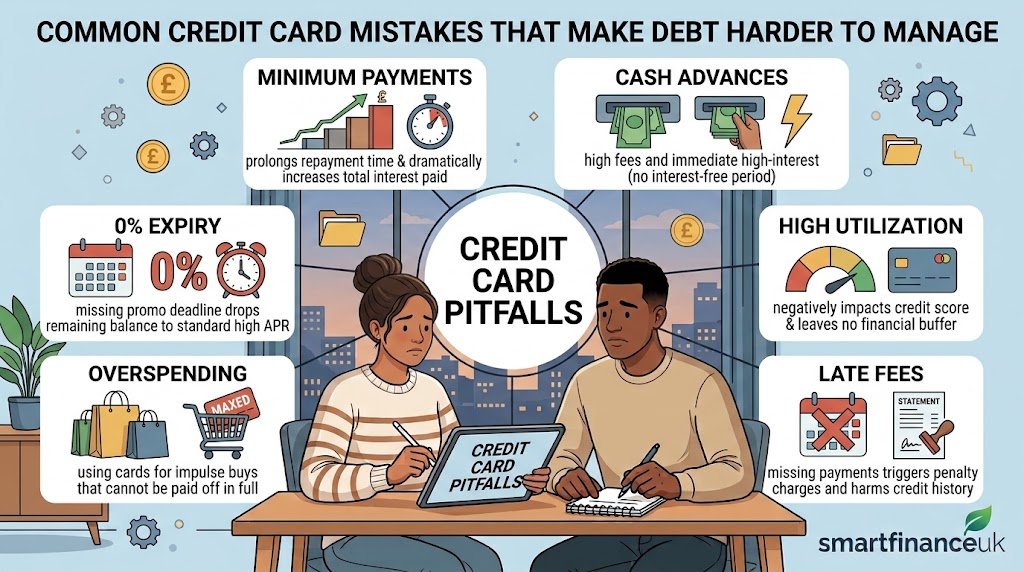
Making at least the required minimum payment is important. However, the minimum payment is not designed to make every credit card balance disappear quickly.
When only a relatively small amount is paid each month, interest can continue to accumulate while the underlying balance falls slowly.
MoneyHelper warns that paying only the minimum can mean it takes a long time to clear credit card debt and can result in substantial interest costs.
For example, imagine a hypothetical £2,000 balance.
If the cardholder pays only the minimum while continuing to spend on the card, the balance may remain high for a long period.
If the cardholder can afford to pay more and stops adding unnecessary new borrowing, more of each payment can go towards reducing the balance.
The exact repayment period depends on the card’s terms, interest rate, balance and payment pattern.
Continuing to Spend While Trying to Repay the Balance
This is one of the easiest mistakes to overlook.
Suppose you have a £1,500 balance and make a £200 payment. You might feel that you have made good progress.
But if you then spend £180 on the same card, most of that progress has effectively been reversed before considering interest or charges.
This can create a cycle where money goes into the credit card every month but the balance never falls significantly.
If your goal is to reduce an existing balance, consider whether new purchases are necessary and affordable. Separating debt repayment from everyday discretionary spending can make it easier to see genuine progress.
Missing the Payment Due Date
A missed credit card payment can cause more than a simple inconvenience.
Depending on the circumstances and terms of the account, missing a required payment can result in charges, loss of promotional benefits or information being recorded with credit reference agencies.
It can also make it harder to manage your account because you may then have to deal with additional costs.
Setting up a payment reminder or an appropriate Direct Debit can reduce the risk of forgetting a payment.
However, you should still check your statements. A Direct Debit arrangement does not remove the need to monitor your account.
Confusing the Minimum Payment With the Statement Balance
Your statement can contain several different figures, and they do not all mean the same thing.
The statement balance represents what was owed at the relevant statement date.
The minimum payment is the amount you must pay by the due date under the terms of the account.
These figures can be very different.
If your objective is to avoid interest on purchases, your card’s terms will explain what amount needs to be paid and by when.
Do not assume that paying the minimum means you have cleared the amount used during the statement period.
Understanding the difference can prevent unpleasant surprises.
Forgetting When a 0% Offer Ends
A 0% credit card can look attractive because eligible borrowing may not attract interest during the promotional period.
But the offer has an end date.
Once the promotional period finishes, the standard rate applicable under the agreement can begin to apply to a remaining balance.
This can make a previously manageable repayment much more expensive.
Before using a 0% card, check:
- when the promotional period ends
- what interest rate applies afterwards
- whether there is a balance-transfer fee
- what minimum payment is required
- whether missed payments could affect the promotional terms
MoneyHelper notes that 0% deals are temporary and recommends understanding what happens when the promotional period ends.
A useful habit is to make a note of the end date rather than relying on memory.
Treating a Credit Limit as Spending Money
A credit limit is not the same as an affordable budget.
If your card has a £5,000 limit, that does not mean you can comfortably spend £5,000.
The credit limit is simply the maximum amount the lender allows you to borrow under the account terms.
Your own budget may support considerably less.
For example, spending £2,000 on a card because there is enough available credit can create a repayment problem if your monthly income cannot comfortably cover the balance.
Before making a purchase, ask whether you could afford it without relying on additional borrowing.
Using a Credit Card for Cash Withdrawals Without Checking the Cost
Cash withdrawals can work differently from ordinary purchases.
MoneyHelper explains that withdrawing cash using a credit card can involve interest and a cash withdrawal fee.
The transaction can therefore become expensive even if you normally use the card responsibly.
Before withdrawing cash, check the card’s terms carefully.
Do not assume that the same interest-free arrangements available for purchases automatically apply to cash withdrawals.
Taking Out Another Card Without Addressing the Existing Debt
When an existing credit card balance becomes difficult to manage, applying for another card can seem like an easy solution.
Sometimes a balance transfer or other arrangement may have a legitimate purpose. But simply moving borrowing around does not remove the debt.
You need to consider the new card’s interest rate, promotional period, fees, repayment requirements and any restrictions.
There is also a practical risk.
If you transfer a balance to another card and then start using the old card again, you could eventually have two balances instead of one.
Before moving debt, understand why you are doing it and whether the arrangement genuinely improves your position.
Assuming Balance Transfers Are Free
A balance transfer can potentially reduce the interest charged on existing credit card borrowing for a promotional period.
But many balance-transfer products charge a transfer fee.
For example, a hypothetical card could charge a percentage of the amount transferred. The exact fee depends on the product and should never be assumed.
If you are considering a transfer, calculate the total cost rather than looking only at the promotional interest rate.
Ask:
How much is the transfer fee?
How long does the promotional rate last?
What rate applies afterwards?
Can I realistically repay the transferred balance before the promotion ends?
These questions can help you avoid replacing one expensive debt problem with another.
Paying Off One Card and Immediately Reusing It
Clearing a credit card balance can feel like a major achievement.
But if the account is immediately used for purchases that cannot be comfortably repaid, the debt can return.
This is particularly relevant if the card was being used to cover a gap between income and essential household expenses.
If you repeatedly need credit for groceries, utility bills or other basic costs, the underlying issue may be your household budget rather than the credit card itself.
In that situation, simply moving the balance or paying it off temporarily may not solve the problem.
Ignoring Interest and Charges on Statements
Your credit card statement is more than a payment reminder.
It can show how much interest has been added, whether fees have been charged and how recent transactions have affected the balance.
Checking the statement regularly can help you answer an important question:
Why has my balance changed?
If you expected the balance to fall but it has increased, look at the transactions, interest and charges.
If something appears incorrect or unfamiliar, contact the card provider promptly.
An unfamiliar transaction could have a simple explanation, but it could also indicate fraud.
Paying Extra Without Checking the Credit Agreement
Paying more than the minimum can help reduce borrowing faster, but you should still understand the terms of the credit agreement.
This is particularly relevant where a card has promotional conditions or different types of borrowing on the same account.
Check how additional payments are treated and whether any particular terms apply.
For most ordinary credit card balances, paying more can reduce the outstanding amount. But you should not make assumptions about how a particular payment will be allocated.
If you are unsure, ask the card provider.
Using Credit to Cover a Regular Monthly Shortfall
Using a credit card occasionally for an unexpected expense is different from depending on credit every month to pay ordinary bills.
If your income is £2,500 and essential household spending regularly comes to £2,700, a credit card may temporarily cover the £200 difference.
But after several months, you could have a growing balance without having solved the original £200 shortfall.
Interest can then make the gap even harder to close.
If you find yourself repeatedly borrowing to cover essential costs, consider reviewing your budget and seeking debt guidance if necessary.
MoneyHelper provides information about dealing with debt and finding free debt advice.
Closing a Credit Card Simply to Improve Your Credit Score
There are many myths about credit cards and credit scores.
Closing a card does not automatically improve your credit score.
Credit reference agencies calculate scores using information in your credit report, while lenders make their own lending decisions using their own criteria.
Your credit utilisation, payment history, account information and other factors can all be relevant.
If you no longer want a credit card because you are concerned about overspending or do not need it, that is a separate consideration.
Do not close an account simply because someone claims it will guarantee a better credit score.
Applying for Too Much Credit in a Short Period
Repeated credit applications can create unnecessary hard searches on your credit file.
A hard search is recorded when a lender checks your credit report as part of an application.
This does not mean one application will automatically damage your ability to borrow. But making many applications within a short period can be a concern to lenders and may affect your credit profile.
Before applying, check whether the product is suitable and, where available, consider an eligibility checker that uses a soft search.
A soft search does not have the same effect on your credit file as a full application search.
Assuming Every Credit Card Works the Same Way
Credit cards can look similar, but their terms can vary.
Different cards may have different:
- interest rates
- fees
- promotional periods
- cash withdrawal costs
- balance-transfer arrangements
- eligibility requirements
- repayment conditions
Two cards offering 0% interest can also have different promotional periods and fees.
Always check the individual agreement instead of relying on assumptions based on another card you have used.
Ignoring the Total Cost of Borrowing
A monthly payment can look affordable without the overall borrowing being affordable.
For example, imagine two hypothetical borrowing arrangements.
One requires £150 per month for two years.
Another requires £100 per month for four years.
The second option has a lower monthly payment, but that does not automatically mean it is cheaper overall.
The total amount repaid matters.
When considering any borrowing arrangement, look at the interest rate, fees, repayment period and total amount repayable where that information is available.
Using a Credit Card for an Emergency Without a Repayment Plan
An emergency does not always leave you with a choice.
A broken boiler, urgent repair or unexpected essential expense can arrive at an inconvenient time.
If a credit card is the only realistic way to cover a necessary cost, the important issue becomes what happens afterwards.
Before spending, if circumstances allow, consider how the balance will be repaid.
A £1,000 emergency expense is very different when it is repaid promptly from available income compared with carrying it for years while paying interest.
A repayment plan does not need to be complicated. It simply needs to be realistic.
A Simple UK Example
Imagine a hypothetical household with a £2,400 credit card balance.
The cardholder pays the minimum amount each month but continues adding around £200 of new spending.
The card also charges interest on the carried balance.
Although payments are being made, the debt does not fall as quickly as expected.
The household then reviews the account.
It identifies the interest being charged, reduces unnecessary new spending and sets a realistic monthly amount above the minimum towards the existing balance.
The household also checks when any promotional terms expire and reviews each monthly statement.
The example does not guarantee a particular result. It simply illustrates how reducing new borrowing and increasing repayments where affordable can change the direction of a credit card balance.
Practical Habits for Managing Credit More Carefully
A few simple habits can make credit easier to monitor.
Check your statement every month rather than looking only at the amount due.
Know the payment date and make sure the required payment is made on time.
If you carry a balance, understand the interest rate that applies.
Keep track of any 0% promotional end date.
Avoid cash withdrawals unless you understand the costs.
If you are trying to clear debt, consider whether new spending is undermining your repayments.
Keep your credit card balance within an amount you can realistically manage rather than treating the credit limit as part of your income.
Most importantly, act early if the balance becomes difficult to control.
What to Do If Your Credit Card Debt Is Becoming Difficult to Manage
If you are struggling to make required payments, do not wait until the debt becomes significantly larger.
Contact your credit card provider and explain your circumstances.
You can also seek free debt advice from organisations such as MoneyHelper and StepChange.
MoneyHelper explains that free debt advice is available and can help people understand their options when they are struggling with debt.
Be cautious about taking out another loan or credit card simply to make an existing debt appear more manageable.
Debt consolidation can sometimes be appropriate, but it can also increase the total amount repaid or extend the period of borrowing.
The right option depends on the circumstances.
Questions to Ask When Reviewing Your Credit Card
Before continuing to use a credit card, ask yourself:
What is my current balance?
Check the latest statement.
What interest rate am I paying?
Make sure you know whether different rates apply to different transactions.
What is my minimum payment?
Know the amount and due date.
Am I paying more than the minimum?
If you cannot clear the balance, consider whether your budget allows a larger payment.
When does any promotional rate end?
Write the date somewhere you will remember.
Am I still adding new debt?
Look at whether new purchases are preventing the balance from falling.
Have I paid any cash withdrawal fees or other charges?
Check your statements rather than guessing.
Could I afford the balance if my circumstances changed?
This is particularly relevant before making large purchases.
Frequently Asked Questions
Is it bad to carry a credit card balance?
Carrying a balance is not automatically a financial failure, but it can become expensive when interest is charged for a long period. The longer borrowing remains outstanding, the more opportunity there is for interest and applicable charges to increase the total cost. If you cannot repay the full balance, understanding the interest rate and making more than the minimum where affordable can help reduce the debt over time.
Does paying only the minimum payment hurt your credit score?
Making the required payment on time is generally better for your payment history than missing it. However, consistently carrying a large balance can mean you are using a significant proportion of your available credit, which can be relevant to how lenders assess applications. There is no universal credit-score rule that says paying the minimum automatically damages your score. The main concern is that minimum payments can make the debt much slower and more expensive to repay.
Can I use a credit card while paying off debt?
You can, but new spending can make an existing balance harder to reduce. If you are trying to repay debt, consider whether purchases are necessary and affordable. If you repeatedly need to use the card for essential household costs, it may be a sign that your budget needs attention. Continuing to borrow while repaying old borrowing can create a cycle that becomes increasingly difficult to break.
Is a 0% credit card completely free?
Not necessarily. A 0% promotional offer generally relates to interest on particular types of borrowing for a specified period. There may still be fees, such as a balance-transfer fee, and the standard rate can apply after the promotional period ends. You must also normally continue making the required minimum payments. Always read the terms of the specific card rather than assuming every 0% offer works in the same way.
Should I have more than one credit card?
There is no universal number of credit cards that is appropriate for everyone. Having several accounts is not automatically good or bad. What matters is whether you can manage the accounts responsibly, make payments on time and avoid borrowing more than you can afford. If having several cards makes your spending difficult to control, simplifying your finances may be worth considering.
What should I do if I cannot afford my credit card payments?
Contact the provider as soon as possible rather than ignoring the account. You can also seek free debt advice through MoneyHelper or another reputable debt-advice organisation. Avoid automatically taking out more credit to cover the existing payments. If you cannot afford essential bills as well as your debts, getting professional debt guidance early can help you understand your options.
Does paying off a credit card guarantee a better credit score?
No. Paying off a credit card can change information recorded on your credit report, but there is no guaranteed increase in your credit score. Credit reference agencies calculate scores differently, and lenders use their own criteria when deciding whether to lend. The more immediate benefit of paying down debt is that you owe less and may reduce the interest you would otherwise pay.
Final Thoughts
Credit cards are not automatically problematic. The difficulty usually comes from borrowing without understanding the costs or allowing a balance to continue growing.
Some of the most common mistakes are relying on minimum payments, continuing to spend while trying to clear debt, missing payment dates, overlooking promotional end dates and using cash withdrawals without checking the charges.
A good starting point is simple: know your balance, understand the interest rate, check your statements and make repayments on time. If you are carrying a balance, consider whether you can afford to pay more than the minimum and whether new spending is making the debt harder to reduce.
If you are struggling to keep up with repayments, seek help early. Free debt advice is available in the UK, and getting support before the situation becomes more serious can give you more options.
This article provides general educational information and is not personalised financial advice.