
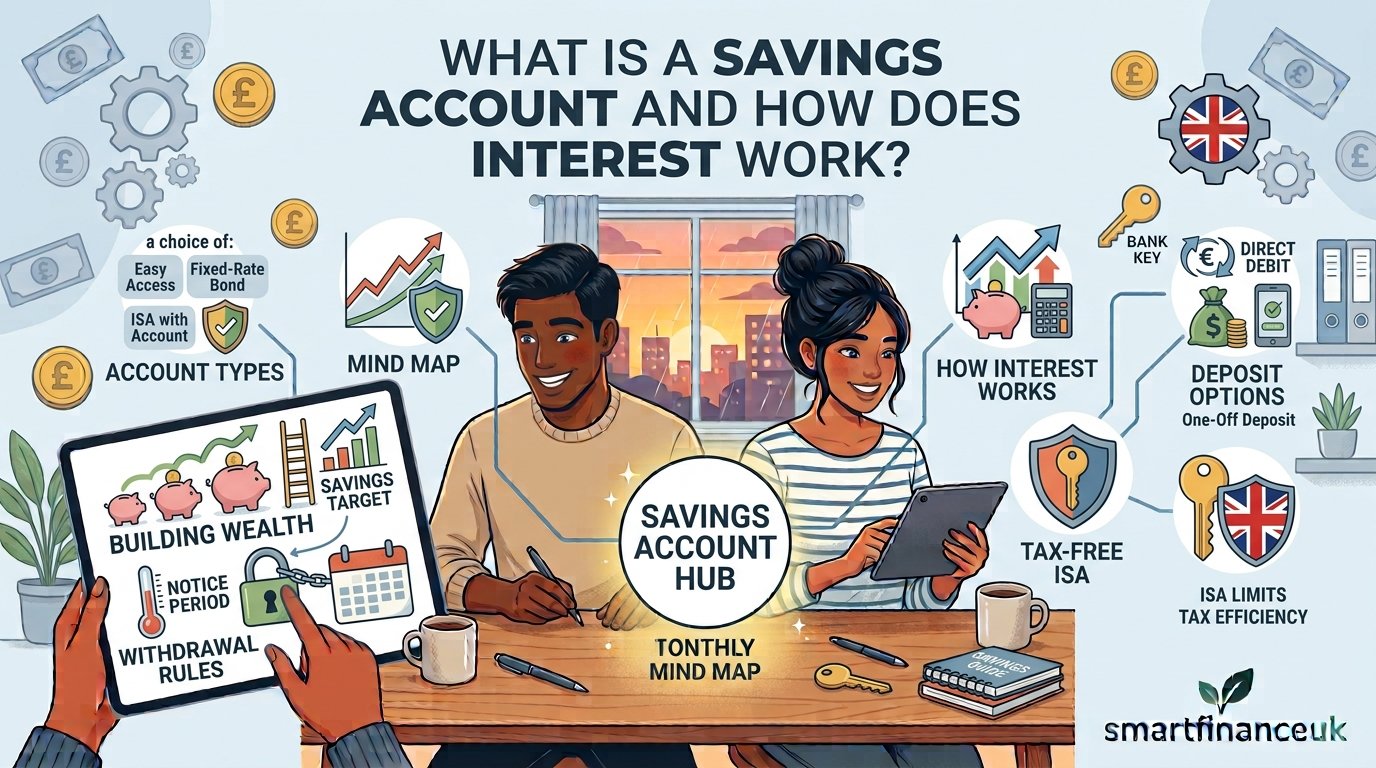
A savings account is designed for money you want to put aside rather than spend on everyday purchases. In the UK, people use savings accounts for many different purposes, from building an emergency fund to saving for a planned expense or simply keeping money separate from their current account.
One of the main differences between a savings account and a current account is the potential to earn interest on your balance. Interest is essentially the amount a bank or building society pays you for keeping eligible money in the account, although the rate, conditions and calculation method vary between products.
Understanding how savings accounts and interest work can make it easier to compare accounts without focusing only on an advertised rate. The access rules, withdrawal restrictions, minimum deposits, tax treatment and provider protection can all matter too.
This guide explains the basics in straightforward terms for UK savers.
What Is a Savings Account?
A savings account is a bank or building society account intended for money you want to set aside.
Unlike a current account, which is generally used for everyday payments, a savings account is normally designed to hold money for a period of time while potentially earning interest.
You might use one to save for:
- Unexpected household expenses
- A future purchase
- A holiday
- Home improvements
- A car
- A deposit
- Longer-term financial goals
There is no single type of savings account that suits everyone.
Some accounts allow you to withdraw money whenever you want. Others offer a higher interest rate in exchange for giving the provider more notice before making a withdrawal or keeping the money untouched for a specified period.
How Does Interest on a Savings Account Work?
Interest is the money a provider pays you based on the balance held in your savings account.
Suppose, purely as a hypothetical example, you deposit £2,000 into an account paying 4% AER and leave the full balance untouched for a year.
A simplified calculation would be:
£2,000 × 4% = £80
That does not necessarily mean you will receive exactly £80 in interest.
The actual amount can depend on how the provider calculates and pays interest, whether the rate changes, whether you make withdrawals or deposits during the year, and the account’s terms.
This is why it is important to read the product information rather than relying on a simple multiplication.
What Does AER Mean?
You will often see savings accounts advertised using AER, which stands for Annual Equivalent Rate.
AER is designed to make it easier to compare savings rates because it reflects the effect of interest being paid and compounded over a year.
For example, if interest is added to your balance and you then earn interest on that additional amount, you are benefiting from compounding.
The important point is that an AER is a comparison figure, not necessarily the amount you will receive regardless of how you use the account.
Always check whether the advertised rate is:
- Variable or fixed
- Available for the whole term
- Subject to a bonus
- Restricted to a particular balance
- Dependent on regular deposits
- Dependent on making no withdrawals
What Is the Difference Between Interest Rate and AER?
The terms can look similar, but they serve slightly different purposes.
The interest rate describes the rate used to calculate interest.
The AER takes the frequency of interest payments and compounding into account so consumers can compare savings products more easily.
For example, two accounts could have interest paid at different intervals. Looking only at the basic rate may not give you an accurate comparison of the return over a year.
For this reason, AER is often the more useful figure when comparing savings accounts.
Is Savings Interest Always Fixed?
No.
Savings accounts can have either fixed or variable interest rates.
Variable-rate savings accounts
A variable rate can change.
The provider may increase or reduce the rate in accordance with the account’s terms.
This means an account offering a particular rate today may offer a different rate later.
If you choose a variable-rate account, it is worth checking your rate periodically rather than assuming it will remain unchanged.
Fixed-rate savings accounts
A fixed-rate account generally pays an agreed rate for a specified period.
These accounts can provide greater certainty about the rate, but they may impose restrictions on access to your money.
For example, a fixed-term savings product may not allow withdrawals before maturity or may impose a penalty if withdrawals are permitted.
The exact terms vary between products.
What Is a Regular Savings Account?
A regular savings account is designed for people who want to save a set amount regularly.
The account may offer a relatively attractive rate, but there can be conditions around:
- The amount you can deposit each month
- The maximum balance
- The number of withdrawals
- The length of the account term
- Eligibility for the advertised rate
For someone who is building a savings habit, these conditions may be manageable.
However, do not compare the headline interest rate without checking the maximum monthly deposit and other restrictions.
What Is an Easy-Access Savings Account?
An easy-access savings account generally allows you to withdraw your money without giving a lengthy notice period.
This can make such accounts useful for money that you might need unexpectedly.
For example, an emergency fund may need to be accessible when your car requires an unexpected repair or a household appliance stops working.
The trade-off is that easy-access accounts do not necessarily offer the highest available savings rate.
The most useful account is therefore not always the one with the highest headline rate.
Access matters too.
What Is a Notice Savings Account?
A notice account usually requires you to give the provider advance notice before withdrawing money.
For example, the account might require a specified number of days’ notice.
This can be useful for money that you do not expect to need immediately.
However, it may be unsuitable for an emergency fund because you could have to wait before accessing the money.
Always check the exact notice period and what happens if you need the money sooner.
What Is a Fixed-Term Savings Account?
A fixed-term savings account allows you to save money for an agreed period, often in return for a fixed interest rate.
The term could be relatively short or extend over several years, depending on the product.
The key issue is access.
Before putting money into a fixed-term account, ask yourself whether you might need it during the term.
A higher rate is not particularly useful if accessing your own money early creates a significant penalty or is not permitted.
What Is the Personal Savings Allowance?
UK taxpayers may have a Personal Savings Allowance, which determines how much savings interest they can receive without paying tax on that interest, depending on their Income Tax band.
HM Revenue & Customs explains that basic-rate taxpayers can generally receive up to £1,000 of savings interest tax-free, while higher-rate taxpayers can generally receive up to £500. Additional-rate taxpayers do not receive a Personal Savings Allowance.
These thresholds are based on the relevant tax rules and can change, so check the latest GOV.UK information if your circumstances are close to the relevant limits.
Your Personal Savings Allowance is not a separate savings account. It is a tax allowance that can affect whether you owe tax on savings interest.
What About ISAs?
A Cash ISA is another way of saving in the UK.
Unlike an ordinary savings account, interest from a Cash ISA is generally tax-free.
The annual ISA allowance is subject to government rules and applies across your ISA holdings rather than giving you a separate unlimited allowance for each account.
ISAs have their own rules concerning eligibility, contributions and transfers, so compare the specific account terms before opening one.
For current information about ISA rules and allowances, GOV.UK is the appropriate source to check.
Does Savings Interest Count as Income?
Savings interest can have tax implications.
The amount of tax you may need to pay depends on your circumstances, including your Income Tax position and the type of savings product you use.
For many people, the Personal Savings Allowance means ordinary savings interest does not result in additional tax, but this is not true for everyone.
If you have substantial savings, are a higher or additional-rate taxpayer, or have other circumstances that make your tax position less straightforward, check the current HMRC rules or consider obtaining appropriate professional tax advice.
How Often Is Savings Interest Paid?
The provider determines how and when interest is paid.
Depending on the account, interest may be added:
- Monthly
- Annually
- At the end of a fixed term
- At another specified interval
This matters because the timing of interest payments can affect compounding.
If interest is added to your savings balance, you may then earn further interest on that amount, depending on the product.
Check the account’s terms for the exact payment frequency.
What Happens When You Withdraw Money?
The effect of withdrawing money depends on the savings account.
With an easy-access account, you may be able to withdraw money relatively quickly.
With a notice account, you may need to give advance notice.
With some fixed-term accounts, early withdrawals may not be permitted or could involve a penalty.
Some accounts also restrict the number of withdrawals you can make while retaining a particular interest rate.
This is why access conditions should be considered alongside the interest rate.
Why the Highest Interest Rate Is Not Always the Best Choice
It is tempting to search for the highest savings rate and choose it immediately.
But imagine two hypothetical accounts.
Account A pays a higher rate but requires 90 days’ notice before withdrawals.
Account B pays a slightly lower rate but allows easy access.
If you are saving an emergency fund, Account B could be more practical because you may need the money unexpectedly.
On the other hand, if you have separate emergency savings and know that you will not need the money for a particular period, the restrictions on Account A may be less problematic.
The right comparison depends on what the money is for.
A Simple Hypothetical Example
Imagine that you have £5,000 available to save.
You are comparing two hypothetical accounts.
Account A
- Variable rate
- Easy access
- Lower interest rate
Account B
- Fixed rate
- Limited access
- Higher interest rate
If the £5,000 represents your emergency fund, immediate access could be more important than earning the maximum possible interest.
If the £5,000 is earmarked for a future expense that you know you will not need for the fixed period, the second account might be worth considering.
The figures and account characteristics here are hypothetical. The example demonstrates the decision-making process rather than recommending a particular product.
What Should You Check Before Opening a Savings Account?
Interest rate and AER
Check both the advertised rate and AER.
Make sure you understand whether the rate is fixed or variable.
Access restrictions
Find out how quickly you can access your money.
Withdrawal rules
Check whether there are limits, penalties or notice requirements.
Minimum and maximum balances
Some accounts have limits on how much you can deposit while receiving the advertised rate.
Bonus rates
Some accounts include a temporary bonus.
Find out when the bonus ends and what rate applies afterwards.
Regular deposit requirements
A regular saver may require you to deposit a particular amount each month.
Provider protection
Check whether your eligible deposits are protected by the Financial Services Compensation Scheme (FSCS).
The FSCS currently protects eligible deposits up to £120,000 per person, per authorised institution, subject to its rules and certain temporary high-balance provisions.
Importantly, the protection limit applies by authorised institution rather than simply by brand name.
If you have substantial savings spread across different brands, check whether those brands belong to the same banking licence or authorised institution.
Should You Keep Emergency Savings in a Savings Account?
For many people, a savings account can be a practical place for emergency money because it separates the funds from everyday spending.
The account should generally be accessible enough for the type of emergency you are preparing for.
For example, money intended for an unexpected boiler repair may need to be available much sooner than money being saved for a planned purchase several years from now.
Avoid putting emergency savings into an account where accessing the money could be difficult or expensive unless you fully understand the restrictions.
Common Savings Account Mistakes
Chasing the headline rate
A high rate may come with restrictions that make the account unsuitable for your purpose.
Forgetting about introductory bonuses
A temporary bonus can make an account look more attractive initially. Check the rate that applies afterwards.
Ignoring withdrawal restrictions
An account that pays more interest may not allow convenient access.
Saving too much in one place without checking protection
If you hold significant deposits, check how FSCS protection applies across your banking relationships.
Forgetting about tax
Interest can have tax implications, particularly for people with larger savings balances or higher incomes.
Assuming variable rates stay the same
A variable rate can change.
Review your account periodically.
Choosing a fixed-term account for money you may need soon
The interest rate may be attractive, but restricted access can become a problem if your circumstances change.
How to Compare Savings Accounts
A simple comparison table can make the decision clearer.
| Feature | Account A | Account B | Account C |
|---|---|---|---|
| AER | Check | Check | Check |
| Fixed or variable | Check | Check | Check |
| Easy access | Check | Check | Check |
| Notice period | Check | Check | Check |
| Withdrawal limits | Check | Check | Check |
| Minimum deposit | Check | Check | Check |
| Maximum balance | Check | Check | Check |
| Bonus rate | Check | Check | Check |
| Tax considerations | Check | Check | Check |
| FSCS protection | Check | Check | Check |
Do not fill the table using only comparison-site headlines.
Check the provider’s current terms and conditions, particularly if the account has complicated eligibility or withdrawal rules.
Questions to Ask Before Opening a Savings Account
Before transferring money into a savings account, consider asking:
What is the current AER?
Is the rate fixed or variable?
How often is interest paid?
Can I withdraw money whenever I need it?
Is there a notice period?
Are withdrawals limited?
Is there a temporary bonus rate?
What happens when the bonus ends?
Is there a minimum or maximum balance?
Will I need to pay tax on the interest?
Is the provider covered by the FSCS?
These questions can reveal differences that are easy to miss when simply comparing advertised rates.
Frequently Asked Questions
Is a savings account better than a current account?
They serve different purposes. A current account is generally designed for everyday spending, payments and receiving income, while a savings account is intended for money you want to put aside and may earn interest on. Some current accounts also pay interest, so compare the specific features rather than assuming one account type is always better.
How does a bank make money by paying me interest?
Banks and building societies use deposits as part of their wider funding and lending activities, subject to their business models and regulatory requirements. They can pay savers interest while generating income from activities such as lending and other financial services. The exact way a particular provider operates varies.
Is savings interest taxable in the UK?
It can be. Many people have a Personal Savings Allowance that allows a certain amount of savings interest to be received without additional Income Tax, depending on their tax band. Additional-rate taxpayers do not receive this allowance. ISA interest has different tax treatment. Check the latest HMRC rules for your circumstances.
What does AER mean on a savings account?
AER means Annual Equivalent Rate. It is a standardised way of expressing the annual rate of return on savings while taking the effect of interest payments and compounding into account. It is particularly useful when comparing accounts with different interest-payment frequencies.
Can a savings account interest rate change?
Yes, if the account has a variable rate. The provider can change the rate according to the account’s terms. If you are relying on savings interest to achieve a particular goal, check the rate periodically rather than assuming that today’s rate will remain unchanged.
Can I withdraw money from a savings account?
It depends on the account. Easy-access accounts generally provide relatively straightforward withdrawals, while notice and fixed-term accounts can impose restrictions. Some accounts may also limit the number of withdrawals. Always check the terms before depositing money that you may need soon.
How much money should I keep in a savings account?
There is no universal amount that is suitable for everyone. Consider your regular expenses, income stability, upcoming costs and the type of financial buffer you want to maintain. Emergency savings generally need to be accessible, while money for a known future expense may be suitable for an account with different access conditions.
Final Thoughts
A savings account is more than a place to put spare money.
The interest rate matters, but so do access, withdrawal restrictions, fees, tax treatment, account conditions and protection arrangements. An account with the highest advertised rate may not be the most suitable place for money you might need quickly.
Start by deciding what the money is for. Then compare the AER, whether the rate is fixed or variable, how quickly you can access your money and what conditions apply.
For UK savers, it is also worth understanding how the Personal Savings Allowance and Cash ISAs can affect the tax treatment of savings.
Most importantly, read the current terms before opening an account. Savings rates and product conditions can change, so information that was accurate when an account was launched may not remain accurate indefinitely.
This article provides general financial education and is not personalised financial advice. If your tax or financial circumstances are complicated, consider checking the latest information from HMRC, MoneyHelper or obtaining advice from an appropriately authorised professional.