
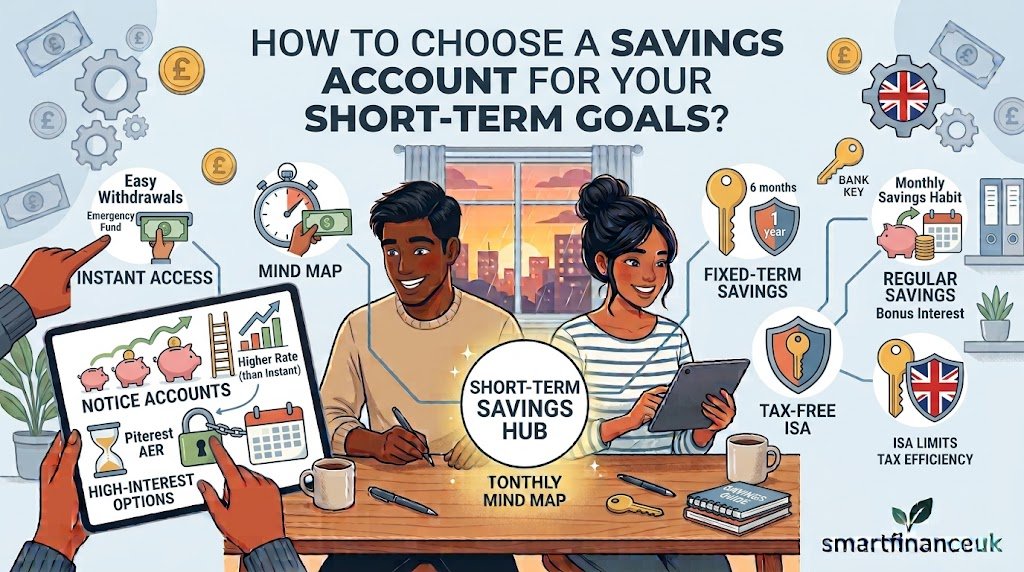
Choosing a savings account for a short-term goal is not simply a matter of finding the highest interest rate. The right account also needs to give you suitable access to your money, fit your savings timetable and have conditions you can realistically follow.
Perhaps you are putting money aside for a holiday, car repairs, a home improvement, an insurance payment or an emergency fund. You may only need the money for a few months or a couple of years. In that situation, locking your money away for too long could create more problems than the extra interest is worth.
For UK savers, the main things to compare are the AER, access rules, withdrawal restrictions, account conditions, tax treatment and protection of your deposits. MoneyHelper also advises that the account with the highest rate is not necessarily the best choice for your circumstances.
This guide explains how to choose a savings account around the goal itself rather than simply chasing a headline rate.
What Counts as a Short-Term Savings Goal?
There is no single definition that applies to every financial situation, but a short-term goal generally means something you expect to need your money for within the next few years.
Examples could include:
- Building an emergency fund
- Paying for a holiday
- Replacing a car
- Covering an annual insurance bill
- Buying furniture
- Paying for home repairs
- Saving for a wedding or family event
- Preparing for an expected household expense
MoneyHelper describes savings goals of up to five years as short-term goals and suggests considering savings products such as savings accounts, term deposits or Cash ISAs for this period.
The exact account you choose should depend on when you need the money and how certain that date is.
Someone saving for a holiday six months from now has different requirements from someone building an emergency fund that could be needed tomorrow.
Start With the Goal, Not the Savings Rate
Before comparing accounts, write down three things:
What are you saving for?
How much do you need?
When will you need it?
For example, imagine you want to save £1,200 for a holiday in 12 months.
Ignoring interest for a moment, you would need to save:
£1,200 ÷ 12 = £100 per month
The £1,200 and £100 figures are purely hypothetical.
Interest could reduce the amount you need to contribute from your own income, depending on the account and how the money is deposited. But the calculation gives you a starting point.
MoneyHelper’s savings calculator can also help estimate how much you need to save regularly to reach a particular target.
Once you know the target and deadline, you can decide how much flexibility you need from the savings account.
Decide How Easily You Need to Access the Money
This is one of the most important decisions.
Ask yourself:
Could I need this money unexpectedly?
If the answer is yes, an easy-access account may be more appropriate than an account that locks your money away.
For example, an emergency fund is specifically intended for unexpected expenses. If your boiler breaks or you suddenly face an essential household repair, waiting several weeks to access your savings may not be practical.
MoneyHelper says instant-access savings accounts allow you to withdraw money when you need it, making them suitable for people who want flexibility and do not want to take investment risk with their savings.
On the other hand, money being saved for a known expense on a known date may not need the same level of access.
Compare Easy-Access Savings Accounts
An easy-access savings account can be useful when you want your money available without a lengthy notice period.
These accounts can work well for goals such as:
- Emergency savings
- Unexpected household costs
- A future purchase where the date may change
- A general financial buffer
The trade-off is that the rate may be lower than accounts that impose stricter withdrawal conditions.
That does not automatically make an easy-access account a poor choice.
If access is important, paying slightly more attention to flexibility may be sensible than choosing an account solely because it has a higher advertised rate.
Check the provider’s definition of “easy access”, too. Some accounts may have restrictions on the number of withdrawals even if they are marketed as accessible.
Consider a Notice Account
A notice account requires you to give the provider advance notice before withdrawing your money.
MoneyHelper says notice periods can vary significantly, with some accounts requiring 30, 60, 90 days or more.
This type of account could make sense when:
- You are unlikely to need the money immediately
- You know roughly when you will need it
- You want to discourage unnecessary withdrawals
- The additional interest makes the restrictions worthwhile
It may be less suitable for an emergency fund.
Imagine you have saved £3,000 for unexpected household expenses but need to wait 60 days before withdrawing it. The account may offer a better rate, but the delay could defeat the purpose of having an emergency fund.
Consider a Fixed-Term Savings Account Carefully
Fixed-term savings accounts can offer a fixed interest rate for a specified period.
The attraction is certainty.
If the rate is fixed, you generally know the rate that applies during the agreed term.
The downside is access.
MoneyHelper notes that fixed-rate savings products generally restrict access until the end of the fixed term, with early access potentially unavailable or subject to a charge or loss of interest depending on the product.
This makes fixed-term savings more suitable for money you are confident you will not need before the account matures.
For a short-term goal, pay particular attention to the maturity date.
If you need the money in nine months but the fixed term lasts 12 months, the account may not fit your plan regardless of how attractive the interest rate looks.
Look at the AER Rather Than Just the Headline Rate
AER stands for Annual Equivalent Rate.
It is designed to make savings accounts easier to compare by taking the effect of interest payments and compounding into account.
MoneyHelper recommends looking at AER when comparing savings products.
However, AER should not be the only figure you consider.
Suppose one hypothetical account offers a slightly higher AER but restricts withdrawals, while another offers a slightly lower AER with easy access.
If your goal requires flexibility, the second account could be more useful.
The question is not:
“Which account has the highest rate?”
It is:
“Which account gives me an appropriate return while allowing me to use the money when I need it?”
Check Whether the Rate Is Fixed or Variable
A savings account’s rate may be fixed or variable.
A fixed rate generally remains unchanged for the agreed term.
A variable rate can change according to the provider’s terms.
This distinction matters when planning a short-term goal.
If your goal is several months away and you choose a variable-rate account, the rate you receive later may not be the same as the rate you saw when opening the account.
MoneyHelper recommends regularly checking whether you are still receiving a competitive savings rate, because savings rates can change.
You do not need to move your money every time another account offers a slightly higher rate. But it is sensible to review the account when your circumstances or the provider’s rate changes.
Check for Temporary Bonus Rates
Some savings accounts offer a bonus for a limited period.
This can make the initial rate look attractive.
Before opening such an account, find out:
- How long the bonus lasts
- What rate applies afterwards
- Whether the bonus requires regular deposits
- Whether withdrawals affect the bonus
- Whether the account automatically changes after the bonus period
A temporary bonus can be useful when it matches your savings timeline.
But if your goal lasts longer than the bonus period, the post-bonus rate becomes much more important.
Check Minimum and Maximum Deposits
Some savings accounts have limits on how much you can deposit.
Others may require a minimum opening balance or regular monthly contributions.
MoneyHelper notes that savings accounts can have different opening-balance and regular-payment requirements.
For example, a regular savings account might be designed for someone putting aside a set amount every month rather than someone who already has a large lump sum.
If you have £5,000 ready to save, a product that only allows £200 per month may not meet your needs.
Likewise, if you can only afford £50 a month, an account requiring a much larger monthly deposit may not be suitable.
Think About How You Will Save
Your savings pattern can influence the type of account that makes sense.
Saving a lump sum
If you already have money available, you may want an account that lets you deposit most or all of it at once.
Easy-access, notice or fixed-term accounts could potentially be considered depending on your need for access.
Saving every month
If you are building your balance gradually from your income, a regular savings account may be worth considering.
These accounts can sometimes offer attractive rates, but they often have conditions around monthly deposits and withdrawals.
Doing both
You might already have some savings while continuing to contribute each month.
In that case, you could potentially use more than one savings account if the terms make sense.
There is no rule saying all your savings must be held in one account.
Do Not Ignore Withdrawal Conditions
Withdrawal restrictions can be easy to overlook when comparing accounts.
Check:
- How quickly withdrawals are processed
- Whether notice is required
- Whether there is a withdrawal limit
- Whether withdrawing affects your interest rate
- Whether an early withdrawal fee applies
- Whether closing the account early affects the return
MoneyHelper specifically highlights withdrawal limits and access requirements as factors to compare rather than focusing only on the interest rate.
A restriction that seems minor when opening the account can become important when you actually need the money.
Consider Whether You Need a Cash ISA
A Cash ISA can be another option for short-term cash savings.
One major feature is that interest earned within an ISA is tax-free.
The rules around ISAs, including annual allowances, can change, so check the current GOV.UK guidance before making a decision.
A Cash ISA can be particularly relevant if you expect your savings interest to exceed the tax-free allowances available to you outside an ISA.
However, tax is only one part of the comparison.
You should still consider:
- AER
- Access
- Withdrawal rules
- Fixed or variable rate
- Transfer rules
- Minimum deposits
- The length of your savings goal
There is little value in choosing a tax-efficient account that does not provide the access you need.
Understand the Personal Savings Allowance
Interest earned on ordinary savings accounts can have tax implications.
For the 2026/27 tax year, the Personal Savings Allowance generally allows basic-rate taxpayers to receive up to £1,000 of savings interest tax-free and higher-rate taxpayers up to £500. Additional-rate taxpayers do not receive a Personal Savings Allowance.
There are also other rules that can affect the tax treatment of savings income.
For most people with modest short-term savings, this may not be a major issue. But if you hold substantial savings or have a higher income, it is worth checking the current HMRC rules.
Do not assume that all savings interest is automatically tax-free.
Check FSCS Protection
Where you are holding cash with a UK-authorised bank, building society or credit union, check whether your money is covered by the Financial Services Compensation Scheme.
The FSCS deposit protection limit is currently £120,000 per eligible person, per authorised firm.
The important detail is that the limit applies at the authorised-firm level.
Two different banking brands can belong to the same authorised firm, meaning money held across both could count towards the same protection limit.
For ordinary short-term savings, this may not affect most people. If you have substantial cash deposits, however, it is worth checking the provider using the FSCS protection checker.
Match the Account to Your Deadline
Your deadline should influence your choice.
Consider these hypothetical situations.
You need the money within three months
Access is likely to be more important than squeezing out a slightly higher rate.
An easy-access account may be more practical.
You need the money in six to twelve months
You may have more options.
An easy-access account, regular saver or suitable fixed-term product could potentially work depending on your savings pattern and exact deadline.
You need the money in two years
You have more time to consider products with restrictions, provided you are confident that you will not need the money early.
The key is to avoid choosing a term that extends beyond the date when you need the cash.
A Simple Hypothetical Example
Imagine that Sarah wants to save £2,400 for a home improvement project that she expects to pay for in 12 months.
She can afford to save £200 each month.
She compares three hypothetical options:
| Feature | Easy Access | Regular Saver | Fixed Term |
|---|---|---|---|
| Monthly saving | Flexible | £200 | Lump sum usually preferred |
| Access | Easy | May be restricted | Restricted |
| Interest | Variable | May be higher | Fixed |
| Suitable for changing plans | Generally more flexible | Depends on terms | Less flexible |
| Main consideration | Access | Conditions | Timing |
Sarah should not automatically choose whichever column has the highest interest rate.
She needs to check whether she can deposit £200 each month, whether withdrawals are allowed, when she needs the money and whether the fixed term matches her project deadline.
The figures and account characteristics are hypothetical and are intended only to demonstrate how to compare options.
What If Your Short-Term Goal Is an Emergency Fund?
An emergency fund is slightly different from saving for a planned purchase.
You know the money is there for an unexpected event, but you do not know when you will need it.
That makes access especially important.
MoneyHelper recommends keeping emergency savings accessible rather than tying them up for a long period.
An easy-access savings account can therefore be a practical option.
You might also separate emergency savings from money being saved for planned expenses.
For example:
Emergency fund: accessible savings account
Holiday fund: separate savings account
Annual bills: separate savings pot or account
This can make it easier to see what your money is actually reserved for.
Consider Using Separate Savings Accounts for Different Goals
You do not necessarily have to keep every short-term goal in one account.
Suppose you are saving for:
- A £1,000 emergency fund
- A £1,200 holiday
- £600 for annual car costs
Keeping the money separate can make your progress easier to monitor.
Some banking apps offer savings pots or similar budgeting features, while separate savings accounts can also be used.
MoneyHelper’s recent guidance on sinking funds notes that an easy-access savings account can be useful for money set aside for known future expenses.
The important thing is to avoid creating so many separate accounts that managing them becomes confusing.
Calculate the Difference in Interest
A higher rate does not always create a huge difference over a short period.
Suppose, purely as an illustration, you have £2,000 saved for six months.
If one hypothetical account produced an annual return of 3% and another produced 4%, the difference in simple interest over six months would be approximately:
£2,000 × 1% × 0.5 = £10
The actual interest calculation will depend on the provider’s terms and how interest is calculated and paid.
This illustrates why access and conditions should not automatically be sacrificed for a small difference in the advertised rate.
If the higher-rate account makes it difficult to access your money when you need it, the additional return may not justify the restriction.
Check the Account After You Open It
Choosing an account is not necessarily the end of the process.
If you have a variable-rate account, check the rate periodically.
Also look out for:
- Bonus rates ending
- Changes to withdrawal conditions
- Changes in your own savings goal
- Better rates becoming available
- Changes in your expected deadline
MoneyHelper recommends regularly checking whether you are still getting a competitive rate because savings rates can change.
You do not have to switch accounts constantly. A periodic review is usually enough.
Common Mistakes to Avoid
Choosing the highest AER without checking access
A higher rate can come with restrictions.
Locking away emergency money
Emergency savings may need to be available quickly.
Ignoring the savings deadline
A fixed-term account that matures after you need the money may be unsuitable.
Forgetting bonus rates
A temporary introductory rate may disappear before you reach your goal.
Overlooking monthly deposit requirements
A regular saver may require you to contribute consistently.
Assuming all withdrawals are free
Some accounts reduce interest or charge fees when you withdraw.
Forgetting tax considerations
Savings interest can have tax consequences depending on your circumstances.
Ignoring deposit protection
If you have substantial savings, check how FSCS protection applies across banking brands.
Opening too many accounts
Separate accounts can make budgeting easier, but too many can make your finances unnecessarily complicated.
A Simple Checklist Before Opening the Account
Before transferring your money, check:
1. What is my savings goal?
2. When will I need the money?
3. How much can I save each month?
4. Do I need instant access?
5. What is the AER?
6. Is the rate fixed or variable?
7. Is there a bonus rate?
8. Are there withdrawal restrictions?
9. Is there a minimum or maximum deposit?
10. Could the interest be taxable?
11. Is the provider covered by the FSCS?
12. What happens when the account’s promotional period or fixed term ends?
This checklist can help you compare accounts based on the purpose of your savings rather than the headline rate alone.
Questions to Ask Before Choosing a Savings Account
If you are comparing several accounts, ask:
Can I access the money whenever I need it?
If not, how long will I have to wait?
Will withdrawals reduce the interest I earn?
Is the advertised AER fixed or variable?
Does the rate include a temporary bonus?
What rate applies after the bonus ends?
Do I have to deposit a specific amount every month?
Is there a maximum balance that earns the advertised rate?
Would a Cash ISA be relevant to my tax position?
Is my money covered by the FSCS?
Does the account’s term match the date I need the money?
These questions can reveal whether an account actually fits your goal.
Frequently Asked Questions
What type of savings account is best for a short-term goal?
There is no single account that is best for every short-term goal. Easy-access accounts can be useful when you need flexibility, while regular savings accounts may suit people making monthly deposits and fixed-term products may suit money that will not be needed until a known future date. Compare access, interest and conditions alongside your deadline.
Should I choose an easy-access account for an emergency fund?
An easy-access account can be practical for emergency savings because the money is generally available when you need it. MoneyHelper specifically recommends considering accessible savings rather than tying emergency funds up for a long period. The exact account should still be assessed based on its withdrawal rules and current terms.
Is a fixed-rate savings account suitable for short-term savings?
It can be, but only when the fixed term matches your plans and you are confident you will not need the money early. Fixed-rate accounts can restrict access until maturity or impose a charge or other consequence for early access. A higher rate is not necessarily worthwhile if you need flexibility.
How much should I save each month for a short-term goal?
Divide the amount you need by the number of months until your deadline to get a basic starting figure. For example, saving £1,000 over 10 months would mean £100 per month before taking interest into account. Your actual target may change depending on the account’s interest and whether your income and expenses vary.
Is the highest savings rate always the best option?
No. MoneyHelper specifically recommends looking beyond the interest rate and considering factors such as opening balances, regular payments, notice periods, withdrawal limits and account access. An account with a slightly lower rate can be more suitable if it gives you the flexibility your savings goal requires.
Should I use a Cash ISA for short-term savings?
A Cash ISA can be worth considering because interest earned within it is tax-free, subject to ISA rules and allowances. However, you should still compare the rate, access arrangements and account conditions. For many people with modest savings interest, the tax advantages may not be the deciding factor, so compare the complete product rather than focusing on its ISA status.
How often should I review my savings account?
Review it when your savings goal changes, a bonus rate ends or the provider changes the interest rate. It can also be sensible to check periodically whether another suitable account offers better terms. MoneyHelper notes that savings rates can change, so regularly checking your rate can help you avoid leaving money in an account that has become less competitive.
Final Thoughts
Choosing a savings account for a short-term goal starts with understanding when and why you will need the money.
If you may need the cash at short notice, accessibility should carry significant weight. If you have a firm deadline and do not expect to need the money early, you may have more flexibility to consider notice or fixed-term products.
Compare the AER, but do not stop there. Check withdrawal rules, minimum deposits, bonus periods, tax considerations and FSCS protection. A savings account should fit the purpose of the money rather than forcing your plans to fit the account.
It can also help to review your account as you get closer to your target. Your needs may change, and a variable rate or introductory offer may change the value of the account over time.
This article provides general financial education for UK readers and is not personalised financial advice. Savings rates, tax rules and account conditions can change, so check the provider’s current terms and the latest official guidance before making a financial decision.
Sources and Further Reading
- MoneyHelper — How to choose between saving and borrowing
- MoneyHelper — How to find the best savings account
- MoneyHelper — How to set a savings goal
- MoneyHelper — Instant-access savings accounts
- MoneyHelper — Regular savings accounts
- FSCS — Bank and savings protection checker
- GOV.UK — Tax on savings interest