
Opening a new current account can be surprisingly easy. The harder part is deciding whether the account is actually suitable for the way you manage your money.
A headline reward, cashback offer or attractive-looking app may catch your attention, but those features do not tell the whole story. A current account can also have monthly fees, overdraft costs, minimum funding requirements, overseas charges or conditions attached to its benefits.
For UK consumers, comparing these details before applying can help you avoid choosing an account that looks good at first but becomes expensive or inconvenient later.
This guide explains how to compare current accounts in a practical way, what charges to check, how overdrafts and rewards should be assessed, and what to consider before switching from your existing bank.
What Should You Compare When Choosing a Current Account?
Most current accounts provide the basic services you would expect, such as receiving money, making payments, using a debit card and managing your account online.
The differences tend to appear in the details.
MoneyHelper recommends considering the features you actually need, comparing deals and charges, checking eligibility and thinking about how you want to access your bank.
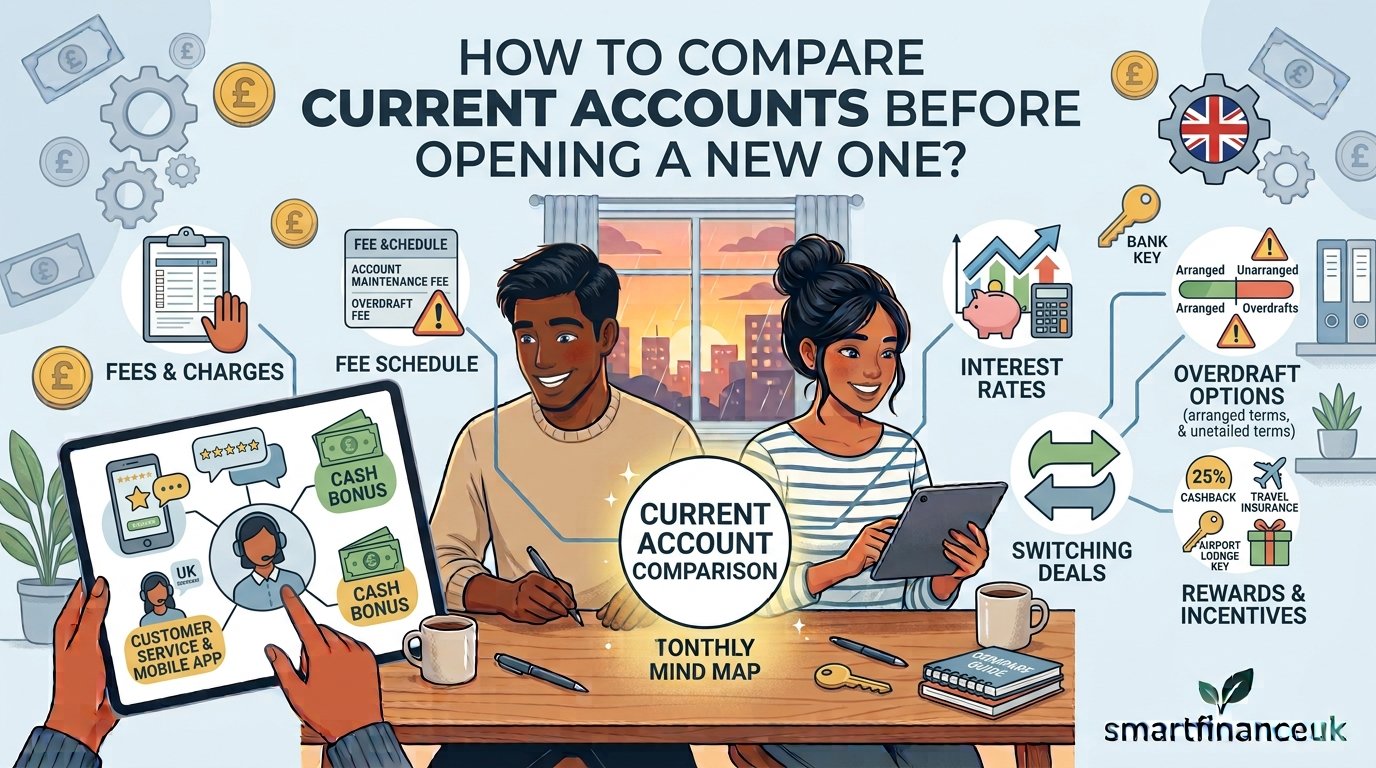
When comparing accounts, start with these areas:
- Monthly fees
- Overdraft costs
- Interest or cashback
- Minimum monthly deposits
- Debit-card charges abroad
- Branch and customer-service access
- Mobile and online banking
- Switching incentives
- Eligibility requirements
- Additional benefits and their conditions
You do not necessarily need the account with the most features. You need one whose costs and features make sense for your circumstances.
Start by Working Out What You Need From the Account
Before looking at individual banks, think about how you currently use your account.
For example, ask yourself:
Do you mainly use it for receiving your salary and paying bills?
Do you regularly use an overdraft?
Do you travel abroad?
Do you want cashback on certain spending?
Do you prefer managing everything through an app?
Do you need access to a physical branch?
Do you want a separate account for household bills?
Your answers can quickly narrow down the choices.
Someone who never uses an overdraft may have little reason to prioritise an account offering a particular overdraft facility. Someone who regularly travels abroad may care much more about foreign transaction charges.
The cheapest account for one household may therefore be quite different from the most useful account for another.
Compare Monthly Account Fees
The first figure to check is whether the account has a monthly charge.
Many standard current accounts are free for ordinary everyday banking, but some accounts charge a monthly fee in exchange for additional benefits.
Suppose a hypothetical account costs £12 a month.
That would be:
£12 × 12 months = £144 a year
The calculation is only an illustration. The actual fee of any account should be checked with the provider.
A fee is not automatically a bad thing. The account may include benefits that you would otherwise pay for separately.
The important question is:
Would you still consider the account good value if you paid the annual fee rather than focusing on the advertised benefits?
Check Whether You Have to Pay in a Minimum Amount
Some current accounts require you to pay a certain amount into the account each month to qualify for particular features.
This can be easy to overlook.
For example, an account could advertise cashback or another benefit but require a minimum monthly payment before you qualify.
Check:
- The minimum amount
- Whether it must come from another bank account
- Whether the requirement applies every month
- What happens if you miss it
- Whether the benefit is lost temporarily or permanently
MoneyHelper specifically recommends checking conditions such as minimum monthly deposits before applying.
If your income varies, make sure you understand these conditions before relying on the account’s advertised benefits.
Compare Overdraft Costs Carefully
If you sometimes spend more than you have available, the overdraft section deserves particular attention.
An overdraft is borrowing. It allows you to spend more than the available balance, subject to the provider’s terms.
MoneyHelper describes overdrafts as a form of debt and advises treating them as short-term borrowing or an emergency option rather than a normal source of income.
When comparing overdrafts, check:
- The overdraft interest rate
- Whether any interest-free amount applies
- The maximum arranged overdraft
- Eligibility requirements
- What happens if you exceed the arranged limit
- Whether the bank can reduce or remove the facility
Do not choose an account simply because it advertises a large overdraft.
If you regularly depend on an overdraft, the cost of using it may matter far more than a small cashback reward.
Do Not Compare Overdrafts by the Limit Alone
Imagine two hypothetical accounts.
Account A offers an arranged overdraft of £500.
Account B offers an arranged overdraft of £1,500.
At first glance, Account B might appear more attractive.
But the larger limit does not automatically make it better.
If Account B charges more for borrowing, someone who regularly uses the overdraft could end up paying more.
The amount you are allowed to borrow and the cost of borrowing are two different things.
If you do not need an overdraft, there is also little reason to choose an account purely because it offers a larger one.
Look at Cashback and Rewards Carefully
Cashback can be useful, but it needs to be assessed against the account’s conditions.
Check:
- What purchases qualify
- Whether cashback has a monthly limit
- Whether particular retailers or bills are excluded
- Whether you need to pay a monthly fee
- Whether a minimum monthly deposit is required
- Whether the offer is permanent or promotional
For example, a hypothetical account might charge £10 a month while offering cashback on certain household bills.
If you receive £4 of cashback each month, you would not have recovered the £10 monthly fee through that cashback alone.
The actual calculation for a particular account will depend on its current terms.
The wider lesson is simple: calculate the net value rather than looking at the reward in isolation.
Check Whether the Account Pays Interest
Some current accounts pay interest on money held in the account, while others do not.
If an account offers interest, check the conditions carefully.
The advertised rate may only apply:
- Up to a particular balance
- If you pay in a minimum amount
- If you meet other account requirements
You should also consider whether money sitting in a current account could be more appropriate in a separate savings account for your circumstances.
Do not move money simply because an account advertises an interest rate. Compare the complete terms and consider what the money is intended for.
Check Fees for Using Your Card Abroad
If you travel outside the UK, overseas charges can make a noticeable difference.
MoneyHelper notes that current accounts can charge foreign exchange fees and other charges when debit cards are used abroad or in foreign currencies.
Before travelling, check:
- Foreign transaction fees
- Cash withdrawal charges
- Exchange-rate arrangements
- Any daily limits
- Whether the account offers fee-free overseas spending
Do not assume that a bank with a good reputation for everyday UK banking will necessarily offer the lowest overseas charges.
If you rarely travel, this feature may not matter much to you. If you regularly spend abroad, it could be a significant factor.
Compare Branch and Customer-Service Options
An account can look excellent on paper but still be inconvenient if you cannot access help in a way that suits you.
Some banks operate mainly through apps and online banking.
Others provide branches as well as telephone and digital services.
Ask yourself how you prefer to manage money.
If you are comfortable doing everything through an app, branch availability may be less important.
If you occasionally need to deposit cash or speak to someone in person, access to branches or banking hubs may matter more.
MoneyHelper recommends checking branch availability and other ways of contacting a bank if in-person support is important to you.
Examine the Mobile Banking App
For an account you expect to use every day, the app can be just as important as the account’s headline features.
Look for practical functions such as:
- Balance checking
- Transaction notifications
- Card controls
- Payment management
- Spending information
- Bank transfers
- Account security features
- Customer support
Do not choose an account solely because an app looks attractive in advertising.
Check whether the features you actually need are available and whether the provider gives clear information about its support arrangements.
Check Eligibility Before Applying
Finding an account you like is only half the process.
You also need to establish whether you are eligible.
Depending on the account, requirements can include:
- Minimum monthly deposits
- Age restrictions
- UK residency
- Credit history
- Income requirements
- Existing-account switching
- Smartphone access
MoneyHelper recommends checking eligibility before applying because different accounts have different requirements.
This can also help you avoid unnecessary applications.
Understand the Credit Check
Some current-account applications can involve a credit search, particularly where borrowing such as an overdraft is involved.
MoneyHelper notes that each current-account application will normally leave a mark on your credit file and that too many applications in a short period can negatively affect your credit score.
This does not mean you should never compare accounts.
It means you should compare first, narrow your choices down and then apply for an account that you have a reasonable chance of being eligible for.
If you are unsure what type of credit search will be used, check with the provider before applying.
Check the Account’s Extra Benefits
Some accounts include additional benefits such as insurance, cashback, interest or other services.
These can be useful, but read the terms carefully.
For example, a packaged account might include travel insurance.
That does not necessarily mean the insurance is suitable for every trip or every person.
Check:
- Who is covered
- Age restrictions
- Exclusions
- Excesses
- Trip limitations
- Pre-existing-condition requirements where relevant
- Whether the cover meets your needs
The same principle applies to mobile phone insurance, breakdown cover and other packaged benefits.
A benefit has value only if it is actually useful to you and provides appropriate cover.
Compare the Total Annual Cost
One of the simplest ways to compare current accounts is to calculate the likely annual cost.
Imagine a hypothetical account with:
Monthly fee: £8
Annual fee: £96
Now suppose you expect to receive:
Cashback: £50 a year
The simple difference would be:
£50 − £96 = −£46
That means the cashback alone would not cover the account fee.
But perhaps the account also includes another benefit that you would otherwise pay for.
You would then need to consider the value of that benefit as well.
The numbers above are purely hypothetical. Use the current account’s actual fees and realistic expected rewards when making your own comparison.
Look Beyond the Introductory Offer
Switching incentives can be appealing, but they should not be the only reason you choose an account.
Ask:
What will this account cost me after the offer ends?
Will I still use the account’s benefits?
Are there ongoing conditions?
Is there a monthly fee?
Does the account suit the way I manage money?
An introductory reward can be useful, but a current account is an ongoing financial product.
Long-term suitability matters.
Consider Whether You Actually Need a New Account
Before switching, ask why you want another account.
Perhaps your existing bank has introduced a fee.
Maybe you want better overseas spending terms.
Perhaps you want a separate account for household bills.
Or you may simply want better digital banking.
Having a specific reason makes it easier to compare accounts objectively.
If your current account already meets your needs and costs you little or nothing, switching purely because another bank advertises an attractive feature may not be worthwhile.
How the Current Account Switch Service Can Help
If you decide to move your main current account, the Current Account Switch Service can make the process easier for eligible participating accounts.
MoneyHelper states that the service can automatically move money and payments from the old account to the new one, including redirecting incoming payments. It normally takes seven working days.
Before starting a switch, check that both providers participate and understand the process.
You should also keep track of your finances during the changeover and make sure important payments are accounted for.
A Simple Current Account Comparison Table
You can create your own comparison using a table like this:
| Feature | Account A | Account B | Account C |
|---|---|---|---|
| Monthly fee | Check | Check | Check |
| Overdraft cost | Check | Check | Check |
| Minimum monthly deposit | Check | Check | Check |
| Cashback | Check | Check | Check |
| Interest | Check | Check | Check |
| Overseas charges | Check | Check | Check |
| Branch access | Check | Check | Check |
| App features | Check | Check | Check |
| Extra benefits | Check | Check | Check |
| Eligibility | Check | Check | Check |
| FSCS protection | Check | Check | Check |
Filling this out using the current terms from each provider can make differences much easier to see.
MoneyHelper also provides a comparison tool that allows consumers to compare account features, fees and charges.
A Practical Example of Comparing Three Accounts
Imagine a UK household is comparing three hypothetical current accounts.
Account A is free, has basic digital banking and no particular rewards.
Account B has a monthly fee but offers cashback on certain bills.
Account C has a monthly fee and includes several insurance benefits.
The household rarely travels, does not need insurance through its bank and spends relatively little on the bills that qualify for cashback.
Account A might therefore be more suitable for that particular household.
Now imagine a different household that regularly uses the benefits included with Account C and would otherwise purchase similar cover separately.
The calculation could be different.
This illustrates why there is no universal “best” current account. The right comparison depends on the value of the features you will actually use.
Common Mistakes When Comparing Current Accounts
Choosing the biggest reward
A large switching incentive may be attractive, but it does not tell you what the account will cost or provide later.
Ignoring monthly fees
Always convert a monthly fee into an annual cost so it is easier to compare.
Focusing only on the overdraft limit
A larger limit does not mean cheaper borrowing.
Forgetting overseas charges
This can matter if you regularly travel or make purchases in foreign currencies.
Assuming cashback is guaranteed
Check qualifying transactions, limits and conditions.
Ignoring eligibility
An account that you cannot qualify for is not a useful option.
Applying for several accounts at once
Compare first and avoid unnecessary applications.
Choosing benefits you will not use
An account packed with features can still be poor value if those features are irrelevant to you.
Forgetting to check ongoing terms
An introductory offer can change the way an account looks compared with its long-term costs.
Questions to Ask Before Opening a New Current Account
Before making an application, ask yourself:
What will I actually use this account for?
Does it charge a monthly fee?
Are there conditions for receiving cashback or interest?
What does the overdraft cost?
Do I need an overdraft at all?
Will I be charged when using the debit card abroad?
Can I access support in the way I prefer?
Is branch access important to me?
Do I qualify for the account?
What type of credit search will be carried out?
What happens after any introductory offer ends?
Is my money eligible for FSCS protection?
These questions can help you move from comparing advertising claims to comparing the actual account.
Frequently Asked Questions
What is the most important thing to compare when choosing a current account?
There is no single feature that matters most to everyone. Start with the way you use your account. For some people, monthly fees are the priority. Others may care more about overdraft costs, overseas spending, cashback, branch access or digital banking. Compare the features you will actually use rather than choosing an account because it has the largest number of benefits.
Should I choose a current account with cashback?
Cashback can be useful if you regularly make qualifying payments and the account’s conditions work for you. Check whether there is a monthly fee, minimum deposit requirement, cashback limit or restrictions on eligible spending. Calculate the likely cashback you would receive and compare it with the account’s total annual cost.
Is a current account with an overdraft better?
Not necessarily. An overdraft is a borrowing facility, and the cost can vary between accounts. If you do not use an overdraft, its availability may not be an important factor in your decision. If you do rely on one, compare the interest rate, conditions and other charges carefully.
How many current accounts should I compare before applying?
There is no fixed number. The useful approach is to compare enough accounts to understand the main differences, then create a shortlist based on your actual needs. Avoid making unnecessary applications simply to see whether you qualify. MoneyHelper notes that current-account applications can leave marks on your credit file.
Are fee-free current accounts always better?
No. A fee-free account may be excellent for someone who wants straightforward everyday banking, but a fee-paying account can sometimes provide benefits that are genuinely valuable to a particular customer. Compare the total cost with the value of features you will actually use rather than focusing only on whether the account has a monthly fee.
Should I switch current accounts for a switching bonus?
A switching bonus can be worth considering, but it should not be the only reason to change banks. Check the account’s ongoing fees, features and eligibility requirements. A short-term reward may be less important than whether the account continues to suit your finances after the promotional period ends.
Can I compare current accounts without opening one?
Yes. You can research the provider’s current terms and use comparison services before making an application. MoneyHelper provides a current-account comparison tool showing features, fees and charges. This approach allows you to narrow down your choices before deciding whether to apply.
Final Thoughts
Comparing current accounts is less about finding the account with the most impressive headline feature and more about finding one that works well for your everyday finances.
Start by identifying what you actually need. Then compare the monthly cost, overdraft terms, minimum funding requirements, rewards, overseas charges, customer-service options and eligibility criteria.
Pay particular attention to conditions. A benefit only has meaningful value if you qualify for it and are likely to use it.
It is also worth looking at the long-term picture. A switching incentive may be attractive today, but ongoing fees and account features will matter for as long as you keep the account.
If you decide to switch, check whether the Current Account Switch Service is available and understand the process before starting.
The information in this article is general financial education for UK readers, not personalised financial advice. Current-account fees, eligibility rules, rates and benefits can change, so check the provider’s latest terms before applying.