
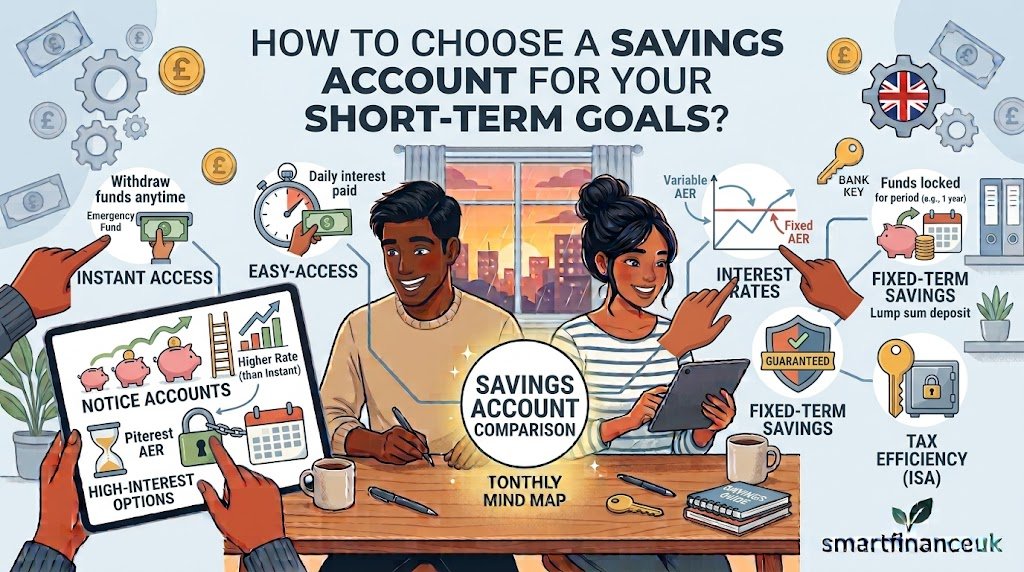
When you have money to put aside, choosing the right savings account can be confusing. Two common options in the UK are easy-access savings accounts and fixed-term savings accounts.
Both can help you earn interest on money you are not currently spending, but they work in very different ways. An easy-access account prioritises flexibility, while a fixed-term account is designed for savers who are comfortable leaving their money untouched for an agreed period.
The right choice depends largely on when you might need the money, how important quick access is, whether you want certainty over the interest rate and what restrictions you are comfortable with.
This guide explains the differences in straightforward terms, including the advantages, disadvantages, access rules, interest rates, tax considerations and practical situations where each type may be useful.
What Is an Easy-Access Savings Account?
An easy-access savings account is designed to let you withdraw your money relatively easily while earning interest on your balance.
MoneyHelper describes instant-access accounts as savings accounts where you can withdraw money when you need it.
The exact rules vary between providers. Some accounts may genuinely allow withdrawals whenever you want, while others marketed as easy access can have conditions or limits.
Before opening one, check the provider’s terms rather than relying only on the account’s name.
An easy-access account can be useful for money you might need unexpectedly, such as an emergency fund or savings for household repairs.
How Does an Easy-Access Account Work?
You deposit money into the account and the provider pays interest according to its terms.
For example, suppose you put a hypothetical £2,000 into an easy-access account. If you later need £500 for an unexpected repair, the account may allow you to withdraw the £500 without waiting for a fixed term to end.
The actual withdrawal process depends on the provider.
You may be able to transfer money through online banking or an app, while some providers may have different arrangements.
The important point is that your money is generally more accessible than it would be in a fixed-term account.
What Is a Fixed-Term Savings Account?
A fixed-term savings account, sometimes called a fixed-rate savings bond, allows you to deposit money for an agreed period.
In return, you may receive a fixed interest rate for that term.
MoneyHelper explains that fixed-rate savings bonds can provide a guaranteed interest rate for a set period, but generally require you to leave the money untouched until the end of the term.
Terms vary between products. Some can last months, while others can run for several years.
The key feature is that you give up some access to your money in exchange for greater certainty over the rate and, depending on the product and market, potentially a higher return than an easy-access account.
Easy Access vs Fixed Term at a Glance
| Feature | Easy-access savings | Fixed-term savings |
|---|---|---|
| Access to money | Generally flexible | Usually restricted until maturity |
| Interest rate | Usually variable | Usually fixed for the agreed term |
| Rate certainty | Lower | Higher |
| Withdrawal restrictions | Usually fewer, but check terms | Usually significant |
| Suitable for emergencies | Often suitable | Usually unsuitable |
| Suitable for known future expenses | Often suitable | Can be suitable |
| Main advantage | Flexibility | Certainty |
| Main drawback | Rate can change | Money may be difficult to access |
These are general characteristics. Individual accounts can have different conditions.
The Biggest Difference: Access to Your Money
The most important difference is what happens when you need your savings.
With an easy-access account, you can generally withdraw money without waiting for a fixed maturity date.
With a fixed-term account, your money is usually tied up until the agreed term ends. Some products do not permit early withdrawals, while others may allow them only under specific conditions or impose a financial consequence.
MoneyHelper warns that fixed-rate savings bonds can involve significant penalties for early withdrawal, so savers should make sure they can afford to leave the money untouched.
This makes access particularly important when choosing an account.
Why Easy Access Can Be Useful for Emergency Savings
Emergency savings are money kept aside for unexpected costs.
You might need it because of:
- An urgent home repair
- An unexpected car bill
- A replacement appliance
- A sudden household expense
- A period when your normal income is disrupted
The timing of these expenses is uncertain.
That makes flexibility valuable.
If your emergency fund is in a fixed-term account and you cannot access it when needed, you may have to find another way to pay the bill.
An easy-access account can therefore be practical for this type of saving.
MoneyHelper also identifies instant-access accounts as an option for people who want to be able to withdraw money when needed.
When a Fixed-Term Account May Make More Sense
A fixed-term account can be considered when you have money that you are confident you will not need before a particular date.
For example, imagine you have £5,000 that you are saving for a future expense expected in 18 months.
If you already have separate emergency savings and do not expect to need the £5,000 early, you may be more comfortable considering a fixed-term product.
The important question is not simply whether the interest rate is higher.
It is whether the extra return and rate certainty are worth giving up access to the money.
Interest Rates: Fixed vs Variable
Another major difference is how the interest rate behaves.
Easy-access rates are usually variable
An easy-access account will generally have a variable rate, although the exact product terms determine how the rate can change.
If the provider changes the rate, the amount of interest you earn can change too.
This means an attractive rate today may not remain the same throughout your savings period.
MoneyHelper recommends regularly checking whether you are still receiving a competitive savings rate because savings rates can change.
Fixed-term rates provide more certainty
With a fixed-rate savings account, the interest rate is normally agreed when you open the account and remains fixed for the specified term.
This can make planning easier.
For example, if you know the fixed rate and the amount you deposit, you can have a clearer idea of what you will receive when the account matures, subject to the product’s terms.
That certainty can be useful if your savings have a specific purpose.
Does Fixed Term Always Mean a Higher Interest Rate?
Not necessarily.
Fixed-term savings products have often been designed to offer higher rates than accounts with greater flexibility, but the difference depends on market conditions and the specific products available.
You should never assume that a fixed-term account will automatically pay more.
Compare the current AER and account conditions when making a decision.
MoneyHelper specifically advises against choosing a savings product solely because it offers the highest interest rate. Access, opening balances, regular payments and withdrawal restrictions can all affect whether the product is appropriate.
What Is AER?
AER stands for Annual Equivalent Rate.
It is used to make savings accounts easier to compare by showing the annual rate while taking the effect of interest payments and compounding into account.
When comparing an easy-access account with a fixed-term account, look at the AER rather than simply comparing an isolated interest-rate figure.
However, remember that the AER is only one part of the comparison.
An account paying a slightly higher rate may be less useful if you cannot access the money when your circumstances require it.
A Simple Hypothetical Example
Imagine two hypothetical accounts.
Account A
- Easy access
- Variable rate
- Lower AER
Account B
- Two-year fixed term
- Fixed rate
- Higher AER
- No normal access until maturity
Now imagine that the money is your emergency fund.
Account B might appear more attractive because of the higher rate, but the lack of access creates a serious practical problem.
If the money is instead being saved for a known expense that you will not need to pay for two years, the restrictions may be less important.
This example uses fictional account features and figures. It is intended to demonstrate the decision rather than recommend a particular product.
Easy-Access Savings: Advantages
You can generally access your money more easily
This is the main benefit.
If your circumstances change, you have more flexibility.
Useful for emergency savings
You can keep money available for unexpected expenses without committing it to a fixed term.
Suitable for changing plans
If your savings goal changes, you are less likely to face a maturity-date problem.
You can continue saving
Many easy-access accounts allow you to add money regularly, although the exact conditions vary.
Easy-Access Savings: Disadvantages
The interest rate can change
A variable rate may be reduced after you open the account.
The rate may be lower
Greater flexibility can come with a lower rate than some restricted savings products.
Some accounts have withdrawal conditions
“Easy access” does not necessarily mean completely unrestricted access.
Check whether there are limits on withdrawals or other conditions.
You may need to review the account
If the rate becomes less competitive, you may need to compare alternatives.
Fixed-Term Savings: Advantages
Greater certainty over the rate
A fixed rate means you know what rate applies during the agreed term.
Useful for money you do not need immediately
If your financial plans are clear, restrictions may be less of a problem.
Can help prevent unnecessary spending
When access is restricted, you are less likely to dip into the money for everyday purchases.
Clear maturity date
You know when the fixed term ends and when the account is due to mature, subject to the provider’s terms.
Fixed-Term Savings: Disadvantages
Your money may be inaccessible
This is the main drawback.
Early withdrawal can have consequences
Depending on the product, early access may not be permitted or may involve a penalty or loss of interest.
Your plans could change
An account that seems suitable today may become inconvenient if you suddenly need the money.
Inflation can affect its real value
Even if your balance increases, your money’s purchasing power can fall if inflation is higher than the interest you receive.
MoneyHelper highlights this risk with fixed-rate savings products.
Which Is Better for an Emergency Fund?
For an emergency fund, easy access will generally be more important than locking the money away.
The purpose of an emergency fund is to provide a financial buffer when something unexpected happens.
Suppose you have £3,000 set aside for emergencies.
If it is held in an easy-access account, you may be able to use it when an unexpected bill arrives.
If it is locked away for two years, the account may offer a predictable return but fail to serve the practical purpose of an emergency fund.
There is no requirement to use a particular account type for an emergency fund. The important consideration is whether the account’s access rules fit the purpose of the money.
Which Is Better for a Planned Expense?
A planned expense gives you more flexibility.
Suppose you are saving for a car that you expect to buy in 18 months.
If you already have separate emergency savings and are confident you will not need the car fund early, you could consider a fixed-term account whose maturity date fits your plans.
However, if the purchase date could change, easy access may be more useful.
The closer your deadline and the more certain your plans are, the easier it can be to assess whether a fixed term is appropriate.
What About Saving for a Holiday?
Holiday savings are often more flexible than emergency savings because you usually know roughly when you will need the money.
An easy-access account can work well if you are still building the fund and want to add money regularly.
A fixed-term account could potentially work if you already have the money and are certain you will not need it before the term ends.
There is no universal answer.
Your departure date, savings amount, access requirements and account conditions all matter.
What About Money for Annual Bills?
Some households have large expenses that arrive once or twice a year.
Examples include:
- Insurance premiums
- Car-related costs
- Council tax-related budgeting
- School expenses
- Christmas spending
- Home maintenance
MoneyHelper refers to this type of planned saving as a sinking fund and notes that easy-access savings can be useful for keeping money set aside for known future expenses.
Because these expenses have known or approximate dates, you can calculate how much needs to be saved each month.
Easy access can still be useful because the exact timing or cost may change.
What Happens When a Fixed Term Ends?
When a fixed-term account reaches its maturity date, the provider will normally return the savings and interest according to the product’s terms.
However, do not assume that the money will automatically move into the account you want.
Some products may automatically transfer the balance into another savings product or apply another arrangement if you do not give instructions.
Check the maturity information before the term ends.
This is particularly important if you need the money on a specific date.
What Should You Check Before Opening an Easy-Access Account?
Look at:
AER: Check the current advertised rate.
Variable-rate conditions: Understand how the rate can change.
Withdrawal rules: Check whether withdrawals are genuinely unrestricted.
Bonus rates: Find out whether the advertised rate includes a temporary bonus.
Minimum balance: Check whether you need to maintain a particular balance.
Maximum balance: Some products only pay the advertised rate up to a certain amount.
Access method: Check whether withdrawals can be made online, through an app, by telephone or in another way.
MoneyHelper recommends checking these practical conditions rather than choosing based solely on the interest rate.
What Should You Check Before Opening a Fixed-Term Account?
Before committing your money, check:
Length of the term: Does it match when you need the money?
Fixed interest rate: Confirm how long the rate remains fixed.
Early access: Can you withdraw before maturity?
Early withdrawal consequences: Check for charges or loss of interest.
Minimum deposit: Make sure your planned deposit qualifies.
Maximum deposit: Check whether there is a limit.
Maturity arrangements: Find out what happens when the term ends.
Deposit protection: Check whether the provider is covered by the FSCS.
These details can be more important than a small difference in the headline rate.
What Is the FSCS Protection Limit?
Eligible deposits held with UK-authorised banks, building societies and credit unions can be protected by the Financial Services Compensation Scheme if the authorised firm fails.
The current deposit protection limit is £120,000 per eligible person, per authorised firm.
The limit applies across accounts held with the same authorised firm.
This means that having money in two different brands does not necessarily give you two separate £120,000 limits if those brands operate under the same banking authorisation.
For most people with ordinary savings balances, this may not be an immediate concern. If you hold a large amount of cash, however, it is worth checking the provider’s authorisation and FSCS protection.
Tax on Savings Interest
Interest from ordinary savings accounts can have tax implications.
The amount of savings interest you can receive before paying tax depends on your circumstances, including your Income Tax position.
A Cash ISA has different tax treatment because interest earned within the ISA is generally tax-free, subject to ISA rules and allowances.
The tax treatment should therefore be considered alongside the account’s rate and access rules.
Do not choose between easy access and fixed term based on tax alone.
If your savings are substantial or your tax circumstances are complicated, check the latest information from HM Revenue & Customs or seek appropriate professional advice.
Can You Use Both Types of Account?
Yes.
You do not have to choose one account type for all your savings.
For example, you could hypothetically have:
Easy-access savings: emergency fund
Fixed-term savings: money for a future expense that you know you will not need before maturity
Regular savings account: money you are building gradually each month
This approach can give different portions of your savings different jobs.
The downside is that managing several accounts can become unnecessarily complicated. Keep the arrangement simple enough that you know what each account is for.
Common Mistakes to Avoid
Choosing the fixed rate without considering access
A higher rate does not help if you need the money before maturity.
Treating an easy-access rate as permanent
Variable rates can change.
Forgetting about bonus periods
A temporary bonus can disappear after a specified period.
Ignoring maturity dates
A fixed-term account should fit your financial timetable.
Keeping your emergency fund locked away
Emergency money generally needs to be available when something unexpected happens.
Focusing only on AER
AER is important, but access, withdrawal rules and other conditions matter too.
Assuming different banking brands have separate FSCS limits
Brands can share an authorised firm and therefore share the same protection limit.
A Simple Decision Guide
Ask yourself these questions:
Could I need the money unexpectedly?
If yes, consider whether easy access is important.
Do I know exactly when I will need the money?
If yes, a fixed term may be easier to consider.
Would I struggle if I could not access the money for several months?
If yes, avoid committing it without carefully checking the withdrawal conditions.
Do I want certainty over the interest rate?
If yes, a fixed-rate product may offer that certainty.
Am I still building the savings?
If yes, check whether the account allows additional deposits.
Is this money genuinely spare for the whole fixed term?
If you cannot confidently answer yes, flexibility may be more valuable.
Frequently Asked Questions
What is the main difference between easy-access and fixed-term savings?
The main difference is access. Easy-access accounts are designed to let you withdraw money when needed, although individual accounts can have conditions. Fixed-term accounts require you to commit your money for a specified period and normally restrict access until maturity. In return, a fixed-rate account can provide greater certainty over the interest rate during the agreed term.
Is an easy-access savings account better than a fixed-term account?
Neither is automatically better. An easy-access account may be more suitable when you need flexibility, while a fixed-term account can make sense when you are confident that you will not need the money until a particular future date. Compare the AER, access arrangements, withdrawal restrictions and other conditions before choosing.
Can I withdraw money from a fixed-term savings account?
It depends on the account. Some fixed-term products do not normally allow withdrawals before maturity, while others may permit early access subject to a charge or loss of interest. Always check the product’s terms before depositing money. MoneyHelper warns that early withdrawal penalties can be significant on some fixed-rate savings products.
Is a fixed-term savings account safer than an easy-access account?
Both can be cash savings products and can qualify for FSCS protection when the provider and deposit meet the relevant requirements. The key difference is access, not necessarily safety. Eligible deposits with a UK-authorised bank, building society or credit union are currently protected up to £120,000 per person, per authorised firm, subject to FSCS rules.
Which type of account is better for an emergency fund?
An easy-access account is generally more practical for emergency savings because the purpose of an emergency fund is to provide money when an unexpected cost occurs. A fixed-term account can create access problems if you need the money before the maturity date. The exact account should still be checked for withdrawal conditions and current terms.
Can an easy-access savings rate change?
Yes. Many easy-access accounts have variable interest rates, meaning the rate can change. The rate you receive when opening the account may therefore not remain the same throughout your savings period. Regularly checking your rate can help you identify when the account’s terms have become less competitive.
Can I have both an easy-access and a fixed-term savings account?
Yes. Different savings accounts can be used for different goals. For example, you might keep emergency money in an easy-access account while putting money for a known future expense into a suitable fixed-term account. The important thing is to understand the terms of each account and keep enough accessible cash for expenses that cannot wait.
Final Thoughts
Easy-access and fixed-term savings accounts are designed for different needs.
An easy-access account prioritises flexibility. It can be useful when you may need the money unexpectedly or when your savings plans are still changing.
A fixed-term account prioritises certainty over the agreed term. It can be worth considering when you know you will not need the money before the account matures and are comfortable accepting restrictions on access.
The interest rate matters, but it should not be the only factor you consider. Check the AER, whether the rate is fixed or variable, withdrawal rules, minimum and maximum deposits, bonus periods, maturity arrangements and FSCS protection.
The best account for your savings is ultimately the one whose conditions fit the purpose of the money.
This article provides general financial education for UK readers and is not personalised financial advice. Savings rates, tax rules and individual account conditions can change, so check the latest provider terms and authoritative UK guidance before making a financial decision.