
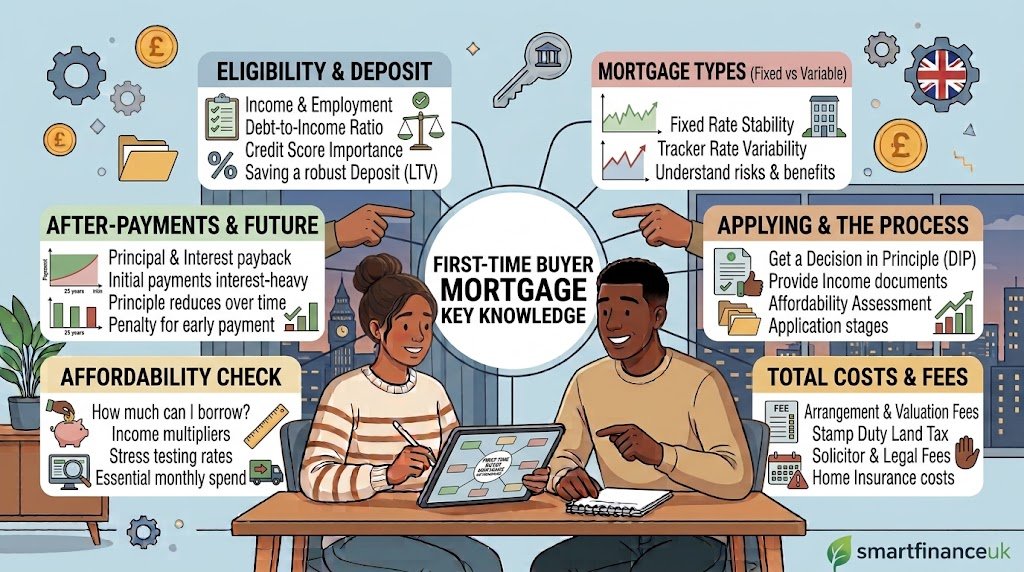
Buying your first home is a major financial commitment, and applying for a mortgage can feel complicated when you are unfamiliar with the terminology and process. Before approaching a lender, it helps to understand how much you can realistically afford, how your deposit affects the mortgage, what lenders look at, and which costs sit outside the monthly mortgage payment.
A mortgage lender will not simply look at your salary and decide how much you can borrow. Affordability assessments can take account of your income, regular spending, existing debts and other financial commitments. You will also normally need to provide evidence such as payslips, bank statements, identification and proof of your deposit.
For first-time buyers, preparation can make the process easier. Checking your credit report, understanding your budget and gathering documents before making a full application can help you spot potential problems early.
This article explains the main things UK first-time buyers should understand before applying for a mortgage. It provides general educational information rather than personalised financial advice.
What Is a Mortgage?
A mortgage is a loan used to buy a property, with the property normally acting as security for the borrowing.
You usually contribute some of your own money as a deposit and borrow the remaining amount from a mortgage lender.
For example, suppose a fictional property costs £250,000 and the buyer has saved £25,000.
The buyer could potentially need to borrow £225,000, subject to the lender’s affordability assessment and the terms of the mortgage.
The mortgage is then repaid according to the agreed terms, usually through monthly payments covering capital and interest if it is a repayment mortgage.
The important point is that being able to save a deposit does not automatically mean you will be approved for the mortgage you want. The lender still needs to assess whether the borrowing is affordable.
How Much Deposit Do First-Time Buyers Need?
There is no single deposit amount that applies to every first-time buyer.
MoneyHelper says you will usually need a deposit of at least 5% to 10% of the property’s price, although mortgages with smaller or no deposits can sometimes be available.
Consider a hypothetical £300,000 property:
- A 5% deposit would be £15,000.
- A 10% deposit would be £30,000.
- A 20% deposit would be £60,000.
The larger the deposit, the less you need to borrow relative to the property’s value.
This is known as the loan-to-value ratio, or LTV.
For example, if you put down £30,000 on a £300,000 property, you would need a £270,000 mortgage. That represents an LTV of 90%.
A larger deposit can sometimes give you access to a wider range of mortgage deals or lower interest rates, although this depends on the lender and market conditions.
Don’t assume that putting every available pound into the deposit is automatically the best approach. You may also need money for moving and property-related costs, as well as a financial buffer for unexpected expenses.
Work Out What You Can Actually Afford
One of the biggest mistakes a first-time buyer can make is starting with the maximum mortgage a lender might offer rather than the payment they can comfortably manage.
A lender’s affordability calculation is important, but it is not the same as your personal household budget.
Before applying, work out your regular monthly income and spending.
Consider costs such as:
- household bills
- council tax
- food
- transport
- existing loan payments
- credit card repayments
- insurance
- subscriptions
- childcare or other regular commitments
- savings and emergency expenses
Then consider what would remain after your proposed mortgage payment.
MoneyHelper recommends preparing a budget before looking for a property and considering whether mortgage payments remain manageable alongside everyday living costs.
A mortgage that technically passes a lender’s affordability assessment may still leave your household budget feeling uncomfortable.
Understand How Lenders Assess Affordability
Mortgage lenders have to assess whether you can afford the proposed borrowing.
They can consider your household income as well as regular expenditure and existing debts.
The FCA explains that lenders look at money coming into the household and money going out when assessing mortgage affordability.
MoneyHelper also explains that lenders can consider income from employment and other sources, while looking at household bills, spending, loans and credit card commitments.
This is why two people earning similar salaries could potentially receive different mortgage offers.
For example, one applicant might have substantial existing loan repayments while another has very little existing borrowing.
The lender is interested in whether the proposed mortgage remains affordable after considering the applicant’s wider financial commitments.
Check Your Credit Report Before Applying
Checking your credit report before a mortgage application is a sensible preparation step.
Your credit report can contain information about your borrowing history and payment records. Checking it gives you an opportunity to identify incorrect information before a lender reviews your application.
MoneyHelper specifically recommends checking your credit report before applying for a mortgage so that errors can be corrected and potential problems identified.
Look for things such as:
- accounts you do not recognise
- incorrect personal details
- inaccurate payment information
- accounts that should have been closed
- financial information that appears to be recorded incorrectly
If you find an error, investigate it with the relevant credit reference agency or lender before making a mortgage application.
A credit report is different from a credit score. Lenders use information from your credit history alongside their own criteria when deciding whether to lend.
Avoid Applying for Lots of Mortgages at Once
It can be tempting to submit applications to several lenders so you can see who accepts you.
However, a full mortgage application can involve a credit search, and making several applications in a short period can create complications.
MoneyHelper advises against applying repeatedly after a mortgage application has been refused and recommends discussing the next step with a mortgage adviser instead.
This is one reason it can be useful to research your options before making a full application.
A Mortgage in Principle, also called a Decision in Principle or Agreement in Principle, can give you an indication of how much a lender might be prepared to lend. It is not a guarantee that your eventual mortgage application will be accepted.
What Is a Mortgage in Principle?
A Mortgage in Principle, or MIP, is an indication from a lender of how much it might be prepared to lend based on information you provide.
Different lenders and brokers can use different names, including:
- Mortgage in Principle
- Agreement in Principle
- Decision in Principle
MoneyHelper explains that these terms are generally used for the same type of preliminary indication.
An MIP can help you understand your potential borrowing range before you seriously search for a property.
However, it is not the same as a formal mortgage offer.
The lender will normally carry out more detailed checks once you make a full application and have a specific property in mind.
Gather Your Documents Early
A mortgage application can require quite a lot of paperwork.
Getting your documents together before applying can make the process less stressful.
Depending on your circumstances, a lender may ask for:
- proof of identity
- proof of address
- recent payslips
- P60
- recent bank statements
- proof of your deposit
- evidence of benefits or other income where relevant
- documents relating to existing debts
Self-employed applicants may need additional evidence, such as business accounts and tax documentation. MoneyHelper says self-employed applicants may be asked for two or three years of accounts and relevant tax-return information, although exact requirements vary.
Make sure the information in your application matches the supporting documents.
If your income varies because of bonuses, commission, freelance work or self-employment, explain your circumstances accurately rather than trying to make your income appear more predictable than it is.
Understand Your Loan-to-Value Ratio
Loan-to-value, or LTV, compares the mortgage borrowing with the property’s value.
Suppose a fictional property is worth £250,000 and you have a £50,000 deposit.
You would need a £200,000 mortgage.
That represents an LTV of 80%.
If you instead had a £75,000 deposit, you would need £175,000, producing an LTV of 70%.
LTV matters because mortgage pricing can vary depending on the level of deposit and borrowing relative to the property’s value.
A lower LTV can sometimes provide access to different mortgage rates.
It also means you are borrowing less relative to the property’s value.
Understand the Difference Between the Mortgage Term and the Interest Rate
These are two separate things.
The mortgage term is the length of time over which you plan to repay the borrowing.
The interest rate determines the interest charged under the mortgage agreement.
For example, a first-time buyer might have a 30-year repayment mortgage with a five-year fixed interest rate.
The mortgage term is 30 years.
The fixed-rate period is five years.
At the end of those five years, the mortgage is not automatically paid off. The borrower needs to consider what mortgage rate will apply next.
Understanding this distinction can prevent confusion when comparing mortgage deals.
Fixed and Variable Rates Work Differently
A fixed-rate mortgage keeps the agreed interest rate unchanged during the fixed period.
This can make monthly budgeting easier.
A variable-rate mortgage can change according to its terms. Tracker mortgages commonly follow a reference rate, while standard variable rates are set by the lender.
MoneyHelper explains the main differences between fixed, tracker, discounted and standard variable mortgages.
Neither type is automatically suitable for everyone.
A fixed rate provides greater payment certainty during the fixed period, but you generally will not benefit from falling rates during that period.
A variable rate may fall when the relevant rate falls, but your payments can also increase when rates rise.
Before choosing a mortgage, consider whether your household budget could cope with changing payments.
Understand the Total Cost, Not Just the Monthly Payment
A mortgage advertised with a low monthly payment is not necessarily the cheapest mortgage overall.
The total cost can be affected by:
- interest rate
- mortgage term
- product or arrangement fees
- valuation fees
- legal costs
- early repayment charges
- other mortgage-related charges
MoneyHelper recommends looking at the total mortgage cost and associated fees when comparing options.
For example, imagine two hypothetical mortgages.
One has a slightly lower interest rate but a £2,000 product fee.
Another has a slightly higher rate but no product fee.
You cannot determine which is cheaper simply by looking at the advertised rate. The amount borrowed and how long you keep the deal will also matter.
Don’t Forget the Other Costs of Buying a Home
Your deposit is not the only money you need before buying.
First-time buyers should also consider costs such as:
- solicitor or conveyancer fees
- survey costs
- mortgage fees
- valuation costs where applicable
- moving expenses
- insurance
- repairs and maintenance
- council tax
- utility bills
MoneyHelper highlights survey costs, legal fees, mortgage fees, insurance and tax among the costs buyers may need to budget for.
Property taxes also depend on where in the UK you are buying.
In England and Northern Ireland, the relevant property tax is Stamp Duty Land Tax (SDLT). Scotland uses Land and Buildings Transaction Tax (LBTT), while Wales uses Land Transaction Tax (LTT). HMRC confirms that SDLT does not apply to property transactions in Scotland and Wales.
Because tax rules and thresholds can change, check the relevant government guidance when you are actually preparing to buy.
Keep an Emergency Buffer
It can be tempting to put every available pound into your deposit.
However, buying a property can create new expenses.
A boiler may fail. A roof may need attention. An appliance could stop working. Moving costs can also be higher than expected.
MoneyHelper recommends building savings that can help protect against unexpected changes in income and expenses.
The exact amount you need depends on your circumstances.
The key point is that becoming a homeowner should not leave you with no accessible savings at all.
Be Careful With New Credit Before Applying
Before a mortgage application, it is worth being cautious about taking on additional borrowing.
A new car finance agreement, personal loan or large increase in credit commitments can affect the affordability picture a lender sees.
Lenders consider existing debts and regular spending as part of their affordability assessment.
This does not mean you should make financial decisions purely to satisfy a mortgage application.
Instead, understand that changes to your finances can affect the information a lender uses.
If your circumstances have changed significantly, it may be sensible to discuss the situation with a regulated mortgage adviser before proceeding.
What If You Are Self-Employed?
Being self-employed does not automatically prevent you from getting a mortgage.
However, you may need to provide additional evidence of your income.
MoneyHelper says self-employed applicants may need to provide accounts for the previous two or three years and relevant tax-return information, depending on their circumstances and lender requirements.
Income can be more complicated when it comes from a business, dividends, contracting or several sources.
The important thing is to keep accurate records and have supporting documentation ready.
Do not assume that the income figure you use for everyday budgeting will necessarily be the same figure a lender uses for affordability.
Should You Use a Mortgage Broker?
You can apply for a mortgage directly through a bank or building society, or you can use a regulated mortgage adviser or broker.
MoneyHelper explains that advisers can be particularly useful in situations such as having a small deposit, being self-employed or having other circumstances that may make finding a suitable mortgage more complicated.
A broker may have access to products from multiple lenders, although the range depends on the type of adviser.
If you use an adviser, ask how they are paid, whether they consider the whole market or a limited range, and what fees may apply.
There is no need to assume that using a broker is automatically better or worse than applying directly. The value depends on your circumstances and the service provided.
A Simple First-Time Buyer Example
Imagine a fictional buyer earning £40,000 a year.
They have saved £30,000 and are considering a property costing £250,000.
Their deposit would represent 12% of the property’s price, leaving a hypothetical mortgage requirement of £220,000.
Before applying, they should not simply assume that £220,000 is affordable.
They would need to consider their monthly income, existing credit commitments, household bills, transport costs, insurance, council tax and other spending.
They should also budget for buying costs and keep some savings available after completing the purchase.
The lender would then carry out its own affordability and eligibility checks.
The example is purely illustrative and does not indicate how much a person on a particular salary could borrow.
Common First-Time Buyer Mistakes
Looking at Properties Before Establishing a Budget
Falling in love with a property that is outside your realistic budget can make the buying process unnecessarily difficult.
Work out what you can afford before deciding what price range to search.
Assuming the MIP Is a Guaranteed Mortgage
A Mortgage in Principle is only an indication.
The lender can still decline the full application after reviewing your finances and the property.
Using Every Pound for the Deposit
You may need cash for buying costs, moving expenses and unexpected repairs.
Checking Only the Mortgage Rate
Fees and other charges can change the overall cost.
Ignoring Your Credit Report
Errors can sometimes be corrected before you make a full application.
Taking on New Debt Without Considering the Consequences
Additional borrowing can affect affordability assessments.
Forgetting About the End of a Fixed Deal
A five-year fixed rate does not mean the mortgage remains at that rate for 25 or 30 years.
Practical Steps Before Applying
A sensible preparation process could look like this:
First, establish your budget. Work out what monthly mortgage payment could fit comfortably alongside your normal spending.
Next, check your credit report. Look for incorrect information and deal with errors before applying.
Then, calculate your deposit and LTV. Understand how much you will need to borrow and what that means for the mortgage options available.
Set aside money for buying costs. Do not treat your entire savings balance as the deposit.
Gather your documents. Have identification, payslips, bank statements, proof of deposit and other relevant evidence ready.
Research mortgage types. Understand fixed, tracker and other variable-rate mortgages before choosing a deal.
Consider a Mortgage in Principle. This can provide an indication of potential borrowing, but it is not a final offer.
Compare the overall cost. Look beyond the headline interest rate and consider fees and other charges.
Review your financial resilience. Ask whether you could cope with higher costs or a change in income.
Questions to Ask Before Making a Mortgage Application
Before proceeding, consider asking:
- How much can I comfortably afford each month rather than simply how much can I borrow?
- How much of my savings should remain available after paying the deposit?
- What type of mortgage rate am I considering?
- How long does the initial rate last?
- What rate could apply afterwards?
- What fees will I pay?
- Are there early repayment charges?
- Can I make overpayments?
- How will the lender assess my income and existing debts?
- What documents will I need?
- Will the mortgage application involve a credit search?
- What happens if my circumstances change before completion?
These questions can help you understand the commitment before signing a mortgage agreement.
Frequently Asked Questions
How much deposit does a first-time buyer need?
Many first-time buyers use a deposit of 5% to 10% of the property’s price, although the amount varies by mortgage product and lender. A larger deposit can reduce the amount you need to borrow and may give you access to different mortgage deals. Some higher-LTV mortgages are available, but they can have different costs and risks.
Does checking my credit report affect my credit score?
Checking your own credit report is generally different from making a full credit application. You can review your report to look for errors and understand what information lenders may see. Before applying for a mortgage, checking your report can be useful because it gives you an opportunity to identify inaccurate information that may need correcting.
What documents do I need for a first mortgage?
Requirements vary between lenders, but you may need proof of identity, proof of address, payslips, bank statements, P60 information and evidence of your deposit. Self-employed applicants may need business accounts and tax documentation. MoneyHelper recommends preparing documents such as recent payslips, bank statements and proof of deposit before applying.
Is a Mortgage in Principle the same as a mortgage offer?
No. A Mortgage in Principle, Agreement in Principle or Decision in Principle is an indication of how much a lender might be prepared to lend based on the information available at that stage. A full mortgage application involves further checks and is required before a formal mortgage offer can be made.
Can I get a mortgage with a 5% deposit?
Some mortgage products are available to borrowers with a 5% deposit. MoneyHelper says first-time buyers will usually need a deposit of at least 5% to 10%, although the exact requirements vary. A smaller deposit means a higher LTV, which can affect the mortgage rates and products available to you.
Should I pay off my debts before applying for a mortgage?
Existing debts are considered as part of mortgage affordability, so reducing debt can change the amount of income available for mortgage payments. However, whether paying off a particular debt is appropriate depends on your wider finances, savings and circumstances. Avoid making a major financial decision solely to improve your mortgage application without considering the consequences for your emergency savings and other commitments.
Can first-time buyers get help with buying a home?
There are government-supported schemes and other forms of assistance that may be relevant to some first-time buyers. Eligibility varies, and schemes can change over time. MoneyHelper provides current information about available home-buying schemes and eligibility.
Final Thoughts
Applying for your first mortgage becomes easier when you understand what the lender is actually assessing.
Your deposit is important, but it is only one part of the picture. Lenders also look at income, regular spending, existing debts and other financial information when considering affordability.
Before making a full application, check your credit report, establish a realistic household budget, gather your paperwork and understand the difference between a Mortgage in Principle and a formal mortgage offer.
Also look beyond the monthly repayment. Mortgage interest, product fees, legal costs, surveys, insurance, taxes and ongoing homeownership expenses can all affect the real cost of buying a property.
Most importantly, do not base your decision simply on the maximum amount a lender says you could borrow. A mortgage needs to fit your household finances for the long term, including periods when your costs rise or your circumstances change.
This article is general educational information and should not be treated as personalised financial or mortgage advice.
Sources and Further Reading
- MoneyHelper — First-time home buyer guide — Guidance on deposits, affordability, mortgage applications and other first-time buyer considerations.
- MoneyHelper — What mortgage can I afford? — Information about affordability, deposits, credit reports and Mortgage in Principle.
- MoneyHelper — How to apply for a mortgage — Details of documents, affordability checks and the application process.
- Financial Conduct Authority — Support available for mortgages — Information about mortgage affordability and lender checks.
- GOV.UK — Stamp Duty Land Tax guidance — Official information about SDLT and the different property tax systems across the UK.