
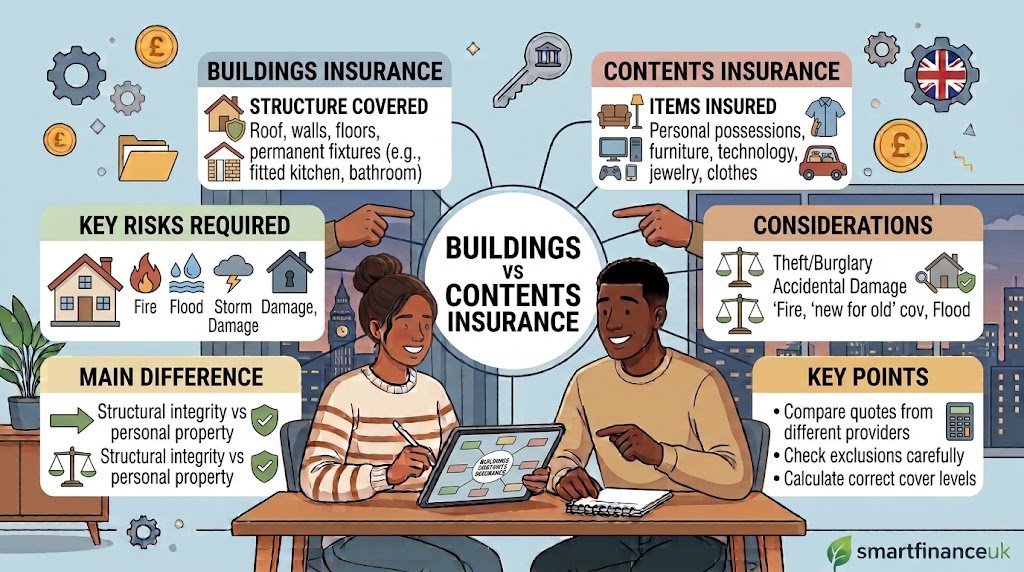
When you own or rent a home in the UK, you may come across two terms that sound similar but protect very different things: buildings insurance and contents insurance.
Buildings insurance is mainly concerned with the property itself. Contents insurance is designed to protect the belongings inside it. Understanding the difference matters because having the wrong type of cover, or too little cover, could leave you responsible for significant costs after an unexpected event.
A fire, flood, storm, escape of water or burglary can affect both the building and the possessions inside it. A damaged roof is a different insurance issue from a damaged television, even if both problems happen during the same incident. MoneyHelper describes buildings insurance as cover for the structure, fixtures and fittings, while contents insurance covers your belongings.
This guide explains how the two types of insurance work, what they usually cover, who needs them, how they differ for homeowners and renters, and what to check before buying a policy.
What Is Buildings Insurance?
Buildings insurance is designed to protect the physical structure of your home and certain permanent fixtures and fittings.
The precise definition depends on the policy, but buildings cover can generally include parts of the property such as:
- the roof
- walls
- floors
- windows
- doors
- fitted kitchens
- bathroom fittings
- permanent fixtures
The Financial Conduct Authority describes home buildings insurance as cover against loss of or damage to the structure of a domestic property.
For example, imagine a severe storm damages the roof of a house. If the damage is an insured event under the policy, the homeowner may be able to claim under the buildings section.
The same principle applies to certain forms of fire, flood, storm, escape-of-water or other insured damage.
However, buildings insurance is not a maintenance contract. Normal deterioration and some maintenance-related problems are generally excluded.
What Is Contents Insurance?
Contents insurance protects the belongings inside your home against specified insured events.
Think about the possessions you would take with you if you moved house. These might include:
- furniture
- televisions
- computers
- clothing
- kitchen equipment
- electrical appliances
- jewellery
- personal belongings
- bedding
- other household possessions
The FCA defines home contents insurance as cover against loss or damage to the contents of a domestic property, rather than the structure itself.
For example, if a burglary results in a stolen television and laptop, contents insurance may provide cover if theft is included and the policy conditions have been met.
Contents insurance does not normally protect the walls, roof or permanent structure of the property.
Buildings Insurance vs Contents Insurance
The simplest way to remember the difference is:
| Buildings insurance | Contents insurance |
|---|---|
| Protects the structure of the property | Protects your belongings |
| Roofs and walls | Furniture and clothing |
| Windows and doors | TVs and computers |
| Permanent fixtures | Personal possessions |
| Fitted kitchen and bathroom elements | Household items |
| May be required by a mortgage lender | Usually optional |
| Primarily relevant to property owners | Relevant to homeowners and renters |
There can be some grey areas, particularly around fitted items and fixtures, so the policy wording should always take priority over a simple rule of thumb.
MoneyHelper describes buildings insurance as covering the structure, fixtures and fittings, while contents insurance covers belongings.
What Does Buildings Insurance Usually Cover?
Policies differ, but buildings insurance commonly protects against certain unexpected events.
Fire and Smoke Damage
Fire can damage the structure of a property as well as permanent fixtures.
Depending on the policy, buildings insurance may cover eligible damage caused by fire and smoke.
For example, a serious kitchen fire could damage ceilings, walls, doors and fitted units. The insurer would assess the circumstances and determine what falls within the policy.
Flooding
Flooding can cause substantial damage to floors, walls, fixtures and other parts of a building.
Flood cover is commonly available through home insurance, although the exact terms and exclusions vary between policies.
If a property has particular flood risks, it is especially important to understand the policy before relying on the cover.
Storm Damage
Strong winds and severe weather can damage roofs, windows and other structural parts of a property.
Buildings insurance may cover qualifying storm damage.
However, insurers can apply specific conditions and definitions, so it is unwise to assume that every form of weather-related damage will automatically be accepted.
Escape of Water
Water escaping from pipes or plumbing systems can cause damage to walls, ceilings, floors and fixtures.
A buildings policy may cover qualifying damage caused by an escape of water.
There can be an important distinction between the damage caused by the water and the underlying fault.
For example, a policy might cover damage resulting from a burst pipe while treating an old, corroded pipe differently.
Subsidence
Some buildings policies provide cover for subsidence, although special excesses or conditions can apply.
If you are concerned about subsidence, read this section of the policy carefully rather than assuming it is treated in exactly the same way as other claims.
Falling Trees and Other Accidental Events
Depending on the policy, buildings insurance can also provide protection for certain damage caused by falling trees, vehicles, vandalism and other insured events.
The circumstances matter.
An insurer does not simply pay for every repair regardless of its cause.
What Does Contents Insurance Usually Cover?
Contents insurance generally protects belongings against specified risks such as theft, fire and some forms of water or flood damage.
Theft
If your belongings are stolen during a burglary, contents insurance may help pay for eligible replacements.
There may be security requirements or other conditions attached to the policy.
For instance, the policy might specify requirements relating to locks or how your home should be secured when unoccupied.
Fire Damage
A fire can destroy furniture, clothing, electrical equipment and other possessions.
Contents insurance may cover eligible losses resulting from fire, subject to the policy terms and excess.
Water and Flood Damage
Water damage can affect carpets, furniture, electrical items and other possessions.
If the cause of the damage is covered by your policy, you may be able to claim for eligible contents.
The exact outcome depends on the circumstances and policy wording.
Vandalism
Some contents policies cover damage resulting from vandalism.
For example, possessions might be damaged during a burglary or another qualifying incident.
Again, check the policy because exclusions and conditions vary.
What Is the Difference Between Fixtures and Belongings?
This is one of the areas that can confuse people.
A useful starting point is to ask whether the item is permanently attached to the property.
A fitted kitchen, bathroom fittings, doors and windows are generally associated with the building.
A sofa, television, clothing or freestanding appliance is generally treated as contents.
But there can be exceptions.
A fitted appliance and a freestanding appliance, for example, may be treated differently depending on the policy.
If you are unsure whether an item falls under buildings or contents insurance, check your policy documents or ask the insurer before assuming it is covered.
Can You Have Buildings and Contents Insurance Together?
Yes.
You can often buy buildings and contents insurance as a combined home insurance policy.
You can also buy the two types separately if that better suits your circumstances.
A combined policy can be convenient because both areas of cover are arranged through the same policy. However, convenience does not necessarily mean it is the cheapest or most suitable option.
When comparing policies, look at:
- the level of cover
- exclusions
- excesses
- individual-item limits
- optional extras
- policy conditions
- total premium
MoneyHelper confirms that buildings and contents insurance can be purchased together or separately.
Do Homeowners Need Both Types?
For many homeowners, having both types of insurance can make sense because the building and possessions represent two different financial risks.
Suppose a fire severely damages a house.
The building itself might require extensive repairs, while furniture, clothing and electrical equipment inside the property could also be destroyed.
Buildings insurance and contents insurance address those different losses.
If you only have buildings insurance, your personal belongings may not be protected.
If you only have contents insurance, you may not have cover for the physical structure of the property.
If you have a mortgage, your lender will normally require buildings insurance as part of the mortgage conditions. MoneyHelper states that mortgage borrowers are normally required to have buildings insurance, while contents insurance is optional.
Do Renters Need Buildings Insurance?
Generally, no.
If you rent your home, buildings insurance is normally the landlord’s responsibility.
The landlord is responsible for insuring the building itself, while your own belongings remain your responsibility.
For example, if a rented flat suffers a fire, the landlord’s buildings insurance may deal with eligible damage to the structure. It would not normally replace your personal laptop, clothing or other belongings.
MoneyHelper states that renters generally only need to consider contents insurance because buildings insurance is the landlord’s responsibility.
Contents insurance is not compulsory for most tenants, but it can protect you from having to replace possessions entirely from your own money after a covered event.
What About Leasehold Flats?
Leasehold flats can be different from freehold houses.
If you own a leasehold flat, buildings insurance may already be arranged for the whole building.
For example, the freeholder may arrange the policy and recover the cost through service charges.
MoneyHelper explains that with many leasehold properties, buildings insurance may be included as part of the service charge, while the leaseholder arranges their own contents insurance.
Before buying separate buildings insurance for a leasehold flat, check your lease and ask the freeholder, managing agent or solicitor how the building is insured.
Otherwise, you could pay for cover that duplicates an existing arrangement.
What About Landlords?
A landlord generally needs to think about the building separately from the tenant’s belongings.
Buildings insurance can protect the property itself.
If the landlord provides furniture or other contents, additional cover may be appropriate depending on the circumstances.
Tenants generally remain responsible for insuring their own possessions.
Some specialist landlord policies can also include features relating to rental income or liability, but these are different from ordinary owner-occupier home insurance.
What Does Neither Policy Usually Cover?
It is just as important to understand exclusions as it is to understand cover.
Normal Wear and Tear
Insurance is not normally designed to pay for gradual deterioration.
A carpet becoming worn over several years would generally not be treated in the same way as sudden damage caused by a covered event.
MoneyHelper states that normal wear and tear is generally not covered by home insurance.
Poor Maintenance
Homeowners are expected to maintain their properties.
An insurer may reject or limit a claim if the damage results from an excluded maintenance problem or failure to take reasonable care.
Deliberate Damage
Damage intentionally caused by an insured person is generally excluded.
Certain Pest or Weather-Related Problems
Some problems involving pests, frost, leaking gutters and similar issues may not be covered.
The precise exclusions depend on the policy, so read the policy wording rather than relying on assumptions.
What Is an Excess?
An excess is the amount you agree to contribute towards an accepted claim.
Imagine a hypothetical contents claim for £1,500 with a £200 excess.
If the claim is accepted and the policy terms apply, you would generally be responsible for the first £200, with the insurer covering the remaining eligible amount.
Policies can have different excesses for different types of claims.
A higher excess can sometimes reduce the insurance premium, but it also means you would have to contribute more if you claimed.
MoneyHelper highlights the importance of checking the excess when comparing home insurance policies.
Before choosing a high excess simply to reduce the premium, consider whether you could comfortably afford that amount after an unexpected event.
How Much Buildings Cover Do You Need?
Buildings insurance is generally based on the cost of rebuilding the property, rather than its market value.
These are not necessarily the same figure.
A house might have a market value of £300,000 but a different cost to clear the site and rebuild the structure.
MoneyHelper says the buildings sum insured needs to be sufficient to rebuild the home following a total loss.
If the amount insured is too low, you may not have enough cover for a major claim.
When determining the appropriate figure, consider the property’s construction, size, features and other relevant factors.
How Much Contents Cover Do You Need?
Contents insurance should reflect the cost of replacing the belongings you want to insure.
It is easy to underestimate this amount.
Instead of looking only at your most expensive possessions, go through the home room by room.
Consider:
Living room: sofa, television, games console, furniture and decorations.
Kitchen: microwave, kettle, toaster, cookware and other appliances.
Bedroom: clothing, shoes, furniture and personal belongings.
Home office: laptop, monitor, printer and other equipment.
Garage or shed: tools, bicycles and other belongings.
MoneyHelper recommends calculating what it would cost to replace everything covered by the policy rather than simply guessing an amount.
What About Expensive Jewellery and Electronics?
Contents policies can have limits on individual valuable items.
For example, a policy may have a maximum amount it will pay for a single item unless that item has been specifically declared.
MoneyHelper notes that many contents policies have a single-item limit and that expensive possessions such as jewellery may need to be listed separately.
Suppose you own a watch worth £3,000 but your policy has a £1,500 single-item limit.
Having a large total contents sum insured does not necessarily mean the insurer will pay £3,000 for the watch.
Check the rules for valuable possessions and keep appropriate receipts, valuations or other evidence where possible.
What Is Accidental Damage Cover?
Accidental damage cover can protect against certain accidents that would otherwise be excluded.
For example, accidentally damaging a fixture or spilling paint on a carpet could potentially fall within accidental damage cover, depending on the policy.
It is not necessarily included as standard.
MoneyHelper explains that comprehensive accidental damage cover can often be added for an additional cost.
Before paying extra for it, consider whether the situations covered are relevant to your household.
What Is Personal Possessions Cover?
Personal possessions cover can extend contents insurance to certain belongings when they are outside your home.
This could include items such as:
- mobile phones
- laptops
- cameras
- jewellery
- bicycles
The cover may be useful if you regularly carry valuable belongings away from home.
However, check whether the policy covers loss as well as theft and accidental damage. These situations may be treated differently.
MoneyHelper identifies personal possessions cover as an optional feature that can provide protection outside the home.
A Simple UK Example
Consider a hypothetical homeowner whose kitchen suffers serious damage after a covered fire.
The fitted kitchen units, walls and other permanent fixtures could potentially fall under buildings insurance.
A television, sofa, clothing and other personal possessions damaged by the same event could potentially fall under contents insurance.
There may also be costs associated with staying somewhere else while major repairs are carried out, depending on the policy.
The insurer would assess the claim against the actual policy, including exclusions, excesses, limits and conditions.
This example is purely illustrative. A real claim can have a different outcome depending on the circumstances and policy wording.
Common Mistakes to Avoid
Assuming Buildings Insurance Covers Your Belongings
It generally does not.
A buildings policy is primarily concerned with the property structure and permanent fixtures.
Assuming Contents Insurance Covers the Building
It generally does not cover the roof, walls or other structural elements.
Underestimating Contents
Replacing everything in a home can cost much more than people expect.
Ignoring Single-Item Limits
A high total contents limit does not necessarily provide unlimited cover for individual valuables.
Assuming Accidental Damage Is Included
Check whether it is included or available as an optional extra.
Choosing an Excess You Cannot Afford
A lower premium can come with a higher excess.
Buying Duplicate Buildings Cover
This can be particularly relevant to leasehold flats where buildings insurance may already be arranged.
Not Reading Exclusions
A policy can look attractive until you discover that a particular risk important to your property is excluded.
How to Compare Buildings and Contents Insurance
When comparing policies, don’t focus exclusively on the premium.
Look at the actual protection being offered.
For buildings insurance, check:
- rebuild sum insured
- storm cover
- flood cover
- escape-of-water cover
- subsidence conditions
- alternative accommodation
- excesses
- exclusions
- accidental damage options
For contents insurance, check:
- total contents sum insured
- individual-item limits
- theft cover
- accidental damage
- personal possessions cover
- valuables
- belongings in garages or sheds
- excesses
- exclusions
MoneyHelper recommends checking what is actually covered and not simply choosing the cheapest policy.
Questions to Ask Before Choosing a Policy
Before buying home insurance, consider asking:
- Do I need buildings insurance, contents insurance or both?
- Is my property freehold or leasehold?
- Who currently insures the building?
- Is the rebuild value sufficient?
- How much would it cost to replace my belongings?
- What is the single-item limit?
- Do I need to list valuable items separately?
- Is accidental damage included?
- Are my possessions covered outside the home?
- What is the excess?
- Are there special excesses for particular claims?
- What are the main exclusions?
- Is alternative accommodation included?
- Does the policy have conditions relating to unoccupied periods?
- Do I need to tell the insurer about working from home or other changes?
These questions can help you compare policies based on their practical protection rather than just their headline price.
Frequently Asked Questions
What is the main difference between buildings and contents insurance?
Buildings insurance protects the physical property, including its structure and certain permanent fixtures and fittings. Contents insurance protects your belongings inside the property. For example, a roof would normally fall under buildings insurance, while a television would normally fall under contents insurance. The exact treatment of individual items depends on the policy wording.
Do I need both buildings and contents insurance?
If you own a house, having both types of cover can protect two different areas of financial risk. Buildings insurance protects the property, while contents insurance protects possessions. If you have a mortgage, your lender will normally require buildings insurance. Contents insurance is generally optional. Leasehold flat arrangements can be different because buildings insurance may already be arranged for the wider building.
Do renters need buildings insurance?
Usually not. Buildings insurance is generally the landlord’s responsibility when you rent a property. A tenant can choose contents insurance to protect their own belongings. The landlord’s insurance would not normally replace a tenant’s personal possessions after an insured event such as fire or theft.
Does contents insurance cover my mobile phone?
It depends on the policy. Your phone may be covered while inside your home against specified insured events, but protection outside the home may require personal possessions cover. Accidental loss and accidental damage may also have separate conditions. Check the individual-item limit and the geographical and accidental-damage provisions before assuming your phone is fully covered.
Is buildings insurance based on my home’s market value?
Usually, buildings insurance is based on the estimated cost of rebuilding the property rather than its market value. The two figures can be very different. The rebuild figure needs to be sufficient for the relevant rebuilding costs following a total loss. MoneyHelper recommends ensuring that the sum insured is enough to rebuild the home.
Does buildings insurance cover normal wear and tear?
Normally, no. Insurance generally covers specified unexpected events rather than gradual deterioration. For example, an ageing roof gradually developing problems may be treated differently from sudden damage caused by a covered storm. Maintenance-related exclusions vary, so the policy wording should be checked carefully.
Can I buy buildings and contents insurance separately?
Yes. You can generally purchase buildings insurance and contents insurance separately, or choose a combined policy covering both. The right arrangement depends on your circumstances. If you own a leasehold flat, check whether buildings insurance is already arranged through the freeholder or service charge before buying separate buildings cover.
Final Thoughts
Buildings insurance and contents insurance protect different parts of your financial life.
Buildings insurance is primarily about the property itself: the roof, walls, windows, doors and permanent fixtures. Contents insurance is about the belongings inside it: furniture, clothing, electronics and other personal possessions.
The distinction becomes especially important when something goes wrong. A fire or flood could damage both the structure and your belongings, but those losses may fall under different sections of your insurance.
Before buying cover, consider your property type, whether you own or rent, the value of your belongings, the rebuild cost, excesses, individual-item limits, exclusions and optional extras.
For homeowners with a mortgage, buildings insurance will normally be required by the lender. For renters, buildings insurance is generally the landlord’s responsibility, while contents cover remains a personal choice.
Most importantly, don’t judge a policy solely by its price. A slightly cheaper policy may offer less protection or have higher excesses and stricter limits. Read the policy details and make sure the cover matches your actual circumstances.
This article provides general educational information about UK home insurance and is not personalised insurance advice.
Sources and Further Reading
- MoneyHelper — What is home insurance? — Explains the difference between buildings and contents insurance, common cover, exclusions, excesses and optional extras.
- MoneyHelper — Buildings insurance: what does a good policy look like? — Useful guidance on rebuild costs, alternative accommodation, liability and buildings policy features.
- MoneyHelper — Contents insurance: what does a good policy look like? — Explains valuable items, personal possessions, contents limits and excesses.
- MoneyHelper — What insurance do I need when buying a house? — Covers insurance considerations for homeowners and buyers.
- Financial Conduct Authority — Insurance product classifications — Provides regulatory definitions of home buildings and contents insurance.