
When you borrow money, the amount you repay is usually higher than the amount you originally received. Interest is one reason, but borrowing can also involve certain fees and charges. This is where APR, or Annual Percentage Rate, becomes useful.
APR is designed to express the annual cost of borrowing as a percentage and can help consumers compare different credit products. However, APR is not the same thing as the interest rate, and it should not be treated as the only figure that matters when deciding whether borrowing is affordable.
For UK borrowers, understanding APR can make it easier to compare personal loans, credit cards and other forms of credit. It can also help you spot why two products with apparently similar interest rates may have different overall costs.
This guide explains what APR means, how it differs from an interest rate, what a representative APR means and why you should also look at the total amount repayable before taking credit.
What Is APR?
APR stands for Annual Percentage Rate.
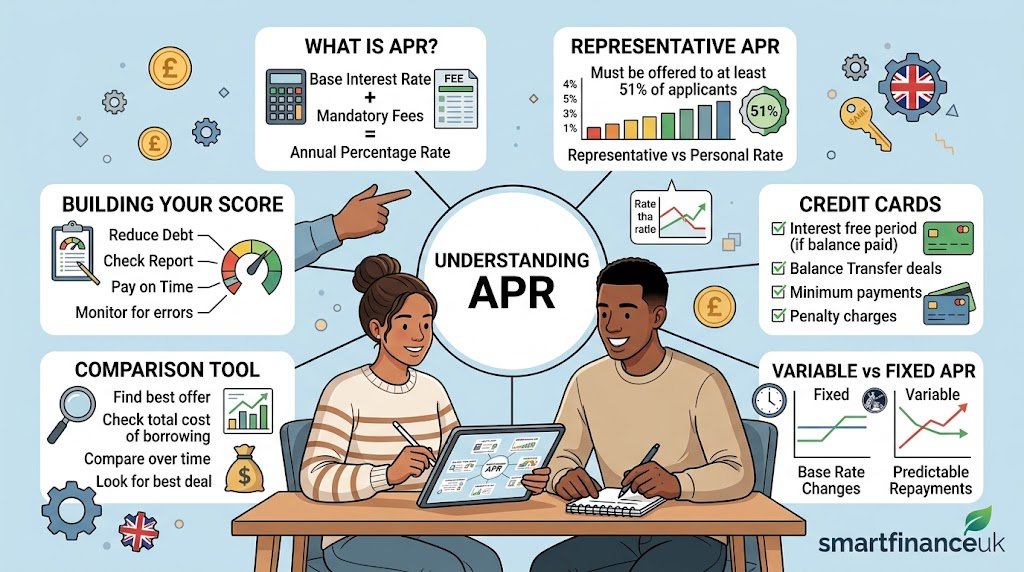
In simple terms, APR is a way of expressing the annual cost of credit as a percentage. It is intended to take account of interest and certain fees and charges associated with the borrowing, making it easier to compare credit products on a broadly like-for-like basis. MoneyHelper describes APR as showing the total amount of interest, including relevant management charges or fees, that you will pay on borrowing over a year.
For example, imagine two hypothetical personal loans:
- Loan A has an APR of 8%.
- Loan B has an APR of 14%.
If the borrowing amount, repayment period and other terms were otherwise comparable, Loan A would generally represent the lower annual cost of borrowing.
But real credit products are not always identical. The amount borrowed, repayment period, fees, promotional periods and other terms can affect the total amount you actually pay.
That is why APR is useful as a comparison measure, but it should not be used in isolation.
What Is the Difference Between APR and an Interest Rate?
The interest rate tells you the rate of interest charged on the money you borrow.
APR goes further by incorporating certain costs associated with the credit.
Imagine a lender offers a hypothetical loan with an interest rate of 9%, but there is also a compulsory arrangement fee. Another lender offers a loan at 9.5% with no equivalent fee.
Looking only at the interest rate could make the first loan appear cheaper.
Looking at the APR may provide a more useful comparison because certain compulsory fees are incorporated into the APR calculation.
MoneyHelper recommends looking at both the interest rate and APR when comparing borrowing, as well as checking the total amount you will repay and other possible charges.
The distinction matters because a product with a lower advertised interest rate is not automatically cheaper overall.
Why Does APR Matter When Borrowing Money?
APR matters because borrowing costs can be difficult to compare when lenders present information in different ways.
One lender might advertise an attractive interest rate but charge a fee. Another might have a slightly higher interest rate but fewer compulsory charges.
APR provides a standardised percentage intended to make these costs easier to compare.
The Financial Conduct Authority says APR indicates the yearly cost of borrowing, including interest and fees. The FCA has also been reviewing how APR information is presented because research found that consumers can struggle to understand what APR means and how it relates to the total cost of borrowing.
This is an important point for borrowers: APR is useful, but it is not the whole borrowing decision.
You should still look at the actual repayment schedule and total amount payable.
What Is a Representative APR?
You may have seen phrases such as “Representative APR 9.9%” when looking at loans or credit cards.
A representative APR is an advertised rate that does not necessarily mean every successful applicant will receive that exact rate.
For many regulated credit products, representative APR advertising is based on the rate or better being offered to at least 51% of successful applicants. The remaining successful applicants may receive a higher rate, depending on the product and the lender’s assessment.
This is why you should never assume that an advertised representative APR is automatically your personal rate.
Your actual rate may depend on the lender’s assessment of your application and circumstances.
For example, a lender might advertise a hypothetical personal loan at 7.9% representative APR. You could qualify for the product but be offered a higher rate.
Checking your eligibility before making a formal application can sometimes help you understand whether a particular deal is likely to be available to you.
A Simple Example of How APR Can Help
Suppose you are comparing two hypothetical personal loans.
Loan A:
- Amount borrowed: £5,000
- Interest rate: 8%
- Arrangement fee: £150
- Repayment period: 3 years
Loan B:
- Amount borrowed: £5,000
- Interest rate: 8.5%
- No arrangement fee
- Repayment period: 3 years
If you only compare the interest rates, Loan A appears cheaper because 8% is lower than 8.5%.
However, Loan A has an additional fee.
The APR calculation is designed to take relevant compulsory charges into account, which can make the comparison more informative.
The exact APR and total repayment would need to be calculated using the actual terms of the products. The figures above are purely hypothetical and are not current market rates.
The wider lesson is simple: do not compare borrowing products using the interest rate alone.
Does a Lower APR Always Mean a Cheaper Loan?
Not necessarily in every situation.
APR is designed to help compare borrowing costs, but the actual amount you pay can depend on how much you borrow, how long you borrow it for and the specific terms of the agreement.
MoneyHelper advises borrowers to look at the total amount they will repay, as well as the interest rate and APR.
This matters because the length of the borrowing can have a significant effect.
Imagine two hypothetical loans for the same amount:
One has a relatively low APR but runs for five years.
The other has a slightly higher APR but is repaid over two years.
The first loan may have a lower monthly payment, but the longer repayment period could mean a different total cost.
The monthly payment therefore should not be the only figure you compare.
APR and the Total Amount Repayable
The total amount repayable tells you how much you would pay back over the agreed term, based on the assumptions and terms of the credit agreement.
This can be one of the most useful figures to examine alongside APR.
Suppose a hypothetical loan offers a relatively attractive APR but stretches repayments over several years. The monthly payment might look manageable, but you could pay interest for a much longer period.
A shorter loan might have higher monthly repayments but result in a lower total amount paid.
That does not automatically make the shorter loan better for every borrower. The higher monthly payment could place more pressure on a household budget.
The right question is therefore not simply:
“Which loan has the lowest APR?”
It is also:
“What will I pay in total, and can I comfortably afford the repayments?”
APR on Credit Cards
APR is also commonly used with credit cards.
However, credit cards can be more complicated to compare than straightforward fixed-term loans because the amount borrowed and repayment pattern can change.
A credit card APR can help you understand the cost of carrying a balance, but your actual interest costs depend on how much you owe, when you make payments and the terms of your particular card.
If you pay your balance in full according to the card’s terms, you may avoid purchase interest on many cards, depending on how the card works.
If you carry a balance, interest can increase the amount you owe.
Minimum payments are particularly important. MoneyHelper warns that making only minimum payments can mean it takes longer to clear a credit card balance and can increase the total cost.
This is why looking at the APR alone does not tell you how much interest you personally will pay.
APR and Overdrafts
Overdrafts are another form of borrowing where understanding the annual rate can be useful.
An arranged overdraft allows you to borrow up to an agreed limit through your current account, subject to your bank’s terms.
MoneyHelper explains that overdraft interest is charged at an annual interest rate, making it easier to compare the cost between accounts.
However, an overdraft is generally designed for short-term borrowing rather than a long-term replacement for income.
If you regularly remain overdrawn for much of the month, calculate how much the borrowing is costing you and consider whether there is a recurring gap in your household budget.
APR and Mortgages: Be Careful With the Terminology
Mortgages require a slightly different explanation.
You may encounter APRC, meaning Annual Percentage Rate of Charge, rather than simply APR.
The FCA explains that APRC is used to show the annual cost of a mortgage over its lifetime and incorporates relevant charges associated with the mortgage borrowing.
Mortgage comparisons can be complicated because a mortgage may have an initial fixed or discounted period followed by a different rate, as well as fees and other costs.
For that reason, mortgage borrowers should look at the mortgage’s full illustration and repayment details rather than relying on a single percentage.
When comparing mortgages, consider the initial rate, what happens afterwards, product fees, repayment method, term and total cost.
Why the Loan Term Matters
The repayment period can have a major effect on the total cost of borrowing.
A longer term generally spreads repayments over more time. This can reduce the monthly payment, but it can also mean interest is charged for longer.
A shorter term can result in higher monthly payments but may reduce the period over which interest accumulates.
Consider a purely hypothetical £10,000 loan.
You might compare a three-year term with a five-year term. The five-year option could have a lower monthly payment, but that does not automatically mean it is cheaper overall.
The actual figures depend on the interest rate, APR, fees and repayment structure.
This is why a sensible comparison should include both monthly affordability and total cost.
What Should You Check Besides APR?
APR is important, but there are several other details worth checking before borrowing.
Total Amount Repayable
Find out how much you will repay over the full term.
This gives you a clearer idea of the financial commitment than the monthly payment alone.
Monthly Repayment
Make sure the required repayment fits comfortably within your household budget.
Do not base affordability solely on your current circumstances if there is a realistic possibility that your income or essential expenses could change.
Fees and Charges
Check whether there are arrangement, application, late-payment, early-repayment or other charges.
Not every possible charge will necessarily be included in the APR calculation in the same way, so read the agreement carefully.
Fixed or Variable Rate
Find out whether the interest rate can change.
A variable rate can make future repayments less predictable.
Promotional Rates
If a product advertises a special introductory rate, check how long it lasts and what happens afterwards.
A 0% or reduced-rate period should never be treated as though it lasts for the entire life of the borrowing unless the agreement actually says so.
Consequences of Missing Payments
Understand what happens if you fail to make a payment.
There may be additional charges, and payment information can potentially affect your credit history.
Common Mistakes When Comparing APR
One common mistake is assuming the advertised APR will definitely be the rate you receive.
A representative APR is not necessarily a personal guaranteed rate.
Another mistake is choosing a product solely because it has the lowest APR.
A lower APR can be useful, but the total repayment, loan term, fees and affordability still matter.
Some borrowers also compare monthly payments without considering how long they will be making those payments.
A low monthly payment can look attractive because it puts less pressure on the household budget today. But if it results from a much longer repayment period, you could pay more overall.
It is also easy to confuse APR with the amount of interest you will personally pay. APR is an annualised comparison measure. Your actual interest cost depends on the product terms and how the borrowing is repaid.
How to Compare Borrowing More Carefully
A useful comparison process is straightforward.
Start by deciding how much you actually need to borrow.
Then check whether borrowing is affordable within your normal household budget.
Compare the APRs of suitable products, but also check the total amount repayable, monthly payment and repayment period.
Look for additional fees and charges.
Check whether the advertised rate is representative rather than guaranteed.
If available, consider using an eligibility checker before making a formal application. MoneyHelper notes that eligibility checks can help consumers assess whether they are likely to qualify without necessarily leaving a hard search on their credit file.
Finally, read the agreement before accepting the credit.
If you do not understand an important term, ask the provider to explain it.
A Practical UK Example
Imagine that James wants to borrow £6,000 for a planned household expense.
He finds two hypothetical loan offers.
The first has a lower advertised APR but a longer repayment term.
The second has a slightly higher APR but a shorter term and a different monthly repayment.
James initially focuses on the lower APR. After checking the repayment schedules, he realises that the lower-APR option does not necessarily mean the lowest total cost in the circumstances he is comparing.
He then looks at the total amount repayable and monthly payment for both options.
This example does not identify a universally better loan. It demonstrates why APR should be considered alongside the repayment period, total cost and affordability.
When Should You Avoid Taking More Credit?
APR can help you compare borrowing, but it cannot tell you whether you should borrow in the first place.
If you are already struggling with household bills or existing debt repayments, taking another loan may make the situation harder.
MoneyHelper advises people who are struggling with bills or existing borrowing to seek help rather than simply taking on further credit.
A warning sign is when new borrowing is being used repeatedly to pay for ordinary living costs or existing debts.
Another is when you can make the minimum payments but have no realistic way of reducing the overall debt.
If you are in this situation, consider seeking free debt guidance before applying for more credit.
Questions to Ask Before Borrowing
Before agreeing to credit, ask yourself:
What is the APR?
This helps you compare the annualised cost with other borrowing options.
Is the advertised APR representative or guaranteed for me?
Do not assume that an advertised representative rate is automatically your personal rate.
How much will I repay altogether?
Look at the total amount payable, not just the interest rate.
How long will I be making repayments?
A longer term can reduce monthly payments but may increase the overall cost.
Are there additional fees?
Check the agreement for arrangement, late-payment, early-repayment or other applicable charges.
Is the interest rate fixed or variable?
If it can change, consider whether you could still afford the repayments if the rate increased.
Can I comfortably afford the repayments?
A lender approving credit does not necessarily mean the borrowing is comfortable for your household budget.
Frequently Asked Questions
Is APR the same as an interest rate?
No. An interest rate describes the rate charged on the amount borrowed, while APR is designed to represent the annual cost of credit and can include certain fees and charges. This makes APR useful when comparing borrowing products. However, you should still check the total amount repayable, repayment term and other conditions before deciding which credit product is suitable.
Is a lower APR always better?
A lower APR is generally helpful when comparing otherwise similar borrowing products, but it is not the only factor that matters. The amount borrowed, repayment period, fees, monthly payment and total amount repayable can all affect the overall cost. MoneyHelper recommends considering APR alongside the total amount you will repay and other borrowing costs.
What does representative APR mean?
A representative APR is an advertised rate that does not necessarily apply to every customer who is accepted. For many regulated credit products, at least 51% of successful applicants must receive that rate or better, while other successful applicants can be offered a higher rate.
Why can a loan with a lower monthly payment cost more?
A lower monthly payment can result from spreading the borrowing over a longer period. Although this may make each individual payment smaller, interest can be charged for longer. As a result, the total amount repaid may be higher. Always compare the repayment term and total amount repayable rather than judging a loan solely by its monthly payment.
Does APR include every possible fee?
APR incorporates certain costs associated with borrowing, but you should still read the agreement and check all applicable charges. Different types of credit can have different fees and assumptions used in the APR calculation. The FCA sets rules governing how APR is calculated for regulated credit agreements.
Can I compare APRs on every type of borrowing?
APR can be useful for comparing many forms of consumer credit, but products can have different structures and features. Mortgages, for example, commonly use APRC, which is calculated differently and reflects the annual cost of mortgage borrowing over its lifetime. Always compare products using the information and calculations relevant to that particular type of credit.
Should I choose a loan with the lowest APR?
Not automatically. The lowest APR may be attractive, but you should also consider whether the borrowing is affordable, how much you will repay in total, how long the agreement lasts and whether there are additional costs. If you are already struggling with existing debts, taking further borrowing may not be appropriate, regardless of the APR.
Final Thoughts
APR is one of the most useful figures to understand when comparing borrowing in the UK. It provides an annualised measure of the cost of credit and can take certain fees into account, making it more informative than looking at an interest rate alone.
But APR should not become the only number you consider.
Check the total amount repayable, monthly repayment, loan term, fees, rate type and any promotional conditions. If an advertised rate is representative, remember that it may not be the rate you personally receive.
Most importantly, separate two questions: “Which borrowing costs less?” and “Can I comfortably afford to borrow at all?”
The first is a comparison question. The second is an affordability question, and it should come first.
This article provides general educational information and is not personalised financial advice.
Sources and Further Reading
- MoneyHelper — Interest rates explained
- MoneyHelper — Do you need to borrow money?
- MoneyHelper — Managing credit well
- MoneyHelper — Personal loans
- Financial Conduct Authority — APR research and consumer understanding
- FCA Handbook — APR calculation rules
SEO Information
SEO Title: What Is APR? A UK Guide to Borrowing Costs
Meta Description: Learn what APR means, how it differs from an interest rate, and why APR matters when comparing loans, credit cards and other UK borrowing.
URL Slug: what-is-apr
Primary Keyword: what is APR
Secondary Keywords:
APR explained UK, annual percentage rate, APR vs interest rate, representative APR, borrowing costs, loan APR
Search Intent: Informational / Educational / Practical
Suggested Featured Image Concept:
An original editorial illustration showing a UK borrower comparing two fictional loan offers on a laptop. Display simple fictional figures for APR, monthly repayment, loan term and total amount repayable, with a calculator and £ symbols nearby. Avoid using real lender branding or real financial product rates.
Suggested Internal Links
Suggested internal article: Simple Habits That Can Help You Manage Credit Responsibly
Suggested anchor text: manage credit responsibly
Suggested internal article: How to Check Your Credit Report and Understand the Information on It
Suggested anchor text: check your credit report
Suggested internal article: How Credit Card Interest Works and Why Balances Can Grow
Suggested anchor text: understand credit card interest
Suggested internal article: How to Understand the Total Cost of Borrowing Before Taking Credit
Suggested anchor text: understand the total cost of borrowing
Suggested internal article: How to Review Your Debts and Organise Your Monthly Repayments
Suggested anchor text: review your debts and repayments