
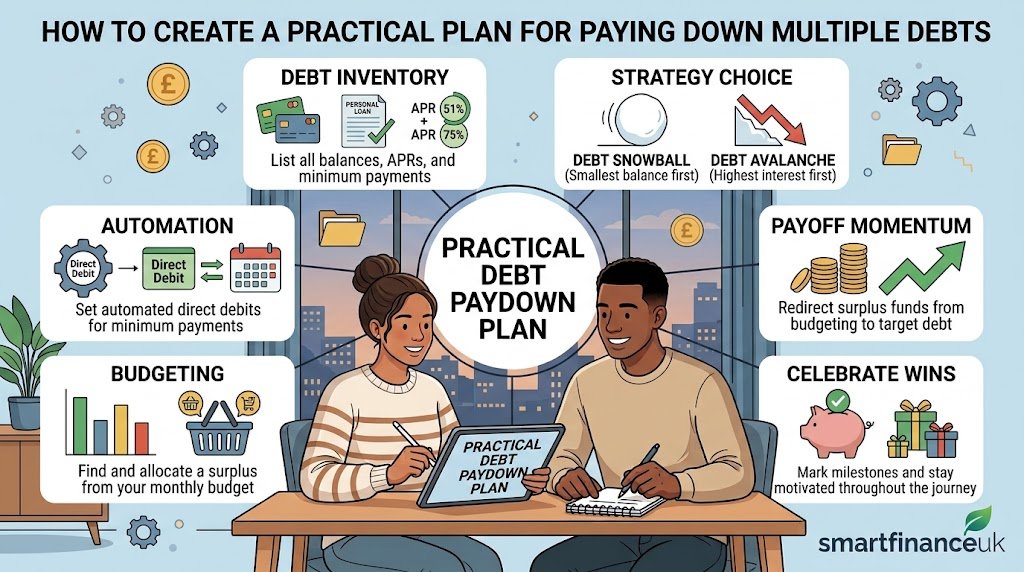
Having several debts at the same time can make your finances feel difficult to organise. You may have a credit card balance, personal loan, overdraft, car finance or other borrowing, each with a different balance, interest rate and repayment date.
The problem is not always the total amount owed. Sometimes it is simply that there is no clear system for managing everything.
A practical debt repayment plan can help you see the full picture, protect essential household spending and decide how to direct any money available for additional repayments. It can also help you recognise when your debts are becoming difficult to manage and when free debt advice may be appropriate.
There is no single repayment method that is right for every household. Your income, essential costs, interest rates, arrears, debt type and financial circumstances all matter.
This guide explains how to organise multiple debts, create a realistic repayment budget, compare different repayment approaches and avoid common mistakes when trying to reduce what you owe.
What Does a Debt Repayment Plan Involve?
A debt repayment plan is a structured way of managing money owed to creditors.
At its simplest, it involves knowing:
- who you owe money to
- how much you owe
- what interest or charges apply
- what payment is required
- when each payment is due
- how much money you can realistically put towards your debts
The aim is not necessarily to pay every debt at exactly the same rate.
Instead, you first need to make sure essential household costs and required debt payments are accounted for. If there is money left over, you can decide how to use it towards reducing your debts.
For some people, this can be done independently with a household budget. For others, particularly where payments are already being missed, professional debt advice may be needed.
MoneyHelper recommends getting help if you are struggling to manage your debts rather than waiting until the situation becomes more serious. (moneyhelper.org.uk)
Start by Listing Every Debt
The first practical step is to stop relying on memory.
Create a complete list of your debts.
For each one, record the creditor, outstanding balance, interest rate, minimum or contractual payment, payment date and type of borrowing.
For example, a hypothetical household might have:
| Debt | Balance | Interest/Cost | Required Payment |
|---|---|---|---|
| Credit card | £2,400 | Variable | £75 |
| Personal loan | £6,000 | Fixed | £190 |
| Overdraft | £700 | Variable | Depends on account |
| Car finance | £4,500 | Fixed | £165 |
These figures are entirely hypothetical and are not current market rates.
The purpose of the table is to show why adding debts together can be useful.
The household may think about four separate debts. The table shows the total amount owed and the monthly commitments in one place.
Do not leave out smaller debts. A £300 balance is still part of your financial picture.
Separate Essential Bills From Debts
Before deciding how much to pay towards debts, identify essential household expenses.
These can include housing costs, council tax, energy, food, transport and other necessary expenses.
Some debts and bills can have particularly serious consequences if they are not paid. MoneyHelper distinguishes between priority and non-priority debts because failing to pay certain priority debts can put essential services, housing or other important aspects of your situation at risk. (moneyhelper.org.uk)
This is important because the debt with the highest interest rate is not automatically the debt that should receive every available pound.
For example, mortgage or rent arrears can have consequences that are very different from an unsecured credit card balance.
If you are behind on essential bills or priority debts, seek appropriate advice rather than focusing only on interest rates.
Work Out How Much You Can Afford to Repay
Once you know your debts and essential expenses, calculate what is realistically available.
Start with your regular household income.
Then subtract essential living costs and required debt repayments.
The amount remaining is not automatically your debt overpayment budget.
You also need to allow for irregular expenses and a reasonable amount for everyday spending. A budget that leaves no room for an unexpected cost may look efficient on paper but be difficult to maintain.
For example, suppose a hypothetical household has £3,000 of monthly income.
After essential household expenses and required debt payments, £250 remains.
That does not necessarily mean the household should commit the entire £250 to additional debt repayment every month.
If an annual insurance bill, car repair or other predictable irregular expense is approaching, some of the available money may need to be set aside.
A successful debt plan needs to be realistic enough to continue.
Stop the Debt From Growing Where Possible
Paying down debt becomes much harder when new borrowing is being added at the same time.
Suppose you repay £300 from a credit card balance but then spend another £250 on the same card.
You have technically made a payment, but most of the progress has been reversed.
This does not mean every credit card must immediately be cancelled or every form of borrowing must stop. Some accounts may be necessary for particular circumstances.
The important question is whether new borrowing is undermining the repayment plan.
If credit is being used to cover normal household expenses because income does not cover essential costs, that is a different problem from using a card occasionally for planned spending.
Repeated borrowing to cover ordinary living costs can be a warning sign that the budget needs attention or that debt advice may be appropriate.
Choose a Repayment Method
Once your essential payments are covered and you know what you can realistically afford, you can consider how to direct additional repayments.
Two commonly discussed approaches are the highest-interest method and the smallest-balance method.
Highest-Interest Method
With this approach, you make the required payment on each debt and direct additional money towards the debt with the highest interest rate or borrowing cost.
Once that debt is cleared, you redirect the money that had been going towards it to the next debt.
The potential advantage is that expensive borrowing is targeted first.
For example, imagine three hypothetical debts:
- Credit card: £2,000 at a high interest rate
- Personal loan: £5,000 at a lower fixed rate
- Interest-free family borrowing: £1,000
After making required payments, you could direct additional money towards the credit card first because it is the most expensive debt in this example.
The exact financial benefit depends on the actual rates, balances and terms.
Smallest-Balance Method
The smallest-balance approach starts with the debt with the lowest outstanding balance.
You continue making required payments on the other debts while directing additional money towards the smallest balance.
Once it is cleared, you move the money to the next smallest debt.
The advantage is psychological as well as practical. Clearing one account can create a sense of progress and simplify the number of debts you are managing.
However, it may not minimise interest costs as effectively as prioritising the highest-cost debt.
Neither approach is universally right.
The important thing is to choose a method you understand and can maintain.
Do Not Ignore the Interest Rate
When comparing debts, interest matters because it determines how expensive it is to carry the balance.
A credit card with a relatively high interest rate can become expensive if the balance remains outstanding for a long period.
A fixed-rate personal loan may have a lower borrowing cost but could have a contractual repayment schedule that you need to follow.
An overdraft may work differently again.
This is why simply ranking debts by their balances can be misleading.
A £1,000 debt with a high interest rate may cost more over time than a £3,000 debt with a much lower rate, depending on the terms.
When deciding where additional money should go, look at the actual cost of each debt rather than just the amount outstanding.
Check Whether You Can Make Overpayments
Before paying extra towards a debt, check the agreement.
Some borrowing allows additional payments without a charge. Other agreements can have rules concerning early repayment.
For certain loans, an early repayment charge may apply depending on the agreement and circumstances.
Mortgage borrowing can have particularly important early-repayment conditions, including possible early repayment charges on some products.
Do not assume that every debt can be overpaid in exactly the same way.
If you are considering a large overpayment, contact the lender and ask:
Will the additional payment reduce the balance immediately?
Will it reduce future interest?
Is there an early repayment charge?
Will my required monthly payment change?
Is there a specific process for making an overpayment?
Getting the answers first can prevent an unexpected cost.
Consider the Difference Between Interest Rates and Fees
Interest is not the only cost that can affect debt.
Some products can have fees, charges or penalties.
For example, a credit card may have a balance-transfer fee. A loan can have specific charges under its agreement. An overdraft can have its own pricing structure.
When comparing debts, look at the overall cost rather than assuming the advertised interest rate tells you everything.
Your credit agreement and statements are the best places to check the charges that actually apply to your account.
Keep Making Required Payments on Every Debt
When you choose one debt to prioritise, that does not normally mean ignoring the others.
Continue making the required payments on your other accounts.
A repayment strategy only works if the underlying agreements continue to be managed.
Missing payments can lead to charges and may affect your credit history. Depending on the type of debt, there can also be more serious consequences.
If you cannot afford all your required payments, do not simply choose which creditors to pay based on interest rates.
This is a situation where free debt advice can be particularly important.
MoneyHelper provides guidance on dealing with different types of debt and explains how to seek support when repayments become unaffordable. (moneyhelper.org.uk)
Build a Small Financial Buffer If You Can
It can seem logical to put every spare pound towards debt.
But having no money available for an unexpected essential expense can lead to new borrowing.
Suppose you use every spare pound to make an extra debt payment and then your car needs an urgent repair.
If you have no accessible savings, you may have to use a credit card or another form of borrowing to cover the cost.
A small emergency buffer can therefore sometimes make a debt repayment plan more sustainable.
There is no universal amount that every household needs. Your circumstances, income stability and essential expenses matter.
If you have serious arrears or cannot meet required payments, getting debt advice should take priority over trying to build a large savings balance.
Review Your Budget Regularly
A debt plan should not be treated as something you create once and never change.
Your income and expenses can change.
Energy bills, rent, mortgage payments, childcare, transport costs and other household expenses may increase or decrease.
A loan may eventually be paid off, freeing up money for another debt.
Your credit card balance may also change depending on spending.
Review your plan at least periodically and update the figures.
If your income increases, you might decide to direct part of the extra money towards debt.
If essential expenses rise, you may need to reduce your additional debt payment temporarily.
A flexible plan is usually more practical than one that assumes every month will look identical.
Avoid Taking New Credit Just to Make the Plan Look Better
Debt consolidation is sometimes presented as a way of combining several debts into one.
This can make repayments easier to manage, but combining debts does not automatically make them cheaper.
A consolidation loan may have a lower interest rate but a longer repayment term. There could also be fees or other costs.
Another risk is paying off credit cards with a consolidation loan and then using the cards again.
You could end up with the new loan plus new credit card balances.
If you are considering consolidation, compare the total amount repayable, interest rate, fees, repayment term and monthly payment carefully.
Do not judge the option solely because it gives you one monthly payment instead of several.
Be Careful With Balance Transfers
A balance transfer can sometimes move credit card debt to another card, potentially with a promotional interest rate.
This can be useful in some circumstances, but it is not automatically a debt solution.
Check the transfer fee, promotional period and interest rate that applies after the promotion ends.
You also need to continue making the required payments.
If you use the new card for additional spending, the balance can become more difficult to manage.
Before transferring a balance, calculate whether the arrangement actually helps you reduce the debt within the promotional period.
A Simple UK Example
Consider a hypothetical household with three debts:
Credit card: £2,500 balance with a relatively high interest rate.
Personal loan: £5,500 balance with a fixed repayment schedule.
Overdraft: £800 balance with its own borrowing costs.
The household has enough income to make the required payments but can afford an additional £200 per month.
Rather than splitting that £200 equally between all three debts, the household could choose a clear strategy.
Under a highest-interest approach, the additional £200 could be directed towards the most expensive debt while the required payments continue on the others.
Under a smallest-balance approach, the household might target the £800 overdraft first.
Both approaches can be structured sensibly. The better choice depends on the actual interest rates, fees, contractual terms and the household’s priorities.
The figures are hypothetical and are included only to demonstrate how a repayment strategy could work.
What If You Have Priority Debts?
Not every debt should be treated in the same way.
MoneyHelper describes debts such as mortgage or rent arrears, council tax arrears, gas or electricity arrears, certain court fines and some other obligations as priority debts because the consequences of not paying them can be particularly serious. (moneyhelper.org.uk)
For example, failing to pay rent or mortgage arrears can put your housing situation at risk.
This means a simple “highest interest first” strategy may not be appropriate if you have serious arrears on priority bills.
If you are behind on priority debts, seek advice before deciding how to distribute your money.
What If You Cannot Afford All Your Minimum Payments?
This is an important point.
If your budget shows that you cannot afford the required payments on your debts after essential household costs, you may need more than a DIY repayment strategy.
Do not take out another loan simply to make the payments appear manageable.
Instead, contact your creditors and seek free debt advice as soon as possible.
MoneyHelper can help explain available debt solutions and where to find free debt advice. (moneyhelper.org.uk)
Depending on where you live in the UK and your circumstances, different formal debt solutions and legal processes can apply. Scotland, for example, has debt arrangements that differ from those in England and Wales.
This is one reason general online guidance cannot replace individual debt advice where serious financial difficulties exist.
Track Your Progress
Once your repayment plan is running, track the balances.
You can update a spreadsheet each month or simply record the figures in a notebook.
Seeing a balance move from £2,500 to £2,300 and then £2,100 can make the progress visible.
However, do not judge success only by the number of accounts you have.
If you have cleared one small debt but another high-cost balance has increased, the overall situation may not have improved.
Look at your total debt as well as individual accounts.
Also record interest and charges where possible. This can help you understand how much of your payment is reducing the actual balance.
Common Mistakes When Paying Down Multiple Debts
One common mistake is making extra payments without first listing all debts.
You cannot create a useful strategy if you do not know the balances and borrowing costs.
Another mistake is paying everything equally without considering interest rates or priority status.
Equal payments can feel fair, but they are not necessarily the most efficient approach.
Some people also forget to leave room for irregular household expenses. This can lead to new borrowing when an annual bill or unexpected repair arrives.
Another mistake is assuming that debt consolidation is automatically cheaper.
Finally, avoid ignoring creditors when payments become difficult. Contacting them early and seeking free debt advice can provide more options than waiting until arrears have built up.
Practical Monthly Debt Review
A monthly review does not need to take hours.
Start by checking your current balances.
Confirm that required payments have been made.
Look at any interest or charges added during the month.
Check whether you have taken on new borrowing.
Then compare your actual spending with your budget.
If you have spare money, decide whether an additional debt payment is affordable.
If your circumstances have changed, adjust the plan rather than pretending the original budget still works.
This simple routine can help you stay aware of your financial position.
Questions to Ask Before Choosing a Debt Repayment Strategy
How much do I owe in total?
Add every debt together rather than considering accounts separately.
Which debts have the highest borrowing costs?
Check the actual interest rates and applicable fees.
Do I have any priority debts or arrears?
These may need different treatment because of the consequences of non-payment.
Can I afford every required payment?
If not, seek debt advice rather than choosing which payments to skip yourself.
Can I make additional payments without a charge?
Check each credit agreement before overpaying.
Do I have enough money for essential irregular expenses?
A plan that leaves no room for predictable costs may not be sustainable.
Am I still adding new debt?
If new borrowing continues, reducing the existing balances may be much harder.
Would consolidation actually reduce the total cost?
Compare the full cost rather than focusing only on the number of monthly payments.
Frequently Asked Questions
Should I pay the debt with the highest interest rate first?
For unsecured debts where required payments are being maintained and there are no special circumstances, targeting the highest-cost debt can reduce the amount of interest that accumulates. However, this is not suitable for every situation. Priority debts can have more serious consequences if unpaid, and some agreements have specific terms. If you cannot afford all required payments, seek debt advice rather than relying on a simple repayment method.
Is it better to pay the smallest debt first?
The smallest-balance method can make your progress easier to see because you may clear an account sooner. This can simplify your finances and provide motivation to continue. However, it may not minimise interest costs if a larger debt has a much higher rate. Compare both approaches using your actual balances, interest rates and budget before deciding which method you can realistically maintain.
Should I save money while paying off debt?
There is no universal answer. Having some accessible money for an unexpected essential expense can reduce the need to use new credit. However, expensive debt may also make it sensible to prioritise repayments. If you are behind on priority bills or cannot afford your required payments, seek debt advice before deciding how much to save or overpay.
Is debt consolidation always a good idea?
No. Consolidating several debts into one can make repayments simpler, but it does not automatically reduce the total cost. A new loan may have a longer repayment period, different fees or other conditions. There is also a risk of building new credit card balances after the old debts have been consolidated. Compare the total amount repayable, rate, fees and term before making a decision.
Should I close my credit cards after paying them off?
Not necessarily. Closing an account can have different consequences depending on your circumstances and credit history. You should not close an account simply because someone says it will automatically improve your credit score. If you are concerned about overspending, however, reducing access to unused credit may be worth considering as part of a broader financial plan.
What should I do if I cannot afford my debt repayments?
Contact your creditors and seek free debt advice as soon as possible. Do not wait until several payments have been missed, and avoid automatically taking additional borrowing to cover existing debts. MoneyHelper provides guidance on dealing with debt and can direct you towards free debt advice services. (moneyhelper.org.uk)
Does paying off debt improve my credit score?
Paying debts according to their agreements can help maintain a positive repayment history, but there is no guaranteed credit-score increase from clearing a particular debt. Credit reference agencies use their own scoring systems, while lenders use their own criteria. The main benefit of reducing debt is that you owe less and may pay less interest, depending on the debt and its terms.
Final Thoughts
Paying down several debts becomes easier to manage when you stop looking at each account separately and create a complete picture.
List every debt, identify priority bills, understand the interest rates and charges, and calculate what your household can realistically afford after essential expenses.
If you can afford additional repayments, choose a clear strategy and keep making the required payments on your other accounts. The highest-interest approach can focus on expensive borrowing, while the smallest-balance approach can provide visible milestones.
Do not forget to check whether overpayments are allowed without charges, and be cautious about consolidation or new borrowing that simply moves the debt elsewhere.
Most importantly, recognise the difference between having several manageable debts and being unable to afford the required payments. If you are struggling, free debt advice can help you understand your options before the situation becomes more serious.
This article provides general educational information and is not personalised financial advice.