
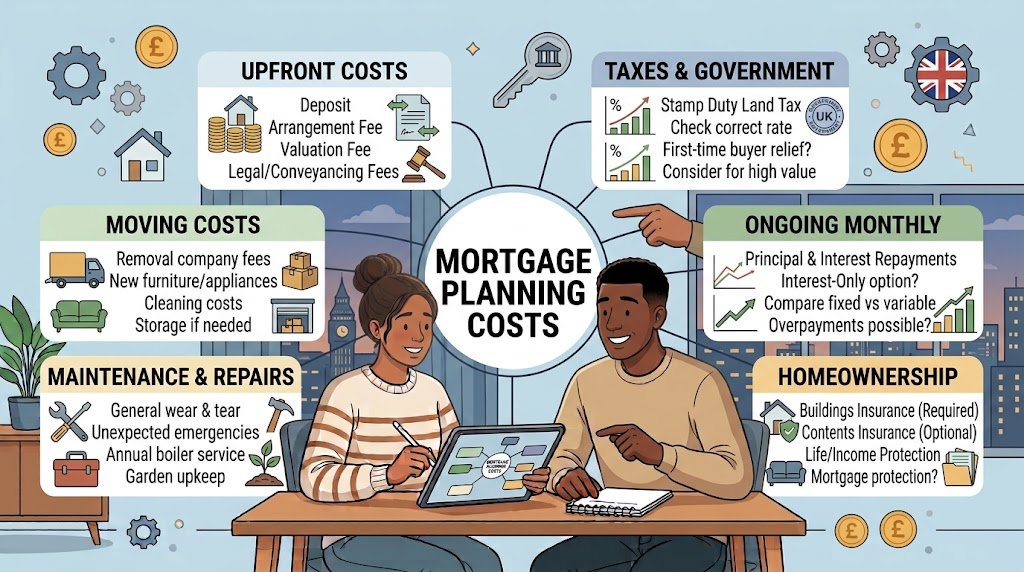
Planning for a mortgage is about much more than working out whether you can afford the monthly repayment. Buying a home in the UK can involve a deposit, mortgage fees, legal costs, surveys, taxes, insurance, moving expenses and ongoing household bills.
Some costs are paid before you complete the purchase. Others appear on completion, while some continue for as long as you own the property.
This matters because a mortgage can look affordable on paper while the wider cost of buying and running the home puts pressure on your household budget. GOV.UK specifically advises prospective buyers to consider additional costs such as taxes, surveys, solicitor’s fees, mortgage fees, search fees and land registration fees, as well as ongoing costs such as Council Tax and household bills.
Understanding these costs before you make an offer can help you build a more realistic budget and reduce the chance of being caught out by expenses you had not considered.
This article provides general educational information and is not personalised mortgage or financial advice.
The Main Costs to Include in Your Mortgage Budget
A useful way to plan is to divide the costs into three groups:
Upfront costs: money needed before or around the property purchase.
Mortgage-related costs: charges connected with arranging and maintaining the mortgage.
Ongoing costs: expenses you will continue paying after you become a homeowner.
The exact amounts vary considerably depending on the property, lender, location and your circumstances. MoneyHelper notes that buying or selling a home can involve more than £5,000 in fees in some circumstances, excluding the deposit and Stamp Duty or Land Tax.
That is why it is risky to assume that your deposit is the only significant amount you need to save.
Your Mortgage Deposit
The deposit is usually the largest upfront cost.
It is the part of the property’s purchase price that you pay yourself rather than borrowing through the mortgage.
For example, imagine a hypothetical home costing £300,000.
If you had a £45,000 deposit, you would need a £255,000 mortgage.
Your deposit would therefore represent 15% of the purchase price.
The larger the deposit, the less you need to borrow. It can also affect your loan-to-value ratio and the mortgage products available to you.
However, there is an important planning point here: do not automatically assume that every pound you have saved should go towards the deposit.
You may also need money for legal work, surveys, tax, moving costs, insurance and unexpected expenses.
Keeping some money available after completion can be valuable because homeownership brings costs that renters may not have had to deal with directly.
Mortgage Arrangement or Product Fees
Some mortgage products come with a fee for arranging the mortgage.
You may hear this described as a:
- product fee
- arrangement fee
- mortgage fee
The amount and structure vary between mortgage products.
Some mortgages may have no product fee but a different interest rate, while another mortgage may charge a fee but offer a different rate.
This means you should not compare mortgages based solely on the advertised interest rate.
Look at the overall cost over the period you expect to hold the mortgage deal.
A mortgage fee may sometimes be added to the mortgage rather than paid upfront. If you do this, remember that you are borrowing the fee and may pay interest on it over the mortgage term.
The precise treatment depends on the lender and mortgage product.
Mortgage Broker or Adviser Fees
If you use a mortgage broker or adviser, check whether you will be charged a fee.
Some advisers may be paid through commission from lenders, while others may charge the customer a fee. The arrangement should be explained before you proceed.
Ask:
Will I pay a fee?
When is it payable?
Is it refundable if the mortgage does not complete?
How is the adviser paid?
Do not assume that every mortgage adviser operates under the same fee structure.
If you are using a broker, check the terms carefully before agreeing to their service.
Mortgage Valuation
A mortgage lender will generally want a valuation of the property before deciding whether to lend against it.
The valuation is primarily for the lender’s purposes.
It should not automatically be treated as a detailed inspection of the home’s condition.
This distinction is important.
A lender may be satisfied with the property as security while there are still defects that a buyer would want to know about.
Depending on the lender and mortgage product, a valuation may be included without a separate charge, but this varies.
Check the mortgage offer or lender’s fee information rather than assuming it is always free.
Survey Costs
A property survey is different from a mortgage valuation.
A survey can provide information about the condition of the property and potential problems that may not be obvious during a normal viewing.
The appropriate type of survey depends on factors such as the property’s age, condition, construction and your concerns about it.
For example, an older property may warrant more detailed investigation than a relatively new home.
MoneyHelper lists surveyor’s fees among the costs buyers may need to consider.
A survey is an additional expense, but finding a significant problem before exchanging contracts can potentially give you an opportunity to investigate it further and make a more informed decision.
The survey does not guarantee that every defect will be discovered.
Solicitor and Conveyancing Costs
Buying a property involves legal work.
A solicitor or licensed conveyancer can deal with matters such as checking the legal title, carrying out searches, reviewing the contract and handling the transfer of ownership.
The final bill can depend on the property and transaction.
For example, a straightforward freehold purchase may involve different work from a leasehold purchase.
Before instructing a solicitor or conveyancer, ask for a clear estimate of the expected costs.
Find out whether the quote includes:
- legal fees
- VAT where applicable
- searches
- Land Registry-related costs
- bank transfer charges
- leasehold work
- additional legal work if complications arise
A very low headline quote may not represent the final amount if important services are charged separately.
GOV.UK specifically identifies solicitor’s fees, search fees and land registration fees as costs that buyers may need to consider.
Property Search Fees
Property searches provide information about matters that could affect the property or surrounding area.
The searches required can vary according to the location and property.
Your conveyancer will normally explain which searches are needed.
Do not assume that a search is unnecessary simply because the property appears straightforward from a viewing.
The purpose is to uncover information that may not be visible from the property itself.
Search costs should therefore be included in your buying budget rather than treated as an unexpected legal expense.
Stamp Duty and Other Property Taxes
Property taxes differ across the UK.
In England and Northern Ireland, the relevant purchase tax is Stamp Duty Land Tax (SDLT).
In Scotland, buyers generally deal with Land and Buildings Transaction Tax (LBTT).
In Wales, the equivalent is Land Transaction Tax (LTT).
GOV.UK confirms that SDLT does not apply in Scotland or Wales, where separate systems operate.
The amount of tax you may owe can depend on the property price, whether you are a first-time buyer, whether you already own another property and other circumstances.
Because tax rules and thresholds can change, avoid relying on an old calculator or article when planning a current purchase.
For England and Northern Ireland, HMRC’s current SDLT guidance sets out different rates for single-property purchases, first-time buyers and additional properties.
If you are buying in Scotland or Wales, use the relevant government guidance for that country.
Buildings Insurance
Mortgage lenders commonly require appropriate buildings insurance because the property acts as security for the mortgage.
Buildings insurance generally relates to the structure of the property rather than your personal belongings.
The policy may cover specified risks according to its terms.
Do not assume every policy provides identical protection.
Check what is covered, exclusions, excesses and the conditions attached to the policy.
If you are buying a leasehold flat, the arrangements can be different because buildings insurance may be organised through the building’s management arrangements or service charge.
MoneyHelper includes home insurance among the costs associated with buying and owning a property.
Contents Insurance
Contents insurance is separate from buildings insurance.
It is intended to cover eligible personal belongings against insured risks, subject to the policy’s terms.
For example, your furniture, electrical items and other possessions may be relevant to a contents policy.
It is worth considering the replacement cost of the belongings you would need to replace if they were damaged or stolen.
Do not assume that a buildings policy automatically protects everything inside your home.
The two types of cover serve different purposes.
Life Insurance and Mortgage Protection
You may also come across life insurance or mortgage protection when arranging a mortgage.
These are not the same as buildings insurance.
Life insurance can provide a payment to beneficiaries if the insured person dies, subject to the policy terms. This can be particularly relevant where a household relies on one or more people’s income to meet the mortgage.
However, the need for and type of protection depends on individual circumstances.
Some mortgage-related protection products can also cover specific circumstances such as illness or unemployment, but the terms, exclusions and eligibility requirements vary considerably.
Do not assume that a product described as “mortgage protection” covers every situation in which you cannot make a mortgage payment.
Read the policy carefully and consider professional advice if you are unsure what type of protection is appropriate.
Estate Agent Costs
If you are buying your first home and do not currently own a property, you normally will not have an estate agent’s selling fee yourself.
However, if you are selling an existing home at the same time as buying another, estate agent fees can become part of the overall moving cost.
MoneyHelper includes estate agent fees among the potential costs involved when buying or selling a home.
This is one reason the cost of moving house can be substantially higher for someone selling and buying than for a first-time buyer.
Moving Costs
The physical move itself costs money.
Depending on your circumstances, you might need to pay for:
- a removals company
- van hire
- packing materials
- storage
- temporary accommodation
- cleaning
- new furniture
- changing locks
- utility setup or changes
GOV.UK includes removals among the practical costs associated with buying a home.
You do not necessarily need to spend heavily on these services, but they should still be considered when calculating the amount of money you need to have available.
Leasehold Service Charges
If you are buying a leasehold property, particularly a flat, there may be ongoing service charges.
These can contribute towards costs associated with maintaining and managing shared parts of the building.
The amount can vary significantly between properties.
Before buying a leasehold property, find out:
- the current service charge
- what it covers
- whether it has changed recently
- whether major works are planned
- whether there are other administration charges
- what the lease says about future payments
GOV.UK notes that leasehold buyers may have service charges and ground rent to consider.
A property with a seemingly affordable mortgage payment can have substantially different overall housing costs from another property once service charges are included.
Ground Rent
Some leasehold properties can also involve ground rent.
The position depends on the property, lease and applicable rules.
Do not assume that every leasehold property has the same ground-rent arrangements.
Ask your solicitor or conveyancer to explain the relevant terms before committing to the purchase.
The important budgeting principle is simple: look beyond the mortgage payment when comparing properties.
Council Tax
Once you own and occupy a property, Council Tax becomes one of the regular household costs in England, Wales and Scotland.
Northern Ireland has a different local property taxation system, with domestic rates administered by Land & Property Services.
The amount you pay depends on the property and applicable local rules.
GOV.UK specifically lists Council Tax among the ongoing costs that homeowners should consider.
When preparing a mortgage budget, add the relevant local charge to your monthly household expenses rather than treating the mortgage as the complete cost of housing.
Energy and Water Bills
Owning a home means continuing to pay for household services.
These can include:
- electricity
- gas
- heating
- water
- broadband
- other communications services
The cost can vary greatly depending on the property.
A large detached house with poor energy efficiency could have very different heating costs from a smaller, well-insulated flat.
This is worth considering when comparing properties.
A slightly cheaper home is not necessarily cheaper to run.
Repairs and Maintenance
One cost that is easy to underestimate is maintenance.
As a homeowner, you are generally responsible for maintaining the property, subject to the nature of the property and any relevant lease or management arrangements.
Possible costs include:
- boiler repairs
- roof maintenance
- plumbing
- electrical work
- appliance replacement
- decorating
- window repairs
- garden maintenance
- structural repairs
Not every expense will occur every year.
The problem is that major repairs can be expensive when they do arise.
This is why it can be sensible to think about maintenance when deciding how much mortgage you can comfortably afford.
A Simple Hypothetical Mortgage Budget
Imagine a fictional buyer purchasing a £300,000 home.
They have saved £50,000.
Instead of assuming that the entire £50,000 can be used as a deposit, they first create a separate budget for buying costs.
For example:
Deposit: £40,000
Legal and conveyancing costs: Allowance required based on quotes
Survey: Allowance based on the chosen survey
Mortgage-related fees: Check the selected mortgage
Property tax: Calculate based on location and circumstances
Moving costs: Obtain quotations
Insurance: Obtain actual policy quotes
Emergency cash: Amount based on household circumstances
The £10,000 difference between the original savings and deposit in this hypothetical example is not presented as a recommended amount. It simply demonstrates why buyers should calculate additional costs before deciding how much of their savings to put into the deposit.
The actual amounts will vary considerably.
Think About the Cost After the Mortgage Completes
Your budget should not stop at the completion date.
Once you move in, your regular housing costs could include:
Mortgage payment
Council Tax or relevant local charge
Energy and water
Buildings or contents insurance
Maintenance
Service charges, if applicable
Ground rent, where applicable
Broadband and other household services
These costs can make a significant difference to how comfortable the mortgage is within your household budget.
A useful exercise is to estimate the full monthly cost of owning the property rather than asking only:
“Can I afford the mortgage?”
A better question is:
“Can I comfortably afford the home?”
What Happens If Mortgage Rates Change?
Your mortgage rate can affect your monthly payment and the overall cost of borrowing.
With a fixed-rate mortgage, your rate remains fixed for the agreed period.
With certain variable or tracker mortgages, the rate can change according to the product’s terms.
Even after a fixed-rate period, your future payment may differ from the payment you are making during the initial deal.
When planning a mortgage, therefore, consider what happens when the initial rate ends.
Do not build a budget that only works under the most favourable possible interest-rate conditions.
Consider Early Repayment Charges
Some mortgages impose an early repayment charge if you repay all or part of the mortgage during a particular period.
The exact rules depend on the mortgage agreement.
If you expect to move home, refinance or make large overpayments, check the mortgage’s early repayment conditions before signing.
A mortgage with a slightly lower interest rate may not necessarily be the most suitable option if its other costs or restrictions do not fit your circumstances.
This is another reason to compare the overall terms rather than focusing on one number.
Common Mortgage Cost Mistakes to Avoid
Budgeting Only for the Deposit
The deposit may be the largest upfront cost, but it is not the only one.
Legal work, surveys, tax, mortgage fees and moving expenses can all add to the amount required.
Looking Only at the Interest Rate
The lowest advertised rate does not automatically mean the lowest overall cost.
Consider fees, the length of the deal and other mortgage conditions.
Forgetting Property Taxes
Tax treatment differs between England, Wales, Scotland and Northern Ireland.
Check the rules that apply to your property.
Ignoring Leasehold Charges
A low mortgage payment can be offset by substantial service charges or other property costs.
Ask for the relevant information before proceeding.
Spending Every Pound of Savings
Moving into a home with no accessible money left can make an unexpected repair or household expense much harder to handle.
Assuming a Mortgage Valuation Is a Full Survey
A lender’s valuation is not necessarily a detailed inspection of the property’s condition.
Understand what service you are paying for.
Underestimating Moving Costs
Removals, storage, cleaning and other moving expenses can add up.
Obtain quotations where possible.
A Practical Mortgage Cost Checklist
Before committing to a property, check whether you have considered:
Deposit
Mortgage product or arrangement fee
Mortgage adviser fee, if applicable
Mortgage valuation
Survey
Solicitor or conveyancer
Property searches
Land Registry or relevant registration costs
Stamp Duty, LBTT or LTT, depending on location
Buildings insurance
Contents insurance
Life or other protection, if appropriate
Estate agent fees if selling another property
Removal and moving costs
Leasehold service charges
Ground rent where applicable
Council Tax or local rates
Energy and water bills
Broadband and other household services
Repairs and maintenance
Emergency savings
You do not need to know the exact final figure for every item immediately. The purpose of the checklist is to make sure that nothing important is missing from your initial budget.
Questions to Ask Before Choosing a Mortgage
Before accepting a mortgage, consider asking:
What is the total amount I will need upfront?
Include the deposit, taxes, legal costs, survey and other purchase expenses.
What are the mortgage’s fees?
Check whether fees are paid upfront or added to the mortgage.
What will my monthly payment be?
Make sure you understand how the payment is calculated.
When does the initial mortgage rate end?
Record the date so you can review your position before the deal expires.
What happens if interest rates rise?
Consider whether your household could manage higher payments where applicable.
Are there early repayment charges?
This matters if you expect to overpay, refinance or move.
What other property costs will I have?
Ask about service charges, ground rent, insurance and expected maintenance.
Which property tax applies to me?
Check the rules for England, Wales, Scotland or Northern Ireland.
How much cash will I have left after completion?
A deposit should not be considered in isolation from your wider financial position.
Frequently Asked Questions
What are the main costs of getting a mortgage in the UK?
The main costs can include the deposit, mortgage fees, valuation or survey costs, legal and conveyancing fees, property searches and applicable property taxes. You may also have moving costs and insurance expenses. After completion, you need to budget for the mortgage payment, Council Tax or relevant local charge, household bills, maintenance and potentially leasehold service charges or ground rent. The exact costs depend on your circumstances and property.
Is the deposit the biggest cost when buying a home?
For many buyers, the deposit is the largest single upfront cost, but it is not the only substantial expense. Legal work, property taxes, surveys, mortgage fees and moving costs can add thousands of pounds depending on the transaction. MoneyHelper notes that home-buying and moving fees can potentially exceed £5,000, excluding the deposit and Stamp Duty or Land Tax.
Do all mortgages have arrangement fees?
No. Mortgage products differ. Some have a product or arrangement fee, while others may not. A mortgage with a fee can have a different interest rate from one without a fee. When comparing options, consider the overall cost rather than assuming that a mortgage with no upfront fee is automatically cheaper. If a fee is added to the mortgage, remember that you are borrowing that amount and may pay interest on it.
Do I need a property survey if the lender values the home?
A lender’s mortgage valuation and a property survey have different purposes. The valuation is primarily intended to help the lender assess the property as security for the mortgage. A survey can provide additional information about the property’s condition. GOV.UK lists surveys separately from mortgage valuations among the costs buyers may need to consider.
What property tax will I pay when buying a home?
It depends on where the property is located. England and Northern Ireland use Stamp Duty Land Tax, Scotland uses Land and Buildings Transaction Tax and Wales uses Land Transaction Tax. The amount can depend on factors such as the purchase price and your circumstances. Because thresholds and rates can change, check the current government guidance for the relevant UK nation before completing your budget.
What ongoing costs should I budget for after getting a mortgage?
Your mortgage payment is only one ongoing housing expense. You may also need to pay Council Tax or local rates, energy and water bills, insurance, maintenance and, for some properties, service charges or ground rent. GOV.UK specifically highlights Council Tax, heating, water and broadband among the costs associated with running a home, while leasehold properties can involve additional charges.
Should I use all my savings for the mortgage deposit?
There is no universal amount that every buyer should keep or use as a deposit. Putting more money into a deposit reduces the amount borrowed, but buying a home also involves other upfront costs and unexpected expenses can arise after completion. Before deciding how much to put down, calculate the full purchase costs and consider how much accessible money you would have left afterwards.
Final Thoughts
Planning for a mortgage means planning for the whole cost of homeownership, not just the amount shown on a mortgage illustration.
Start with the deposit, then add mortgage fees, legal costs, searches, surveys, applicable property taxes and moving expenses. Once you have completed the purchase, remember to budget for insurance, household bills, maintenance and any leasehold charges.
The rules also differ across the UK. SDLT applies in England and Northern Ireland, while Scotland and Wales have their own property transaction tax systems.
Before committing to a mortgage, make sure your budget still works after all these costs have been included. A realistic calculation can give you a much clearer idea of whether a property is affordable for your household rather than simply whether a lender is prepared to offer the required mortgage.
This article provides general educational information and is not personalised financial advice.
Sources and Further Reading
- GOV.UK — Preparing to buy a home — Official guidance covering mortgage affordability and additional buying and running costs.
- MoneyHelper — Mortgage fees and costs when buying or selling a home — Guidance covering deposits, mortgage fees, surveys, legal costs, insurance, moving and ongoing costs.
- GOV.UK — Buying a home — Official overview of the home-buying process in England and Wales.
- GOV.UK — Stamp Duty Land Tax overview — Official information about SDLT and the different tax systems in Scotland and Wales.
- GOV.UK — Residential property SDLT rates — Current HMRC guidance on SDLT rates and reliefs.
- nidirect — Buying a home: things to consider — Northern Ireland-specific information about mortgage, insurance, rates and other home-buying costs.