
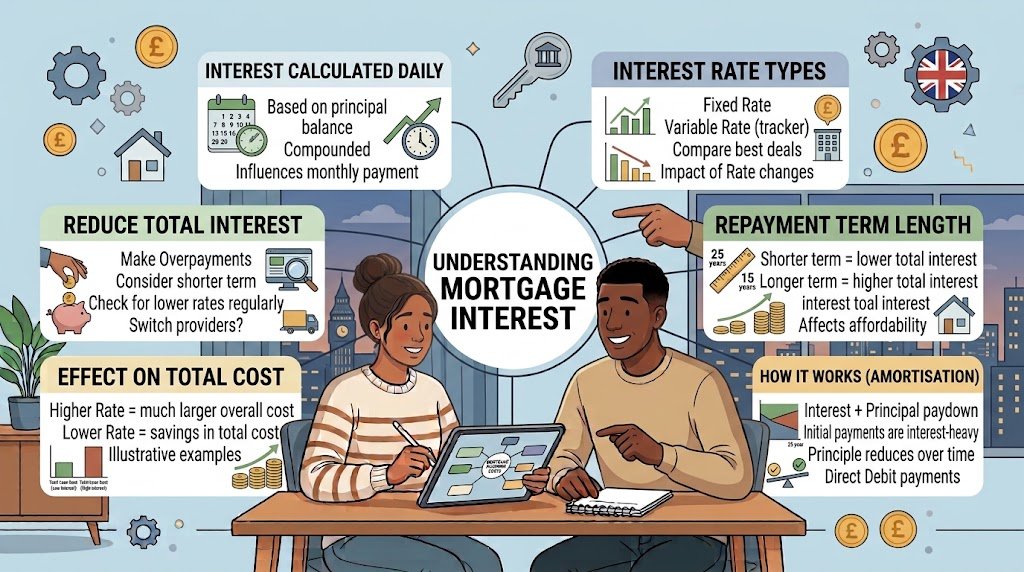
When you take out a mortgage, the amount you borrow is only part of what you will eventually pay back. The lender also charges interest for providing the money, and over a long mortgage term that interest can become a substantial part of the total cost.
This is why two mortgages with the same borrowing amount can have very different overall costs. The interest rate matters, but so does the mortgage term, the way you repay the mortgage, whether the rate can change, and any fees that are added to the borrowing.
For example, a lower monthly payment may look attractive, but extending a mortgage over a longer period can mean paying interest for many additional years. MoneyHelper confirms that longer mortgage terms can reduce monthly repayments while increasing the amount of interest paid over the life of the mortgage.
Understanding how mortgage interest works can help you look beyond the monthly payment and consider the bigger cost of borrowing.
This article provides general educational information and is not personalised mortgage or financial advice.
What Is Mortgage Interest?
Mortgage interest is the charge a lender makes for allowing you to borrow money to buy a property.
Your mortgage has two basic components:
Capital: the amount you borrow.
Interest: the cost charged by the lender for that borrowing.
With a standard repayment mortgage, your monthly payments gradually reduce the capital while also paying the interest due. MoneyHelper describes a repayment mortgage as one where you pay back both capital and interest over the agreed term.
Imagine a hypothetical buyer borrowing £200,000.
They do not simply repay £200,000 over the mortgage term. The lender also charges interest according to the mortgage agreement.
The total amount eventually paid therefore depends on the interest rate and how long the money remains outstanding, as well as applicable fees and other charges.
Why Does Mortgage Interest Make Such a Big Difference?
Mortgages are usually large loans that can remain outstanding for many years.
That combination makes the interest cost important.
If you borrow £200,000 for a relatively short period, the balance is reduced more quickly. If you spread the same borrowing over a much longer period, the lender is charging interest while the balance remains outstanding for more years.
MoneyHelper gives the same general principle: longer mortgage terms can produce lower monthly payments but result in more interest being paid over time.
This creates an important trade-off:
Shorter term = generally higher monthly payments but less interest over the full term.
Longer term = generally lower monthly payments but more interest over the full term.
The exact figures depend on the mortgage rate, borrowing amount and repayment structure.
How Is Mortgage Interest Reflected in Your Monthly Payment?
With a repayment mortgage, part of your monthly payment goes towards interest and part towards reducing the mortgage balance.
The precise calculation depends on the lender and mortgage terms.
At the beginning of a typical repayment mortgage, the outstanding balance is at its highest. Consequently, the interest calculated on that balance can represent a significant portion of the early payments.
As you gradually reduce the capital, there is less outstanding to generate interest.
This means that the composition of your monthly payment can change over the mortgage term.
MoneyHelper’s mortgage repayment calculator explains that mortgage repayments include interest charges and that the amount borrowed, interest rate and repayment period all affect the resulting payment.
A Simple Hypothetical Example
Consider a fictional borrower with a £200,000 repayment mortgage.
Suppose, purely for illustration, the mortgage has a fixed interest rate of 5% for the entire hypothetical term.
If the borrower repays the mortgage over 25 years, the monthly payment and total interest would be different from the same £200,000 borrowing spread over 35 years.
The 35-year option would generally require lower monthly payments, but interest would be charged over an additional decade.
This example is deliberately simplified because real mortgages rarely keep exactly the same interest rate for the entire term. A borrower may move from a fixed rate to another deal or onto a variable rate, meaning the eventual total cost can differ considerably.
The key lesson is not the fictional figure. It is the relationship between interest rate, outstanding balance and time.
How the Mortgage Term Changes the Total Cost
The mortgage term is one of the most important factors affecting total interest.
Suppose you borrow the same amount under two hypothetical repayment mortgages.
One runs for 25 years.
The other runs for 35 years.
The longer mortgage could have a lower required monthly payment. However, because the debt remains outstanding for longer, interest is charged over a greater period.
MoneyHelper’s recent illustration uses a hypothetical £175,000 mortgage at 5%. It shows that extending the term from 25 to 30 years lowers the monthly payment but increases the total amount paid over the full term. Extending it to 35 years increases the overall cost further.
This does not mean that a longer term is automatically a poor choice.
For some households, a longer term may make the monthly payment more manageable.
The important point is to understand what you are giving up in return for that lower monthly payment.
Does a Lower Interest Rate Always Mean a Cheaper Mortgage?
Not necessarily.
The interest rate is extremely important, but it is not the only cost.
Mortgage products can include arrangement or product fees, booking fees, account fees and other charges. MoneyHelper explains that these costs should be considered when comparing mortgage deals.
For example, imagine two hypothetical mortgages:
Mortgage A: 4.5% interest rate with no product fee.
Mortgage B: 4.3% interest rate with a £2,000 product fee.
Mortgage B has the lower headline rate, but that does not automatically make it cheaper overall.
If the fee is added to the mortgage, you could also pay interest on that fee.
MoneyHelper specifically warns that adding mortgage fees to the borrowing means paying interest on those fees as well.
This is why comparing the interest rate alone can give you an incomplete picture.
What Is APRC and Why Does It Matter?
You may see APRC, which stands for Annual Percentage Rate of Charge, when comparing mortgages.
APRC is intended to show the yearly cost of a mortgage over its full term, including certain fees and charges, assuming the mortgage remains in place for the entire term.
MoneyHelper explains that lenders must state the APRC on mortgage deals and that it includes the overall cost of the mortgage under the assumptions used for the calculation.
It can therefore be useful when comparing mortgage offers.
However, APRC should not be treated as a prediction of exactly what you will personally pay.
For example, you might remortgage before the end of the original mortgage term, make overpayments, sell the property or experience changes in the mortgage rate.
The assumptions behind the APRC matter.
How Fixed Rates Affect Mortgage Interest
A fixed-rate mortgage keeps the interest rate unchanged for the agreed fixed period.
For example, a hypothetical mortgage might have a five-year fixed rate.
During that period, the mortgage rate does not normally change simply because the wider interest-rate environment changes.
That can make household budgeting easier.
However, a fixed rate does not mean your mortgage rate is fixed forever.
When the fixed period ends, you may need to choose another mortgage deal or move onto the lender’s applicable reversion rate if you do nothing.
The FCA explains that a reversion rate is the rate you move onto when an initial fixed or discounted rate ends, and this is often a lender’s standard variable rate.
Therefore, when comparing a fixed-rate mortgage, look beyond the initial rate.
Ask what happens when the deal ends.
How Variable and Tracker Rates Can Change the Cost
Some mortgages have interest rates that can change.
A tracker mortgage usually follows a reference rate, commonly the Bank of England Bank Rate, plus a specified margin.
A variable mortgage may change according to the lender’s terms.
This means your monthly payment can rise or fall.
MoneyHelper explains that tracker mortgages generally move with their reference rate, while standard variable rates are set by the lender and can also change.
For example, suppose a fictional tracker mortgage is priced at:
Bank Rate + 1.5 percentage points
If the underlying rate changes, the mortgage rate can change as well.
That could affect your monthly payment and the amount of interest you pay.
A borrower considering a variable rate should therefore think about whether their household budget could handle higher payments if rates rise.
Why Interest Rates Matter More on Large Mortgages
The amount borrowed also affects the impact of an interest-rate change.
A change in the rate applied to £100,000 of borrowing will generally have a smaller monetary impact than the same rate change applied to £400,000, all else being equal.
This is one reason the size of your mortgage matters when thinking about affordability.
For example, if two households receive the same percentage-rate increase but one has substantially more outstanding borrowing, the increase in interest costs can be greater for the household with the larger balance.
The FCA notes that lenders assess affordability because mortgage payments can become more difficult to maintain if interest rates rise.
What Happens to Interest as You Pay Down the Mortgage?
With a repayment mortgage, the outstanding capital should gradually decrease if you maintain the required payments.
As the balance falls, there is less capital on which interest is calculated.
This is one reason reducing the mortgage balance can affect future interest costs.
However, the exact effect of an overpayment depends on the mortgage terms and how the lender applies it.
Some mortgages allow borrowers to make overpayments without a charge, while others can impose early repayment charges or limits during certain periods. MoneyHelper recommends checking your mortgage terms to understand how much you can overpay without facing charges.
Never assume that making a large overpayment is penalty-free.
Check the agreement first.
Can Mortgage Overpayments Reduce Interest?
Potentially, yes.
If an overpayment reduces the outstanding capital and the lender recalculates the interest based on the lower balance, you may pay less interest over time.
There are several important conditions, though.
Your mortgage may limit the amount you can overpay without an early repayment charge.
The lender may apply the overpayment in a particular way.
Your mortgage rate may change later.
You may also have other financial priorities, such as maintaining an emergency fund or dealing with expensive unsecured debt.
Therefore, the fact that an overpayment can reduce mortgage interest does not automatically mean it is the right financial decision for every household.
How Adding Fees to the Mortgage Can Increase Interest
Consider a simple hypothetical example.
You have a mortgage and are offered a product with a £1,500 fee.
You could pay the fee separately, or the lender may allow it to be added to the mortgage.
If you add it to the mortgage, your initial borrowing increases by £1,500.
Interest can then be charged on that additional borrowing according to the mortgage terms.
Over a long period, the difference can become larger than the original fee.
MoneyHelper specifically highlights this point when discussing mortgage fees.
This is why you should compare the cost of paying a fee upfront with the cost of adding it to the mortgage.
Why a Longer Mortgage Can Look Cheaper Than It Really Is
Imagine looking at two mortgage options.
One requires a monthly payment of £1,100.
Another requires £950.
At first glance, the £950 mortgage may appear more affordable.
But suppose the cheaper monthly payment comes from extending the mortgage term.
You may be paying £150 less each month while keeping the debt outstanding for many additional years.
That can substantially increase the total interest paid.
MoneyHelper’s guidance gives a clear example of this trade-off: longer terms lower monthly repayments but increase the total amount paid over the full mortgage term.
The sensible comparison is therefore not simply:
“Which mortgage has the lowest monthly payment?”
It is:
“What monthly payment can I comfortably afford, and what will this borrowing cost me overall?”
How Mortgage Interest Can Change Your Long-Term Housing Cost
When people think about the cost of a home, they often focus on the purchase price.
Suppose a fictional property costs £300,000.
That does not mean the buyer will necessarily spend only £300,000 on the property.
If they borrow a large portion through a mortgage, interest is added to the cost of financing the purchase.
There can also be mortgage fees, legal expenses, taxes, insurance, maintenance and other property costs.
Therefore, the true long-term cost of owning a home can be considerably different from the property’s original purchase price.
This does not mean mortgage borrowing is necessarily a bad decision. It means the financing cost should be included in the calculation.
What Happens When Your Fixed Mortgage Deal Ends?
This is an important point that borrowers sometimes overlook.
Suppose you take out a five-year fixed mortgage.
The five-year period ends before the mortgage itself is fully repaid.
At that point, you will need to consider your next mortgage arrangement.
If you do nothing, you may move onto the lender’s reversion rate according to the terms of your mortgage.
The FCA warns that the reversion rate is often higher than the initial fixed rate.
That does not mean you should automatically remortgage.
There may be fees, early repayment charges or other considerations.
Instead, review your position before the existing deal ends and compare the available options.
How Interest Rate Changes Can Affect Your Budget
Interest-rate movements can have different effects depending on your mortgage type.
With a fixed-rate mortgage, your rate generally stays unchanged during the fixed period.
With a tracker or other variable-rate mortgage, your rate may change.
MoneyHelper explains that changes in the Bank Rate can affect tracker and variable mortgages, while fixed-rate payments generally remain unchanged until the fixed period ends.
This is why a mortgage budget should not be based solely on whether you can afford today’s payment.
If your mortgage rate can change, consider how your household budget would cope with a higher payment.
A Simple UK Example
Imagine a fictional household borrowing £250,000 on a repayment mortgage.
They are considering two hypothetical terms at the same interest rate.
Option A: 25-year term.
Option B: 35-year term.
Option B would generally have the lower required monthly payment.
However, the household would keep the mortgage outstanding for an additional decade if they followed the scheduled payments for the entire term.
That additional period means interest has more time to accumulate.
Now imagine the interest rate is also higher.
The overall cost could increase further.
This example demonstrates why the mortgage term and interest rate should be considered together rather than separately.
The figures are hypothetical and are not a current mortgage quote or recommendation.
What Should You Look At When Comparing Mortgage Deals?
Do not compare mortgages using the interest rate alone.
Look at:
Initial interest rate
How much interest is charged during the initial deal?
Mortgage term
How long will you take to repay the borrowing?
Initial deal period
How long does the fixed, tracker or discounted rate last?
APRC
What is the stated annual percentage rate of charge?
Product or arrangement fee
Is there an upfront fee?
Other charges
Are there booking, account, valuation or administration charges?
Early repayment charges
Could you be charged if you leave or overpay?
Overpayment rules
Can you reduce the balance early without a penalty?
Reversion rate
What rate applies after the initial deal ends?
MoneyHelper recommends comparing all the figures associated with a mortgage rather than concentrating solely on the advertised interest rate.
Common Mistakes to Avoid
Focusing Only on the Monthly Payment
A low monthly payment can result from a longer mortgage term.
Always consider the total cost as well.
Assuming a Fixed Rate Lasts for the Entire Mortgage
Most fixed-rate deals apply for a specific period rather than the full mortgage term.
Check the date when the initial deal ends.
Ignoring Mortgage Fees
A lower rate with a large product fee may not be cheaper overall.
Automatically Adding Fees to the Mortgage
If you borrow the fee, you may also pay interest on it.
Forgetting About Early Repayment Charges
A mortgage may restrict overpayments or charge you for repaying early during certain periods.
Assuming Rates Can Only Go Down
Interest rates can rise or fall.
If you choose a variable or tracker mortgage, your budget should allow for potential changes.
Treating APRC as a Guaranteed Final Cost
APRC is useful for comparison, but it is based on stated assumptions.
Your actual circumstances may differ.
Choosing the Longest Possible Term Without Considering the Total Cost
A longer term may make the monthly payment more manageable, but the overall interest cost can be significantly higher.
Practical Steps Before Taking a Mortgage
Start by deciding what monthly payment fits comfortably within your household budget.
Then calculate what happens if the mortgage rate changes.
Next, compare the full mortgage cost rather than the headline rate.
Read the mortgage illustration carefully. MoneyHelper says this document sets out information including the repayment frequency, fees, overall mortgage cost, interest rate or APRC, possible rate changes and overpayment conditions.
Also consider how long you expect to keep the property and mortgage deal.
If you might move or remortgage relatively soon, early repayment charges and product fees can become particularly relevant.
Finally, do not forget that your mortgage is only one part of your household budget. Council Tax, energy, insurance, maintenance and other housing expenses still need to be paid.
Questions to Ask Before Choosing a Mortgage
Before committing to a mortgage, consider asking:
What is the total amount I will repay under the stated assumptions?
How much of the cost is interest?
What fees are included?
What is the APRC?
How long is the initial rate guaranteed?
What rate applies after that period?
Can I make overpayments?
Are there early repayment charges?
What would happen to my payment if interest rates increased?
What happens if I want to move home before the mortgage deal ends?
These questions can help you understand the borrowing rather than simply choosing the lowest advertised monthly payment.
Frequently Asked Questions
Does mortgage interest make a home more expensive?
Mortgage interest increases the total cost of financing a property. The purchase price might be £300,000, for example, but if part of that price is financed through a mortgage, the borrower also pays interest to the lender. The total cost depends on the amount borrowed, interest rate, mortgage term, repayment method and applicable fees. This is why the cost of the mortgage should be considered separately from the property’s purchase price.
Does a longer mortgage term mean more interest?
Generally, yes, if the same borrowing and interest rate are used and the mortgage is maintained for the full term. A longer term means the outstanding balance is repaid more slowly, so interest is charged for more years. MoneyHelper confirms that longer mortgage terms generally reduce monthly payments but increase the amount of interest paid over time.
Can a lower mortgage interest rate save money?
A lower interest rate can reduce the interest charged on your borrowing, but the overall saving depends on the mortgage’s other terms. Product fees, arrangement charges, early repayment charges and the length of time you keep the mortgage can all affect the final cost. This is why comparing the interest rate alone is not enough. APRC and the mortgage illustration can provide additional information for comparing deals.
Does making mortgage overpayments reduce interest?
An overpayment can reduce the outstanding mortgage balance and may therefore reduce future interest charges, depending on the mortgage terms and how the lender applies the payment. However, some mortgages limit penalty-free overpayments or impose early repayment charges. Check your mortgage agreement before making a substantial overpayment. MoneyHelper recommends checking the terms to understand how much you can repay without charges.
Why can the first years of a mortgage feel expensive?
A mortgage usually starts with its highest outstanding balance. Because interest is calculated on the amount owed, the interest component can be significant during the early part of a repayment mortgage. As the capital balance reduces, the amount on which interest is calculated also falls. The exact payment structure depends on the mortgage agreement and lender’s calculation method.
Can mortgage interest rates change after I take out a mortgage?
It depends on the type of mortgage. A fixed-rate mortgage normally keeps the agreed rate unchanged during the fixed period. Tracker and other variable-rate mortgages can change according to their terms. MoneyHelper explains that tracker mortgages normally follow a reference rate such as Bank Rate, while standard variable rates are set by the lender.
What happens when a fixed mortgage rate ends?
When an initial fixed period ends, you normally need to consider a new mortgage deal. If you do nothing, the mortgage can move to the lender’s applicable reversion rate under the mortgage terms. The FCA says this is often a standard variable rate and will typically be higher than the initial fixed rate.
Final Thoughts
Mortgage interest can have a major effect on the total cost of buying a home.
The amount you borrow matters, but so do the interest rate and the length of time the balance remains outstanding. A longer mortgage term can make monthly payments easier to manage while increasing the amount of interest paid over the full term.
When comparing mortgages, look beyond the headline rate. Consider the product fee, APRC, initial deal period, reversion rate, early repayment charges and overpayment rules.
It is also worth remembering that today’s mortgage payment does not necessarily represent the cost for the entire life of the loan. Your rate may change when a fixed deal ends, or your payment may move with a variable rate.
A mortgage should therefore be assessed as a long-term financial commitment rather than simply a monthly bill.
This article provides general educational information and is not personalised financial advice.
Sources and Further Reading
- MoneyHelper — Understanding mortgages and interest rates — Useful guidance on fixed, variable and tracker rates, APRC, fees and comparing mortgage deals.
- MoneyHelper — How will interest rates affect my mortgage? — Current guidance on how changes in interest rates can affect different mortgage types.
- MoneyHelper — Should you get a 30-year or longer mortgage? — Explains the relationship between mortgage term, monthly payments and total interest.
- MoneyHelper — Mortgage repayment calculator — Tool for estimating repayments and exploring the effect of interest-rate changes.
- Financial Conduct Authority — Support available for mortgages as interest rates rise — Regulatory guidance on affordability, rate changes, reversion rates and early repayment charges.