
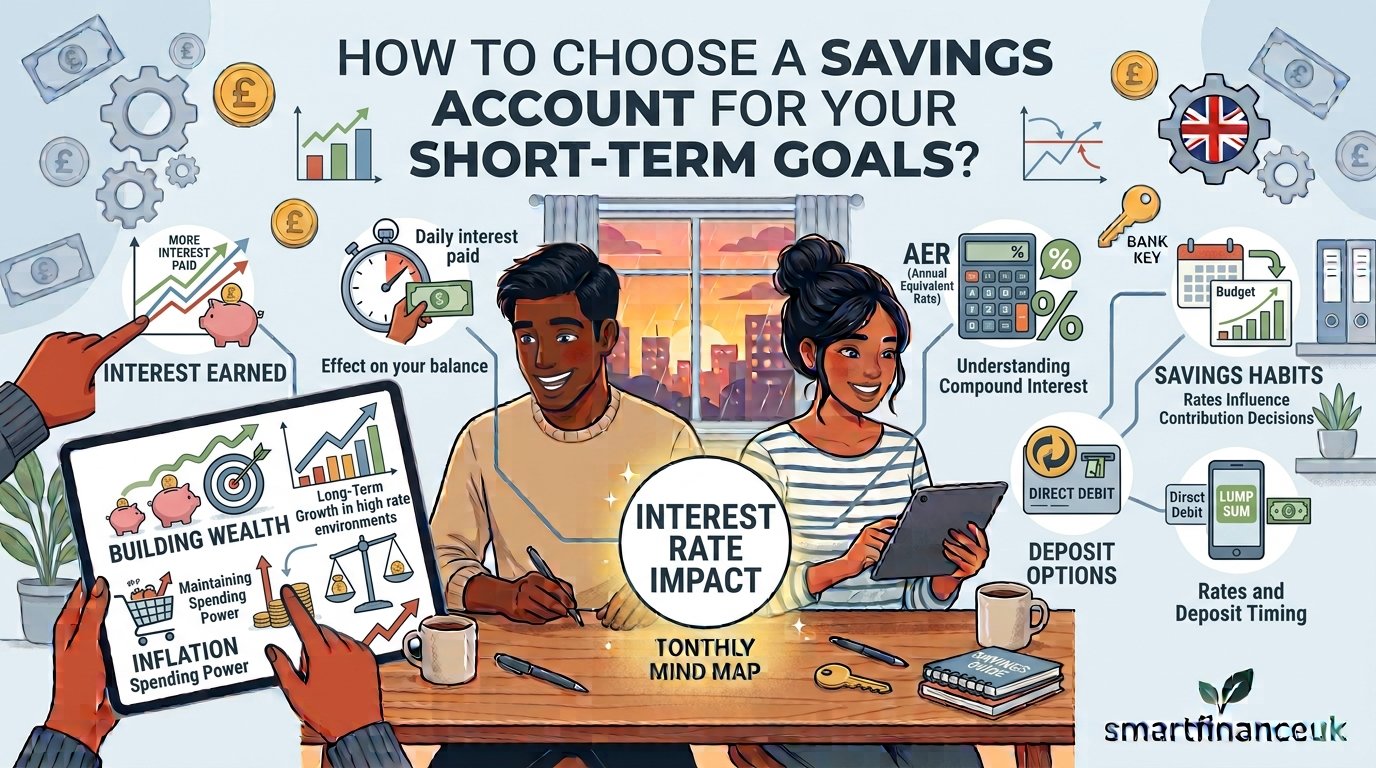
When you put money into a savings account, the interest rate determines how much extra money the bank or building society may pay you for keeping your savings there. A higher rate can help your balance grow faster, while a lower rate means you earn less interest.
But comparing savings accounts is not simply about finding the biggest percentage. The rate may be variable or fixed, interest may be paid monthly or annually, access conditions can differ, and tax may affect the amount you ultimately keep.
For UK savers, understanding how interest works makes it easier to compare accounts and choose one that fits the purpose of your money. This guide explains how savings interest is calculated, what AER means, how compound interest works, why Bank Rate can affect savings rates, and what you should check before opening or switching an account.
What Is an Interest Rate on a Savings Account?
The interest rate is the percentage a bank or building society pays you based on the money you keep in your savings account.
For example, imagine you place a hypothetical £1,000 into a savings account paying 3% interest for a year. If the balance remained unchanged and the rate stayed the same, the simple annual interest would be £30.
Your balance could therefore become £1,030 before considering any applicable tax or differences caused by the account’s actual interest calculation.
MoneyHelper explains that if £1,000 is held in a savings account paying 2% annually, £20 of interest would be earned over a year, assuming the relevant conditions remain unchanged.
The actual amount you receive can differ because savings rates can change and your balance may rise or fall during the period used to calculate interest.
How Does Interest Make Your Savings Grow?
Think of interest as additional money paid on your savings.
If you deposit £2,000 and the account pays interest, the provider calculates the interest according to its terms. Depending on the account, that interest may be added to the balance monthly, annually or at another specified time.
If the interest is added to the account, your balance becomes larger.
That can lead to compound interest.
What Is Compound Interest?
Compound interest means you can earn interest on your original savings as well as interest that has already been added.
For example, imagine £1,000 remains in a hypothetical account paying 3% a year and the interest is compounded annually:
| Year | Approximate balance |
|---|---|
| Starting balance | £1,000 |
| After 1 year | £1,030 |
| After 2 years | £1,060.90 |
| After 3 years | £1,092.73 |
| After 4 years | £1,125.51 |
| After 5 years | £1,159.27 |
These figures are purely illustrative and assume the rate never changes and interest is compounded annually.
The effect becomes more noticeable over longer periods because each year’s interest can contribute to the balance used to calculate future interest. MoneyHelper also demonstrates how compounding can increase savings over time.
What Does AER Mean?
When comparing UK savings accounts, you will often see AER, which stands for Annual Equivalent Rate.
AER is designed to make savings products easier to compare because it reflects the annual return while taking account of how often interest is paid and compounded.
MoneyHelper recommends looking at AER when comparing savings products because a higher AER generally means more interest over a year, assuming the relevant conditions are the same.
For example, if one savings account has an AER of 2.5% and another has an AER of 3.5%, the second account offers the higher annual equivalent return before considering other conditions.
However, that does not automatically mean the second account is the better choice.
Access restrictions, minimum deposits, introductory bonuses and withdrawal rules can all matter.
Why the Interest Rate Matters
A small difference in the interest rate can become more noticeable as your savings balance increases or you leave the money untouched for longer.
Consider a hypothetical £10,000 balance.
At 2% a year, simple annual interest would be approximately £200.
At 4% a year, it would be approximately £400.
The difference is £200 over a year before tax and assuming the balance and rates remain unchanged.
This does not mean every account paying 4% will necessarily produce exactly £400 of interest. The actual calculation depends on the account’s terms, how interest is calculated and paid, whether the rate changes and whether you make withdrawals or additional deposits.
The example simply shows why the interest rate can make a meaningful difference.
What Happens When Interest Rates Rise?
Changes in wider interest rates can affect the rates banks and building societies offer to savers.
The Bank of England Bank Rate influences borrowing and saving rates across the economy. MoneyHelper explains that when Bank Rate rises, you would generally expect savings rates to rise too.
However, this does not mean every savings account automatically receives the same increase.
A bank may change the rate on one account but not another. Some accounts may have fixed rates, while others have variable rates.
MoneyHelper specifically warns that banks do not always increase savings rates automatically when wider interest rates rise, meaning customers may need to check what their current account is paying.
This is one reason it is worth reviewing your savings account periodically.
What Happens When Interest Rates Fall?
The opposite can also happen.
If wider interest rates fall, variable savings rates may also fall.
Suppose you opened an easy-access account because its rate looked attractive. If the provider later reduces the rate, your savings may earn less interest even though you have not changed anything.
This can be easy to miss.
You might continue transferring money into the same account without noticing that the rate has changed.
A quick review of your savings rate can therefore be useful, particularly when your account has a variable rate.
Fixed vs Variable Savings Rates
The type of interest rate is just as important as the percentage.
Variable interest rate
A variable rate can change.
This means the interest you earn in the future may be higher or lower than the rate you receive today.
Easy-access savings accounts commonly use variable rates.
Their main attraction is usually flexibility rather than certainty.
Fixed interest rate
A fixed-rate savings account normally keeps the agreed rate for a specified period.
This can make your expected return easier to estimate.
However, fixed-rate accounts commonly restrict access to your money until the end of the term or impose conditions if you want to withdraw early.
MoneyHelper notes that fixed-rate savings products can offer higher rates than instant-access accounts but can restrict access to your money.
The choice is therefore not simply about which rate is higher.
It is also about whether you need access to the money.
Does a Higher Interest Rate Always Mean a Better Savings Account?
No.
A higher rate can be attractive, but it is only one part of the comparison.
Suppose one account pays a higher rate but requires you to lock your money away for two years.
Another pays slightly less but lets you withdraw whenever you need to.
If the money is your emergency fund, flexibility could be more important than the difference in interest.
MoneyHelper recommends considering factors such as opening balances, regular-payment requirements and access arrangements rather than choosing a savings product solely because it has the highest interest rate.
How Access Can Affect Your Choice
Savings usually have a purpose.
You might be saving for:
- An emergency fund
- A future holiday
- Home repairs
- A car
- Annual household bills
- A house deposit
- A long-term financial goal
The purpose affects how important access is.
Emergency savings
Money you may need unexpectedly generally needs to be accessible.
An instant-access account can be useful because you can normally withdraw money when required, subject to the provider’s terms.
Planned savings
If you know you will not need the money for a particular period, you may be more comfortable considering a fixed-rate account.
The important question is whether you can genuinely leave the money untouched.
How Inflation Affects Your Savings
Interest is only part of the story.
You should also consider inflation, which measures how prices rise over time.
Suppose your savings earn 2% interest but the prices of goods and services rise by more than 2%.
Your account balance has increased in pounds, but the money may buy less than it did previously.
MoneyHelper notes that cash savings can lose purchasing power over time when the interest rate is lower than inflation.
This does not mean you should avoid cash savings.
Savings accounts have an important role, particularly for emergency funds and short-term goals where protecting your money and having access to it can matter more than seeking higher potential returns.
It simply means that the headline interest rate does not tell you everything about the longer-term value of your savings.
How Often Is Savings Interest Paid?
Different accounts pay interest at different intervals.
It may be paid:
- Monthly
- Annually
- At the end of a fixed term
- At another frequency specified by the provider
The payment frequency can affect how quickly compound interest works if the interest is added to your savings balance.
When comparing accounts, check both the AER and the interest-payment arrangements.
If an account advertises a monthly interest option, make sure you understand whether choosing monthly payments changes the rate or how the interest is calculated.
Does Adding Money Change the Interest You Earn?
Yes.
If you add more money to your savings, there is generally a larger balance on which interest can be calculated.
For example, if you save £100 each month, your balance gradually increases.
You will not normally earn a full year’s interest on money you deposit near the end of the year because that money has not been in the account for the entire period.
The exact calculation depends on the account’s terms.
This is why regular saving can gradually increase the amount of interest you receive, even if the interest rate itself does not change.
What Happens If You Withdraw Money?
A withdrawal reduces your savings balance.
That can reduce the amount of interest you earn because there is less money in the account.
For example, imagine you have £5,000 saved and withdraw £1,000.
You now have £4,000 remaining, so future interest calculations will generally be based on the lower balance.
Some savings accounts also have specific withdrawal restrictions or may reduce the rate if you make withdrawals.
This is particularly relevant to regular savings accounts, where the rules can vary considerably between providers.
Always read the withdrawal conditions before opening an account.
How Savings Interest Is Taxed in the UK
Interest earned on ordinary savings can be taxable, although many people can receive some savings interest without paying tax.
For the 2026/27 tax year, the Personal Savings Allowance is generally:
- £1,000 for basic-rate taxpayers
- £500 for higher-rate taxpayers
- £0 for additional-rate taxpayers
The exact position can depend on your income and circumstances.
There is also a starting rate for savings for people with lower incomes, subject to the relevant rules.
Interest earned inside a Cash ISA has different tax treatment.
The important point is that the interest rate advertised by a savings account is not necessarily the same as the amount you ultimately keep after any tax that may apply.
If you are unsure how the rules apply to you, check the latest HMRC guidance.
A Simple Hypothetical Example
Imagine two fictional savings accounts.
Account A
- £5,000 deposit
- 2.5% AER
- Easy access
Account B
- £5,000 deposit
- 3.5% AER
- Fixed for one year
- Early access restricted
Ignoring compounding and tax for simplicity, the difference between the annual interest rates is 1 percentage point.
On £5,000, that difference represents roughly £50 over a year.
But Account B may not be appropriate if you need the money during that year.
This illustrates an important point: the value of an interest rate depends on the purpose of your savings and the account conditions attached to it.
The figures above are hypothetical and are not a recommendation or representation of current market rates.
What Should You Check When Comparing Savings Accounts?
Before opening or switching an account, look at more than the headline rate.
AER
Check the Annual Equivalent Rate so you can make a more meaningful comparison.
Fixed or variable rate
Know whether the provider can change the rate.
Introductory bonuses
Some accounts offer a temporary bonus. Find out when it ends and what rate applies afterwards.
Minimum deposit
Check whether you need a particular amount to open the account.
Maximum balance
Some accounts only pay their advertised rate up to a specified balance.
Regular deposits
A regular savings account may require you to pay in a certain amount each month.
Withdrawal rules
Check whether withdrawals are unrestricted, limited or subject to a reduction in interest.
Interest payment date
Understand when interest will actually be added to the account.
FSCS protection
Eligible deposits held with UK-authorised banks, building societies and credit unions can be protected by the Financial Services Compensation Scheme, subject to its rules and limits. MoneyHelper currently states the savings protection limit as £120,000 per person per authorised firm.
Common Mistakes to Avoid
Leaving money in an old account without checking the rate
A savings account that was competitive when you opened it may not remain competitive.
Looking only at the headline percentage
Access rules and temporary bonuses can change the real value of an account.
Confusing APR with AER
APR is generally associated with borrowing, while AER is used to compare savings returns. MoneyHelper recommends using AER when comparing savings products.
Locking away emergency savings
A higher rate may not compensate for the inconvenience of being unable to access money when an unexpected bill arrives.
Forgetting about tax
The interest you earn may count towards your taxable savings income, depending on your circumstances.
Assuming the rate will never change
Variable savings rates can change.
How to Get More From Your Savings Without Making Things Complicated
You do not necessarily need a complicated collection of accounts.
Start by identifying what the money is for.
If you need immediate access, prioritise an account that provides suitable access.
If you know you will not need the money for a set period, compare fixed-term options.
If you are saving small amounts regularly, look at whether a regular savings account could suit your circumstances.
Then compare the AER and account conditions.
Finally, review your savings occasionally. A change in interest rates can make an account less competitive even if your financial circumstances have not changed.
Questions to Ask Before Opening a Savings Account
Before transferring your money, ask:
What is the AER?
Is the rate fixed or variable?
If it is variable, how can it change?
Is there a temporary introductory bonus?
When will the bonus end?
How often is interest paid?
Can I withdraw my money whenever I need it?
Are there withdrawal limits or penalties?
Is there a minimum or maximum balance?
Do I have to pay money into the account regularly?
How is the account protected if the provider fails?
Could the interest I earn create a tax liability for me?
These questions can help you compare the account as a whole rather than focusing on one percentage.
Frequently Asked Questions
How does an interest rate affect savings?
An interest rate determines how much interest a provider pays on money held in your savings account. A higher rate generally means more interest, assuming the same balance, period and account conditions. For example, a hypothetical £1,000 balance at 3% would generate approximately £30 over a year before considering tax and other factors. The actual amount can differ if the rate or balance changes.
Is a higher savings interest rate always better?
No. A higher rate can mean more interest, but it may come with restrictions such as limited withdrawals, a fixed term or a minimum deposit. A slightly lower rate with easy access could be more suitable for an emergency fund. MoneyHelper recommends considering access and other account features alongside the interest rate.
What is AER on a savings account?
AER stands for Annual Equivalent Rate. It is a standard way of presenting savings returns so consumers can compare accounts more easily, taking account of how often interest is paid and compounded. When comparing savings accounts, looking at AER is generally more useful than comparing an isolated interest-rate figure.
Can savings interest rates change?
Yes, if the account has a variable rate. A provider can change a variable savings rate subject to its terms and applicable rules. Fixed-rate savings accounts generally provide more certainty for the agreed period. This is why it can be useful to review variable-rate savings accounts periodically.
Does Bank Rate affect savings interest?
Bank Rate can influence the interest rates offered by banks and building societies. Generally, a rise in Bank Rate can lead to higher savings rates, while a fall can put downward pressure on them. However, providers do not necessarily change every savings account by the same amount or at the same time.
Do I pay tax on savings interest in the UK?
You may, depending on your income and circumstances. Many UK taxpayers have a Personal Savings Allowance, while additional-rate taxpayers do not receive one. Some lower-income savers may also qualify for the starting rate for savings. Interest earned in a Cash ISA has different tax treatment. Check the latest HMRC guidance if you are unsure.
Does compound interest make a big difference?
It can, particularly over longer periods. With compound interest, previously earned interest becomes part of the balance and can itself earn interest. The effect depends on the rate, how frequently interest is compounded, how long the money remains saved and whether you add or withdraw money.
Final Thoughts
The interest rate on a savings account directly affects how quickly your money can grow, but the percentage is only one part of the decision.
A higher rate can produce more interest, while compound interest can increase the effect over time. However, variable rates can change, fixed-rate accounts can restrict access, and tax may affect the amount you keep.
For UK savers, a sensible comparison should include AER, access, rate type, withdrawal conditions, introductory bonuses, deposit limits, interest-payment arrangements and tax considerations.
The right account is not necessarily the one with the highest advertised rate. It is the one whose rate and conditions fit the purpose of your savings.
This article is for general educational purposes and is not personalised financial advice. Savings rates, tax rules and individual account terms can change, so check current information from the provider and authoritative UK sources before making a financial decision.
2 thoughts on “How Interest Rates Affect the Money in a Savings Account?”