
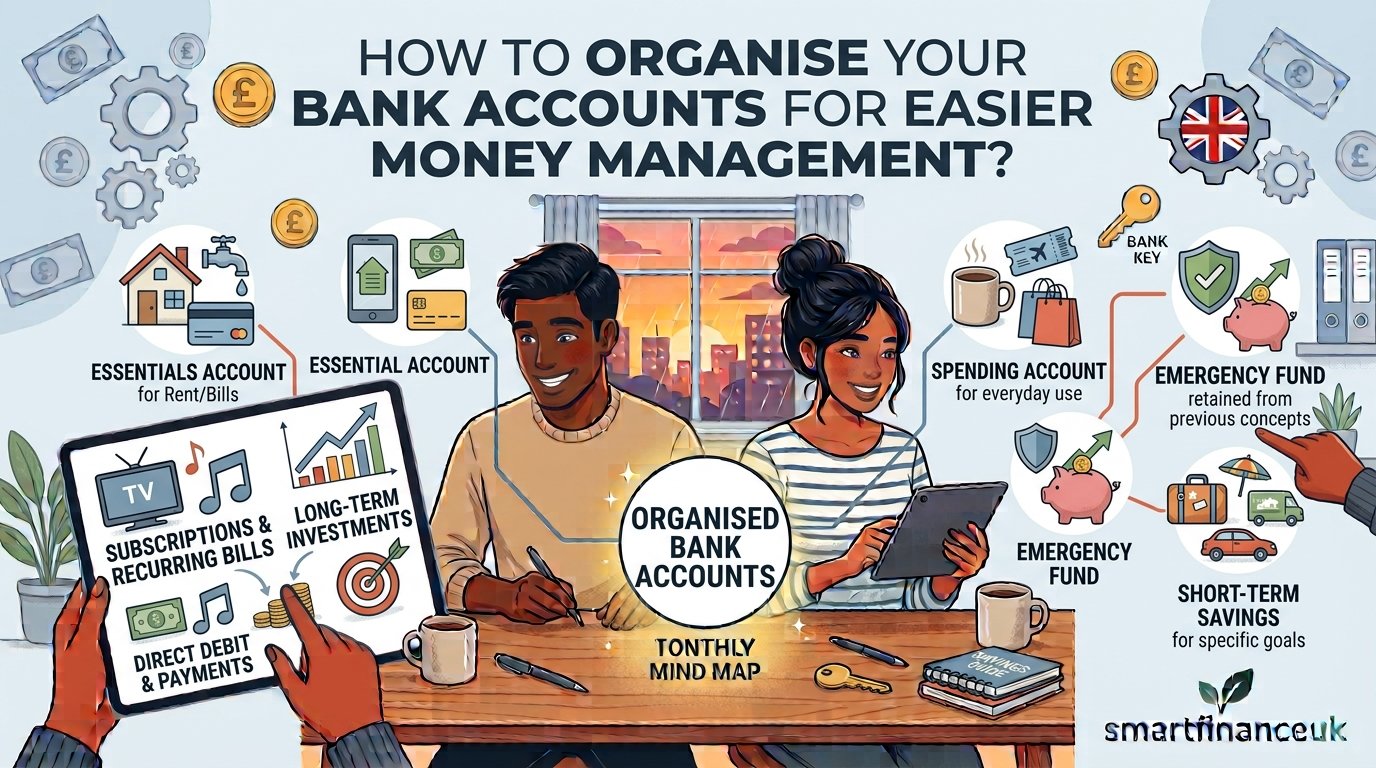
Managing money can become difficult when everything comes out of one bank account. Your salary arrives, household bills are paid, savings are transferred, and everyday spending happens from the same balance. By the middle of the month, it can be difficult to tell how much money is genuinely available.
Organising your bank accounts can make this easier. You do not necessarily need several accounts or complicated spreadsheets. A simple structure can separate money for essential bills, everyday spending, savings and irregular costs.
For UK households, the most useful arrangement depends on income, regular expenses, savings goals and how often you need access to your money. This guide explains practical ways to organise bank accounts, what each account can be used for, and the mistakes to avoid.
Why Organising Bank Accounts Can Help
The main benefit of separating your money is visibility.
Imagine that £2,500 enters your current account after payday. You know that £1,400 will eventually be needed for rent or mortgage payments, council tax, utilities, insurance and other household costs.
If the entire £2,500 remains in one account, your balance might make you feel as though you have £2,500 available to spend.
You do not.
Part of that balance already has a job.
Separating money into different accounts can make this distinction clearer. A bills account can hold money needed for regular commitments, while an everyday account can contain the amount available for normal spending.
The arrangement does not create extra money. It simply makes your existing money easier to manage.
How Many Bank Accounts Do You Actually Need?
There is no ideal number of bank accounts for everyone.
For some people, one current account and one savings account are enough. Others may find three or four accounts useful because their household finances are more complicated.
A practical structure might include:
Main current account: salary, benefits or other regular income arrives here.
Bills account: money for rent or mortgage payments and regular household bills.
Everyday spending account: groceries, transport, meals out and other routine spending.
Savings account: emergency savings and money for future goals.
You do not necessarily need all four.
The best system is one you can maintain without constantly moving money around or losing track of where it is.
A Simple Three-Account System
For many people, three accounts can provide a useful balance between organisation and simplicity.
Account 1: Income and Bills
Use a current account for incoming money and essential payments.
Your salary or other regular income can arrive here. From this account, you can move money to your other accounts after payday.
You might also use it for direct debits and standing orders.
Account 2: Everyday Spending
Transfer a planned amount into a separate account for everyday expenses.
This could cover:
- Food shopping
- Transport
- Clothes
- Eating out
- Entertainment
- Small household purchases
When the balance in this account falls, you have a clearer indication of how much discretionary spending remains.
Account 3: Savings
Keep savings separate from everyday spending.
This can reduce the temptation to treat your savings balance as spare money.
You might use one savings account for an emergency fund or separate savings goals depending on your circumstances and the products available.
When a Separate Bills Account Makes Sense
A bills account can be particularly useful when your household has many regular payments.
Suppose your monthly income is £2,800 and your essential household commitments total £1,750.
Instead of leaving the full £2,800 in your everyday current account, you could arrange for the amount needed for bills to be transferred into a dedicated account.
The figures are purely hypothetical.
The benefit is psychological and practical: the money reserved for bills is separated from the money available for ordinary spending.
This can be especially useful if bills are paid on different dates throughout the month.
What Should Go Into a Bills Account?
A bills account can cover predictable commitments such as:
- Rent
- Mortgage payments
- Council tax
- Gas and electricity
- Water
- Broadband
- Mobile phone bills
- Insurance
- TV licence
- Regular subscriptions
- Loan repayments
- Other regular direct debits
Not every household will have all of these.
You should also check whether certain expenses are paid annually rather than monthly.
For example, if you pay an insurance policy once a year, simply looking at monthly direct debits could underestimate your actual household costs.
How to Deal With Annual and Irregular Expenses
This is one of the most useful reasons to organise your accounts.
Some expenses do not arrive every month, but they still need to be paid.
Examples include:
- Annual insurance
- Car servicing
- MOT costs
- School expenses
- Christmas spending
- Birthdays
- Home maintenance
- Professional memberships
- Seasonal travel
You could create a separate savings pot or account for these expenses.
Suppose you expect a hypothetical £600 of irregular expenses during the year.
Setting aside £50 per month would build £600 over 12 months, assuming the money remained untouched.
This does not make the expenses cheaper. It spreads the preparation across the year.
The actual amount you need will depend on your own expected costs.
Should Couples Have a Joint Account?
A joint account can be useful for shared household expenses, but it is not the only option.
Some couples choose to combine most of their finances.
Others keep individual current accounts and use a joint account solely for household bills.
There is no universal arrangement that works for every couple.
A joint account can make shared payments easier because both people can contribute towards the same pool of money.
However, joint account holders should understand that opening a joint account can create a financial association between them, and the account’s terms should be understood before opening it.
If you are considering a joint account, discuss:
- Who pays what
- Which bills come from the account
- How much each person contributes
- What happens if one person’s income changes
- How savings are handled
- What happens if the arrangement ends
The goal is to make responsibilities clear rather than create another source of confusion.
How to Organise Accounts Around Payday
A good account system becomes much easier when transfers happen automatically.
For example, imagine your salary arrives on the last working day of each month.
You could arrange for money to move shortly afterwards:
Income arrives → bills money is separated → savings contribution is transferred → everyday spending money remains available.
The exact amounts depend on your circumstances.
Standing orders can help automate regular transfers, but make sure you understand when the money will leave your account and whether your balance will be sufficient.
The Financial Conduct Authority explains that consumers should manage their current accounts carefully and understand how payments and overdrafts operate. (fca.org.uk)
Keep a Buffer for Unexpected Changes
Avoid making your bills account so precise that one small change causes a problem.
Household bills can change.
A direct debit may increase. An annual payment may be higher than expected. Your income may arrive on a different date.
A modest buffer can make the system more resilient.
For example, if your expected monthly bills total £1,500, you might choose to keep some additional money in the account rather than transferring exactly £1,500 every month.
The appropriate buffer depends on your circumstances.
It is not necessary to make the account excessively large. The purpose is simply to avoid relying on an overdraft because of a small timing difference or unexpected bill.
How to Separate Needs From Wants
Your account structure can also make budgeting easier.
Essential expenses generally need to be paid regardless of whether you have an enjoyable month.
Discretionary spending is different.
For example:
Needs: rent, mortgage, council tax, food, utilities and necessary transport.
Wants: meals out, entertainment, non-essential shopping and some subscriptions.
The distinction is not identical for everyone.
A mobile phone may be essential for one person but an expensive upgrade may be discretionary. A car may be necessary for someone who needs it to work but unnecessary for another person with reliable public transport.
The purpose of separating spending is not to label everything as good or bad. It is to understand where your money is going.
Should Savings Be in a Different Bank?
Not necessarily.
You can keep a current account and savings account with the same provider or use different providers.
A separate provider can create an extra psychological barrier between spending and saving.
However, convenience matters too.
If transferring money between accounts is simple, you may be more likely to maintain your savings routine.
When comparing savings accounts, consider the interest rate, access conditions, account limits and relevant protection arrangements rather than choosing solely because the account is at a different bank.
Eligible deposits with UK-authorised banks, building societies and credit unions may be protected by the Financial Services Compensation Scheme, subject to its rules and limits. MoneyHelper currently states the protection limit as £120,000 per person, per authorised firm. (moneyhelper.org.uk)
Keep Emergency Savings Separate From Spending Money
An emergency fund serves a different purpose from your normal spending balance.
You may need it for an unexpected repair, replacement appliance, urgent travel or a period when your income changes.
Keeping it in a separate savings account can make it easier to see whether you have actually built an emergency reserve.
MoneyHelper recommends having accessible savings for unexpected expenses and notes that the amount people need can vary depending on their circumstances. (moneyhelper.org.uk)
You do not need to build the entire fund immediately.
Regular contributions can gradually increase the balance.
Do Not Create Too Many Accounts
More accounts do not automatically mean better money management.
If you create separate accounts for groceries, fuel, clothing, holidays, birthdays, Christmas, entertainment, home repairs and every other category, the system can become difficult to maintain.
You may spend more time moving money around than actually understanding your finances.
A simpler approach is often better.
Start with the categories that genuinely cause confusion.
If you consistently overspend your everyday budget, a separate spending account could help.
If annual bills keep catching you by surprise, a dedicated savings pot may be useful.
Add complexity only when there is a clear reason.
Be Careful With Overdrafts
Having multiple accounts can create a false sense of security if you use overdrafts to cover shortfalls.
An overdraft is borrowing, not additional income.
If money is transferred out of your main account and the remaining balance becomes negative, you could incur interest depending on the account’s terms.
The FCA has rules governing overdraft pricing and requires firms to provide information that helps consumers understand and compare overdraft costs. (fca.org.uk)
When organising accounts, try to base your transfers on money you actually have rather than money you expect to borrow.
A Simple Hypothetical Monthly Example
Consider a fictional household with £3,000 of monthly take-home income.
They estimate:
- £1,700 for regular household bills
- £300 for savings and irregular expenses
- £1,000 for everyday spending
One possible structure would be:
Bills account: £1,700
Savings: £300
Everyday spending: £1,000
The numbers are hypothetical and do not represent a recommended budget.
The important idea is that each amount has a purpose.
If the household spends £850 from its everyday account during the month, it can see that roughly £150 remains for discretionary spending.
Meanwhile, the money reserved for bills and savings is not mixed into the same balance.
How to Set Up Your Own System
Start by looking at the previous few months of bank statements.
Identify:
- Regular income
- Direct debits
- Standing orders
- Household bills
- Food spending
- Transport
- Subscriptions
- Irregular expenses
- Savings contributions
- Debt repayments
- Discretionary spending
Then decide which categories would benefit from being separated.
Next, choose a small number of accounts.
Set up regular transfers after payday where appropriate.
Finally, monitor the system for two or three months.
You may discover that your original amounts were too high or too low. Adjust them based on your actual spending rather than trying to make the first version perfect.
Review Your Account Structure Regularly
Your financial situation can change.
You might:
- Change jobs
- Move home
- Take on a mortgage
- Finish repaying a loan
- Have a child
- Start saving for a different goal
- Change how often you travel
- Receive a different level of income
When that happens, your account structure may need adjusting too.
A quick review every few months can help you decide whether each account still has a useful purpose.
Close or consolidate accounts that have become unnecessary if doing so makes your finances easier to manage.
Common Mistakes to Avoid
Opening too many accounts
Complexity can make money management harder rather than easier.
Forgetting annual expenses
Monthly bills do not represent the full cost of running a household.
Automating transfers without checking your balance
A poorly timed standing order can cause problems if income and payments do not line up.
Treating savings as spare spending money
Money becomes easier to spend when it sits in the same account as your everyday balance.
Ignoring account fees
Check whether any account charges a monthly fee or imposes other costs.
Using overdrafts to make the system work
A budgeting system should reflect your available money, not depend on borrowing.
Never reviewing the arrangement
An account system that worked well last year may no longer fit your circumstances.
Questions to Ask Before Organising Your Accounts
Before changing your banking setup, consider:
Which expenses are essential every month?
Which bills are paid annually rather than monthly?
How much do I normally spend on everyday purchases?
Do I need instant access to my savings?
Would separating bills from spending reduce confusion?
Would a joint account make shared household expenses easier?
Are there fees attached to any account I am considering?
Can I automate transfers without risking a shortfall?
Do I have a small buffer for unexpected expenses?
Am I creating more accounts than I can realistically manage?
These questions can help you build a system around your actual financial habits.
Frequently Asked Questions
How many bank accounts should I have?
There is no fixed number that everyone needs. One current account and one savings account may be enough for some people. Others may benefit from a separate bills account or spending account. The best arrangement is one that makes your money easier to understand without creating unnecessary administration or fees.
Is it better to have separate accounts for bills and spending?
It can be useful if you find it difficult to distinguish money reserved for bills from money available for everyday spending. A separate bills account can make regular commitments easier to track. However, it is not essential. You can achieve a similar result with one current account and a well-maintained budget.
Should I keep my emergency fund in a separate account?
A separate savings account can make an emergency fund easier to identify and less tempting to spend. For money you may need quickly, consider an account with appropriate access rather than choosing a product solely because it offers a higher rate.
Should couples have separate bank accounts?
Couples can use separate accounts, joint accounts or a combination of both. There is no universal solution. Some couples use individual accounts for personal spending and a joint account for shared bills. Others combine most of their finances. The important issue is agreeing how shared costs will be managed.
Can having several bank accounts affect my credit score?
Simply having several current or savings accounts does not automatically mean your credit score will improve or fall. However, some applications for financial products can involve credit checks, and overdrafts or other borrowing arrangements can be relevant to your credit history. If you are opening several accounts, check whether the application involves a credit search and understand the provider’s terms.
Is it safe to keep savings with a separate bank?
Eligible deposits with UK-authorised banks, building societies and credit unions may benefit from FSCS protection, subject to the scheme’s rules and limits. MoneyHelper currently states protection of up to £120,000 per person, per authorised firm. If you hold substantial savings, check how the protection rules apply to the institutions and banking brands involved. (moneyhelper.org.uk)
Should I automate my savings?
Automating a regular transfer can make saving more consistent because the money moves before you have an opportunity to spend it. However, choose an amount that fits your actual budget and make sure the transfer date works with your income and other payments. You can review and adjust the amount when your circumstances change.
Final Thoughts
Organising your bank accounts is not about having as many accounts as possible. It is about giving your money clear jobs.
For some people, a current account for income and bills plus a separate savings account will be enough. Others may find that a dedicated bills account and everyday spending account make monthly finances much easier to follow.
Start with your actual spending patterns. Separate the areas that cause the most confusion, automate sensible transfers, keep an appropriate buffer and review the arrangement when your circumstances change.
Most importantly, do not let a complicated account structure become another financial chore. A simple system that you understand and maintain is usually more useful than a sophisticated system you rarely check.
This article provides general financial education for UK readers and is not personalised financial advice. Bank terms, fees and account features can change, so check the latest information from the relevant provider before opening or changing an account.