
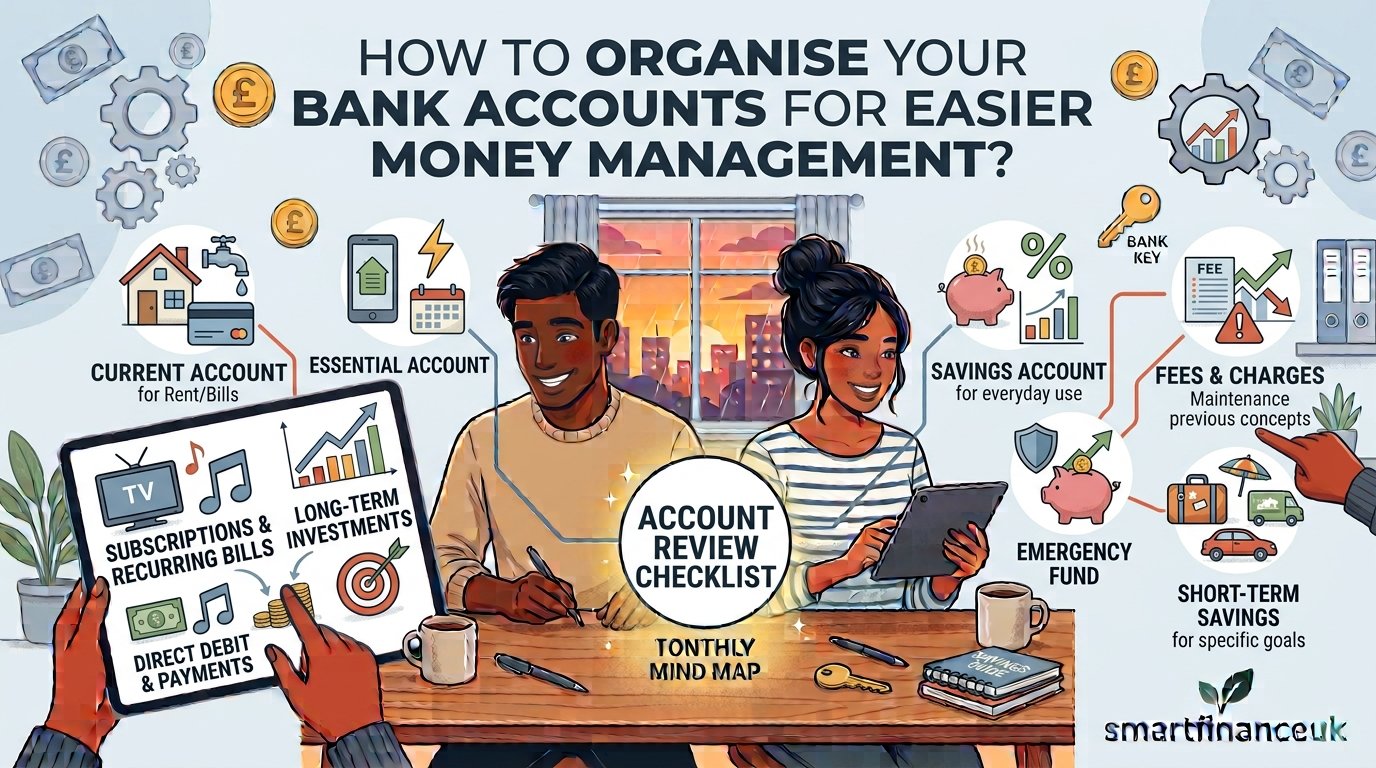
Your bank accounts can quietly become less useful over time.
A current account that once suited your spending habits may no longer offer the features you need. A savings account that looked competitive when you opened it may now pay a different interest rate. Fees can change, introductory offers can expire, and your own financial circumstances may have changed as well.
Reviewing your current and savings accounts periodically does not have to involve moving everything to a new provider. The first step is simply to understand what you currently have, what it costs, what it earns and whether it still fits your needs.
For UK readers, this means looking at things such as account fees, overdraft costs, savings rates, access conditions, protection arrangements and any requirements attached to the account. This guide explains what to check and how to carry out a simple account review without making the process unnecessarily complicated.
Why Review Your Bank Accounts?
It is easy to open an account and then leave it untouched for years.
That can be convenient, but it also means you may miss changes that affect your finances.
For example, a savings account may have an introductory rate that eventually ends. A current account may introduce or change a fee. An overdraft facility may become more expensive, or an account may no longer offer a feature you regularly use.
Your circumstances can change too.
Perhaps you have:
- Started earning a different amount
- Begun working from home
- Started travelling more
- Built up more savings
- Started using an overdraft less often
- Taken on a mortgage
- Begun saving for a specific goal
- Changed how you manage household bills
A short review can help you spot whether your accounts still make sense.
Start With Your Current Account
Your current account is usually where everyday money enters and leaves your finances.
Start by checking the account’s basic terms.
Look at:
- Monthly or annual fees
- Overdraft arrangements
- Overdraft interest
- Cash withdrawal conditions
- Debit-card charges
- Overseas spending fees
- Transfer limits
- Account benefits
- Minimum payment or deposit requirements
Many standard current accounts do not charge a monthly fee, but that does not mean every service is necessarily free.
MoneyHelper recommends checking charges associated with current accounts, including overdrafts, foreign transactions and other services.
The important thing is to focus on the costs that actually apply to your own banking habits.
Check Whether You Pay a Monthly Fee
The first question is straightforward:
Do you pay anything simply for having the account?
Some current accounts have no monthly fee, while packaged accounts charge in return for additional benefits.
If you have a paid account, review what you are receiving in return.
For example, a packaged account might include insurance or other services. That does not automatically make it better value.
Ask yourself whether you actually use the benefits and whether you would choose to pay for them separately.
If the account costs £12 a month, for example, that is £144 over a year. The figure is hypothetical, but it shows why a monthly charge is worth looking at annually rather than in isolation.
Review Your Overdraft
An overdraft is borrowing, so it deserves particular attention during a bank-account review.
Check whether you currently have:
- An arranged overdraft
- An overdraft limit you no longer need
- A balance that regularly goes into overdraft
- An interest charge when you use it
The Financial Conduct Authority requires firms to provide information about overdraft pricing and has rules governing how personal current-account overdraft charges are structured.
If you rarely use your overdraft, check whether the facility is still useful to you.
If you regularly rely on it, look carefully at the cost and consider whether the underlying budget problem needs attention rather than treating the overdraft as part of your normal income.
Look at Your Actual Bank Statements
Terms and conditions tell you what an account can charge.
Your bank statements tell you what it is actually costing you.
Review several recent months and look for:
- Overdraft interest
- Account fees
- Cash withdrawal charges
- Foreign transaction charges
- Other service fees
- Regular subscriptions
- Unusual payments
This is often more useful than simply reading the account’s headline features.
For example, you might discover that you have not paid an overdraft charge for 12 months. In that case, the overdraft rate may not be a major factor in your current comparison.
Alternatively, you might discover that regular overseas card use is creating charges you had not noticed.
Check Your Savings Interest Rate
Once you have reviewed your current account, turn to your savings.
The first thing to check is the current interest rate and AER.
AER stands for Annual Equivalent Rate and is designed to make savings accounts easier to compare by taking account of how interest is paid and compounded.
Do not assume that the rate you remember from when you opened the account is still the rate you are receiving today.
Savings rates can change, particularly when an account has a variable rate.
MoneyHelper recommends checking the rate your savings account is currently paying and comparing it with other available options.
Has an Introductory Rate Ended?
Some savings accounts offer a temporary bonus or introductory rate.
This can make the account attractive when you first open it.
The problem is that the rate may fall after the promotional period ends.
Suppose a hypothetical savings account offers a bonus for 12 months. Once the bonus expires, the underlying rate may be considerably lower.
If you never review the account, you could leave your money earning less without realising it.
Check:
When did the account’s bonus begin?
When does it end?
What rate applies afterwards?
Will the provider notify you?
Do you need to take any action?
The exact terms vary between accounts, so check the provider’s current information.
Check Whether the Savings Rate Is Fixed or Variable
A fixed-rate savings account normally provides an agreed rate for a specified period.
A variable-rate account can change.
This distinction matters when reviewing your savings.
If your rate is variable, you should not assume that today’s rate will continue indefinitely.
If your rate is fixed, check when the fixed period ends and what happens afterwards.
For example, a fixed-term account might move to a different savings product when the term finishes. The provider’s terms should explain the process.
Put the maturity date somewhere you will remember.
There is little benefit in finding a competitive account today if you forget to review it when the fixed period ends.
Check How Easy It Is to Access Your Savings
A savings account needs to match the purpose of the money.
Ask yourself:
Could I need this money unexpectedly?
If the answer is yes, easy access may be more important than obtaining the highest possible rate.
For example, an emergency fund is generally intended to cover unexpected costs. Keeping it somewhere accessible can be useful because you may need the money quickly.
MoneyHelper recommends keeping emergency savings accessible and explains that different savings products offer different levels of access.
On the other hand, money that you know you will not need for a particular period may be suitable for an account with more restrictive access, depending on your circumstances.
Check Withdrawal Restrictions
Do not stop at the words “easy access” or “instant access”.
Read the actual terms.
Some savings accounts may limit the number of withdrawals, reduce the interest rate after certain withdrawals or impose other conditions.
Fixed-term products can have even stronger restrictions.
Before moving money, find out:
- Whether withdrawals are allowed
- How quickly money can be withdrawn
- Whether there is a withdrawal limit
- Whether interest is affected
- Whether early access is possible
- Whether an early-access charge applies
The exact conditions depend on the account.
Review Your Savings Goals
An account can be perfectly good while being completely wrong for a particular purpose.
Consider why you are saving.
You may be building money for:
- An emergency fund
- A house deposit
- Home improvements
- A holiday
- A car
- Annual bills
- Education
- A future purchase
The purpose helps determine how much access you need and how much risk you are comfortable taking.
For short-term savings, protecting the money and having suitable access may be more important than seeking a higher potential return elsewhere.
Check Whether You Are Saving Enough
A bank-account review is also a useful opportunity to look at your savings contributions.
Look at how much you have added over the past few months.
Then ask:
Am I regularly putting money aside?
Is the amount realistic?
Have my savings goals changed?
Do I need to increase or decrease the amount?
Do not judge the answer against someone else’s savings target.
A sustainable contribution that fits your budget is generally more useful than setting an unrealistic target that you cannot maintain.
Check Your Savings Tax Position
Savings interest can have tax implications depending on your circumstances.
For the 2026/27 tax year, the Personal Savings Allowance is generally £1,000 for basic-rate taxpayers and £500 for higher-rate taxpayers, while additional-rate taxpayers do not receive a Personal Savings Allowance. Other rules, including the starting rate for savings, can also affect the position of some savers.
Interest from some tax-efficient accounts, such as Cash ISAs, is treated differently.
Because tax rules and individual circumstances can be complicated, do not assume that your situation is identical to another person’s.
If you are approaching a level of savings interest where tax may become relevant, check the latest HMRC guidance or seek appropriate professional advice.
Check Your FSCS Protection
If you keep significant cash savings with a bank, building society or credit union, check how deposit protection applies.
The Financial Services Compensation Scheme can protect eligible deposits with authorised firms, subject to its rules and limits.
MoneyHelper currently states that eligible deposits are protected up to £120,000 per person, per authorised firm.
The phrase authorised firm matters.
Different banking brands can sometimes operate under the same banking licence, so simply spreading money across different brand names does not necessarily mean each balance receives a separate protection limit.
If you hold a substantial amount of cash across several institutions, check the current FSCS information and how the relevant firms are authorised.
Check Whether You Are Paying for Features You Do Not Use
Go through your current-account benefits.
Do you actually use:
- Travel benefits?
- Insurance?
- Rewards?
- Cashback?
- Preferential rates?
- Other account services?
A feature has little practical value if you never use it.
This does not mean paid accounts are always poor value. It means you should assess the benefits against the fee and your circumstances.
Check Direct Debits and Standing Orders
Your bank-account review should not focus only on banking fees.
Look at recurring payments too.
A current account may be working exactly as intended, but old subscriptions and unused services could still be draining your balance.
Review:
- Streaming subscriptions
- Gym memberships
- Software subscriptions
- Insurance payments
- Charitable donations
- Memberships
- Regular transfers
Ask whether each payment is still necessary.
If you cancel something, make sure you understand the provider’s cancellation terms and do not simply cancel a payment where doing so could cause you to breach a contract.
Review Your Account Security
A financial review should also include security.
Check that:
- Your contact details are current
- Your mobile number is correct
- Your email address is up to date
- Your banking app is updated
- You recognise recent transactions
- You know how to report suspicious activity
- Your cards have not been saved with services you no longer use
If you notice a transaction you do not recognise, contact your bank through an official channel rather than responding to an unexpected message or telephone call.
The FCA provides consumer guidance on protecting yourself from financial scams and fraud.
A Simple Hypothetical Account Review
Imagine someone has:
Current account: used for salary, bills and daily spending.
Savings account: used for an emergency fund.
During their review, they discover:
- The current account has no monthly fee.
- They have not used their overdraft for several months.
- Their savings account is on a variable rate.
- The savings rate is lower than it was when the account was opened.
- They need the savings to remain accessible.
- They have an old subscription they no longer use.
There is no need to make a decision immediately.
The review has simply identified four things worth investigating: the savings rate, the account’s current terms, the unused subscription and whether the existing overdraft facility remains useful.
That is what a good account review should do. It gives you better information before you make a change.
How Often Should You Review Your Accounts?
There is no official requirement to review your accounts at a particular interval.
A practical approach is to carry out a basic review every few months and a more detailed review when something changes.
You may want to check sooner if:
- Your savings account has a temporary rate
- A fixed-rate term is ending
- Your bank changes its fees
- Your income changes
- You move house
- Your spending pattern changes
- You begin travelling more
- You build a much larger savings balance
The goal is not to constantly switch accounts.
It is to avoid leaving your finances on autopilot indefinitely.
Common Mistakes When Reviewing Bank Accounts
Looking only at the interest rate
A high savings rate may come with restrictions or a temporary bonus.
Ignoring access
An account that prevents easy withdrawals may not be appropriate for emergency savings.
Forgetting account fees
A monthly charge can become significant over a full year.
Leaving an expired bonus untouched
A savings rate can fall after an introductory period.
Assuming different banking brands always mean separate FSCS protection
Check the underlying authorised firm rather than relying on the brand name.
Closing an account too quickly
Before switching, check whether you need the account for regular payments, linked services or other financial arrangements.
Chasing every small rate difference
Switching repeatedly can create unnecessary work. Consider the actual financial difference and the account conditions before deciding whether a change is worthwhile.
A Simple Bank Account Review Checklist
You can use the following checklist when reviewing your accounts.
Current account
- Is there a monthly fee?
- Have I paid any charges recently?
- Do I use my overdraft?
- What does the overdraft cost?
- Do I use the account abroad?
- Are there account benefits I no longer need?
- Are all direct debits still necessary?
Savings account
- What AER am I currently receiving?
- Is the rate fixed or variable?
- Has an introductory bonus ended?
- Can I access my money when I need it?
- Are there withdrawal restrictions?
- Is there a minimum or maximum balance?
- Does the account still match my savings goal?
- Could tax on interest become relevant?
- Is my money appropriately covered by deposit protection?
This simple review can give you a much clearer picture of whether your accounts still fit your needs.
Questions to Ask Before Switching an Account
If your review suggests that a different account might be worth considering, ask:
What will this account actually cost me each year?
What rate will my savings receive, and for how long?
Is the savings rate fixed or variable?
Can I withdraw my savings when I need them?
Are there conditions attached to the advertised rate?
Will I lose an existing benefit by switching?
Will regular payments need to be changed?
Does the provider offer the banking facilities I actually use?
How does deposit protection apply?
Is the potential benefit large enough to justify changing accounts?
You do not need to switch simply because another account has a slightly better headline rate.
Frequently Asked Questions
How often should I check my current account?
Checking your transaction history regularly is useful for spotting unexpected payments and keeping track of spending. A more detailed review of fees, overdraft arrangements and account features can be done every few months or whenever your circumstances change. There is no need to switch accounts regularly simply for the sake of switching.
How often should I review my savings account?
A savings account is worth reviewing periodically, particularly if it has a variable rate or temporary introductory bonus. Also check the account when a fixed term is approaching its end. The purpose is to make sure the rate, access conditions and account features still fit your savings goal.
Should I switch savings accounts if another one pays more interest?
Not automatically. Compare the AER, access conditions, minimum deposits, withdrawal restrictions, introductory periods and any other relevant terms. Also consider the actual difference in interest on your balance. A slightly higher rate may not be worth moving your money if the new account has restrictions that do not suit your needs.
Is money in a savings account protected in the UK?
Eligible deposits held with UK-authorised banks, building societies and credit unions can be protected by the FSCS, subject to its rules and limits. MoneyHelper currently states protection of up to £120,000 per person per authorised firm. Check how the protection applies to your specific providers, especially if you hold large balances across several banking brands.
What is the difference between a fixed and variable savings rate?
A fixed savings rate is normally set for an agreed period, while a variable rate can change. A fixed rate can provide greater certainty but may come with restrictions on accessing your money. A variable account may provide more flexibility but the interest rate can fall or rise. Always check the account’s specific terms.
Can my bank change my savings interest rate?
If your savings account has a variable rate, the provider can generally change it subject to its terms and applicable rules. A fixed-rate account is designed to provide a fixed rate for the agreed period. Check your provider’s communications and account terms so you know when changes may occur.
Do I need to change banks if I find a better savings rate?
No. You can compare savings products without necessarily changing your main current account. If another savings account appears more suitable, check its terms and the process for moving your money. Make sure you understand any restrictions on your existing account before transferring funds.
Final Thoughts
Reviewing your current and savings accounts does not have to mean constantly switching banks.
Start with the basics: find out what your accounts cost, what your savings are earning, whether your money is accessible when needed and whether the accounts still fit your circumstances.
Then look at the details that are easy to overlook, such as introductory rates, withdrawal conditions, overdraft costs, account benefits, recurring payments, tax considerations and FSCS protection.
A useful review should leave you with a clearer picture of your finances. Sometimes that will lead to a change. Sometimes it will confirm that your existing accounts are perfectly suitable.
The important part is making the decision based on current information rather than leaving your accounts unchecked simply because they have always been there.
This article provides general financial education for UK readers and is not personalised financial advice. Interest rates, fees, account terms and tax rules can change, so check current information from the relevant provider and authoritative UK sources before making a financial decision.