
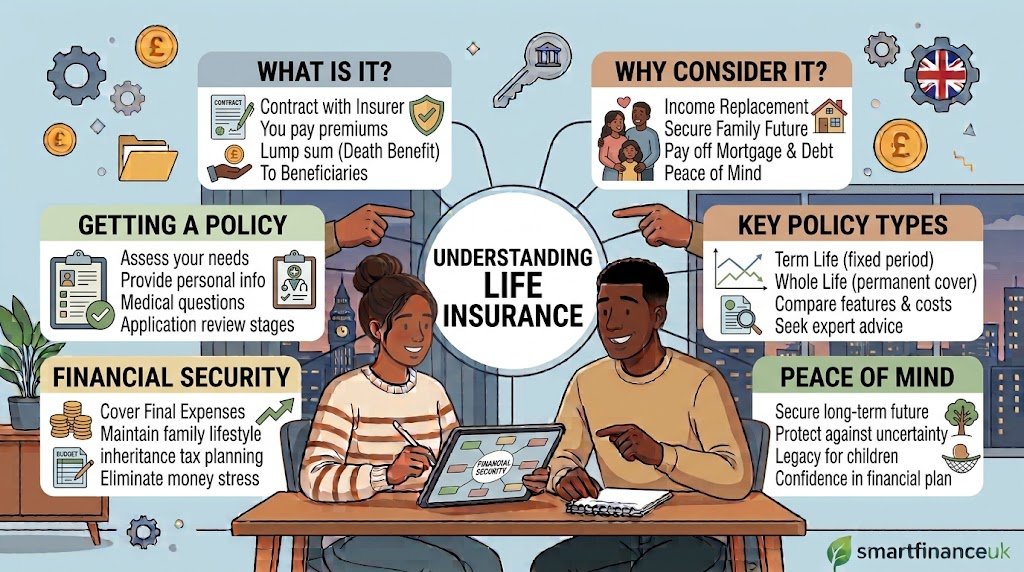
Life insurance is designed to provide financial support to people who depend on you if you die. Depending on the policy, it can pay a lump sum or, in some cases, regular payments to beneficiaries after the insured person’s death. For a household that relies on one or more incomes, this can help with financial commitments such as mortgage payments, rent, household bills, childcare or other costs.
Not everyone needs life insurance, and taking out a policy is not automatically the right choice for every household. The value of cover depends on your circumstances, including whether anyone relies on your income, your debts, housing costs, existing savings and any cover you already receive through work.
Understanding what life insurance actually does is therefore a useful first step before comparing policies or requesting quotes.
What Is Life Insurance?
Life insurance is a type of protection insurance that can pay money to your chosen beneficiaries when you die, provided the claim meets the terms of the policy.
The amount paid depends on the level of cover you purchase and the type of policy.
For example, a hypothetical policy might provide £250,000 of cover for a specified period. If the policyholder dies during that period and the claim meets the policy conditions, the insurer could pay the insured amount to the appropriate recipient.
The money could potentially help loved ones manage financial commitments after the policyholder’s death.
Life insurance is therefore different from savings. With a typical life insurance policy, you are paying premiums for financial protection rather than building a cash balance that you can simply withdraw whenever you want.
The Financial Conduct Authority describes life insurance as one of the main forms of pure protection insurance, alongside products such as critical illness and income protection.
How Does Life Insurance Work?
The basic process is relatively straightforward.
You apply for a policy and provide information requested by the insurer. Depending on the policy and your circumstances, this may include questions about your age, health, lifestyle, occupation and medical history.
You then pay a premium, usually monthly or annually.
In return, the insurer provides the agreed protection subject to the policy terms.
If you die in circumstances covered by the policy, the insurer assesses the claim. If the claim is accepted, the policy pays the agreed benefit according to its terms.
The important point is that the policy wording determines what is covered and how the benefit is paid.
This is why providing accurate information when applying is important. MoneyHelper warns that failing to answer questions accurately or disclose information requested by the insurer can cause problems with a later claim.
Why Do People Consider Life Insurance?
People generally consider life insurance because their death could create a financial problem for someone else.
Imagine a household where one person provides a significant part of the income.
If that person dies, the family could lose part of its regular income while still having to pay for:
- mortgage or rent
- council tax
- household bills
- childcare
- food
- transport
- education
- existing debts
- other regular expenses
Life insurance cannot replace the person who has died, but a payout may provide financial support during a difficult period.
MoneyHelper specifically identifies dependants, partners who rely on income and funeral costs among the reasons someone might consider life insurance.
Who Might Consider Life Insurance?
There is no universal rule saying that everyone needs life insurance.
It can be particularly relevant when another person would experience financial difficulty following your death.
Parents With Dependent Children
Parents may consider life insurance because children depend on the household’s income and financial resources.
The financial impact of losing a parent can involve much more than replacing a salary. There may also be childcare costs, housing costs and everyday expenses to consider.
The appropriate level of cover depends on the family’s circumstances.
People With a Partner Who Relies on Their Income
A partner may rely partly or entirely on your earnings to meet household expenses.
A life insurance payout could potentially help them manage those costs if you die.
This can be relevant even when there are no children.
Homeowners With a Mortgage
A mortgage is a long-term financial commitment.
Life insurance is not legally required to obtain a mortgage, but some homeowners choose cover so their dependants have money that could help with the mortgage and other household costs after their death. MoneyHelper confirms that life insurance is not a legal requirement for a mortgage.
It is important not to confuse life insurance with buildings insurance. They protect against completely different risks.
People With Other Financial Commitments
Life insurance can also be considered where someone has significant debts or other financial responsibilities.
A policy does not necessarily have to be designed solely around a mortgage.
The purpose is to consider what financial commitments could remain and who might be affected if your income or financial contribution disappeared.
When Might Someone Not Need Life Insurance?
Life insurance is not automatically necessary for everyone.
Someone might decide that they do not currently need it if nobody depends financially on them and they have sufficient savings or other resources to deal with their financial commitments.
For example, a single person without dependants may have less need for a policy designed primarily to protect dependants.
MoneyHelper also notes that someone whose partner earns enough to support the household may decide not to take out life insurance.
That does not mean there is a single correct answer.
Circumstances can change. Marriage, having children, buying a home, taking on substantial debt or changing employment can all be reasonable points at which to review your financial protection.
What Are the Main Types of Life Insurance?
There are several forms of life insurance, but two broad categories are particularly important: term life insurance and whole of life insurance.
Term Life Insurance
Term life insurance provides cover for a specified period, known as the term.
A policy might run for a particular number of years. If the policyholder dies during the covered term and the claim meets the policy conditions, the policy can pay the agreed benefit.
If the policy reaches the end of its term and the policyholder is still alive, the standard policy does not normally pay out.
There are different forms of term insurance.
Level Term Life Insurance
With level term insurance, the amount of cover remains broadly the same throughout the policy term.
For example, a hypothetical £200,000 policy could provide £200,000 of cover throughout its agreed term, subject to the policy conditions.
This can make the structure relatively straightforward.
Decreasing Term Life Insurance
With decreasing term insurance, the amount of cover reduces over time.
This type of policy is commonly associated with repayment mortgages because the outstanding mortgage balance can also reduce over time.
The aim is for the insurance protection to broadly reflect a reducing financial liability.
However, the policy’s reduction schedule and the mortgage balance will not necessarily match perfectly, so the terms should be checked carefully.
Increasing Term Life Insurance
Increasing term insurance allows the level of cover to rise over time.
This can be designed to help protect the purchasing power of the payout against inflation.
The trade-off is that premiums can be higher than for a comparable level-term policy.
MoneyHelper identifies level, decreasing and increasing term life policies as the main types of term insurance.
Whole of Life Insurance
Whole of life insurance is designed to pay out whenever the policyholder dies, provided the policy remains in force and the terms are met.
This is different from term insurance, which has a defined period of cover.
Whole of life policies are typically more expensive than shorter-term life insurance. MoneyHelper also warns that some whole of life policies can have premiums reviewed periodically, potentially increasing over time.
Some people consider whole of life insurance for long-term estate or inheritance tax planning, but this area can become complicated.
If inheritance tax planning is the reason for considering a policy, professional advice may be appropriate rather than relying on a general explanation.
Single Life or Joint Life Insurance?
Another decision is whether the policy covers one person or two.
Single Life Insurance
A single-life policy covers one person.
If the insured person dies during the covered period, the policy can pay according to its terms.
Couples can have separate policies so that each person has their own protection.
Joint Life Insurance
A joint policy covers two people.
A common type pays out on the first death, after which the policy ends.
MoneyHelper notes that joint life insurance can be cheaper than two separate single policies, but two individual policies can provide a payout on each person’s death.
This distinction can be important for couples with children or other dependants.
The cheapest arrangement is not necessarily the most appropriate one.
What Does Life Insurance Actually Pay For?
There is no rule that says a life insurance payout must be used for a particular expense.
Depending on the arrangement, the money can provide financial support for the people receiving it.
For example, a payout could potentially help with:
Mortgage costs: A family might use some of the money to reduce or repay a mortgage.
Household expenses: The payout could provide a financial cushion while the surviving household adjusts to a lower income.
Childcare and education: Families may consider future costs associated with raising children.
Debts: Outstanding financial commitments may need to be considered.
Funeral expenses: Some people consider life insurance partly to help their family meet funeral costs.
The actual use of the money depends on the beneficiaries and the circumstances surrounding the policy.
Does Life Insurance Cover Illness?
This is a common misunderstanding.
Standard life insurance primarily pays when the insured person dies, rather than simply because they become ill.
Some policies include a terminal illness benefit that may allow an early claim if specific conditions are met. MoneyHelper explains that many life insurance policies include terminal illness benefits, subject to their definitions and terms.
However, life insurance is not the same as critical illness insurance.
Critical illness cover can provide a lump sum if the policyholder is diagnosed with a specified serious illness covered by the policy.
The definitions and conditions are important.
What Is the Difference Between Life Insurance and Income Protection?
Life insurance and income protection deal with different financial risks.
Life insurance: Primarily provides a benefit after the policyholder dies.
Income protection: Can provide regular payments when someone is unable to work because of illness or injury, subject to the policy terms.
This distinction matters because losing an income due to illness while remaining alive is not normally what standard life insurance is designed to cover.
MoneyHelper identifies income protection as a separate form of financial protection.
Someone concerned about both death and loss of earnings may therefore need to consider different types of protection rather than expecting one policy to cover every situation.
Is Life Insurance Required for a Mortgage?
No. Life insurance is not a legal requirement for taking out a mortgage in the UK.
However, a mortgage lender can have its own requirements concerning buildings insurance and other matters.
A homeowner might still choose life insurance because their family could struggle to maintain the mortgage if they died.
For example, consider a hypothetical couple with a repayment mortgage and two children. If one person’s income represents a substantial part of the household budget, the surviving household could face a significant financial adjustment.
Life insurance might be considered as one way of providing additional financial protection.
The appropriate cover depends on the household’s circumstances.
How Much Life Insurance Might Someone Need?
There is no single figure that works for everyone.
A useful starting point is to consider the financial gap that could arise after your death.
Think about:
- outstanding mortgage
- other significant debts
- household income
- number of dependants
- children’s ages
- childcare costs
- regular household expenses
- existing savings
- workplace death-in-service benefits
- existing life insurance
- other financial assets
For example, someone with a large mortgage and young children could have very different protection needs from a single person with no dependants and substantial savings.
MoneyHelper also identifies debts, mortgage or rent and household circumstances as factors when considering the amount of cover needed.
A useful exercise is to calculate what your household would lose financially rather than choosing an arbitrary round number.
Check Whether Your Employer Already Provides Cover
Before buying a separate policy, check your employment benefits.
Some employers provide death-in-service benefits as part of an employee benefits package.
These can provide a payment to beneficiaries if you die while employed and covered by the scheme.
However, employer-provided cover usually depends on remaining eligible through that employment.
MoneyHelper warns that death-in-service cover can end when you leave the employer.
This means it should not automatically be treated as a permanent replacement for personal life insurance.
If you change jobs, review your protection arrangements.
What Affects the Cost of Life Insurance?
Life insurance premiums vary between individuals.
Factors can include:
- age
- health
- lifestyle
- smoking status
- medical history
- occupation
- policy term
- level of cover
- type of policy
MoneyHelper identifies these factors as relevant to life insurance pricing.
This is one reason it is not sensible to assume that another person’s premium tells you what your policy should cost.
The insurer assesses your circumstances when calculating the premium.
Providing accurate information is essential.
Why Medical Information Matters
When applying for life insurance, you may be asked questions about your health and medical history.
It can be tempting to leave out information that you think is irrelevant or that you worry might increase the premium.
That is risky.
MoneyHelper specifically advises applicants to be honest about their medical history and says inaccurate or incomplete information can cause problems when making a claim.
If you are unsure whether something needs to be disclosed, ask the insurer or adviser rather than deciding yourself that it does not matter.
What Is a Beneficiary?
A beneficiary is someone who receives the life insurance benefit.
You can normally nominate the person or people you want to receive the policy proceeds, subject to the policy’s arrangements.
For example, a person might nominate their partner or children.
The way the policy is legally arranged can affect how and when the money reaches beneficiaries.
MoneyHelper explains that placing a policy in trust can, in suitable circumstances, allow proceeds to be paid outside the estate and potentially avoid the probate process. It can also have inheritance tax implications.
Trusts can have legal and tax consequences, however, so anyone considering this arrangement should understand it properly and consider professional advice where appropriate.
What Happens If You Stop Paying?
A life insurance policy generally depends on premiums being paid as required.
If premiums stop, the policy can eventually lapse and the protection can be lost.
If affordability becomes a problem, it can be better to contact the insurer before simply cancelling the policy or allowing payments to stop.
MoneyHelper says insurers must support customers who are experiencing financial difficulty and may discuss options such as alternative repayment arrangements or adjusting cover.
Cancelling an existing policy also has another potential disadvantage: replacing it later may be more expensive because you are older or your health circumstances may have changed.
What Should You Check Before Buying Life Insurance?
Before choosing a policy, look beyond the monthly premium.
Check:
The amount of cover: Is it enough for the financial needs you are trying to protect?
The term: Does the policy last long enough for your dependants or financial commitments?
The type: Would level, decreasing or increasing term insurance fit the purpose?
Exclusions: Are there circumstances that would prevent a claim?
Medical information: Have you answered application questions accurately?
Beneficiaries: Have you considered who should receive the benefit?
Existing cover: Do you already have insurance or death-in-service benefits?
Premium affordability: Can you realistically maintain the payments?
Policy conditions: Do you understand when and how the insurer will pay?
MoneyHelper recommends shopping around because premiums can differ between providers.
Common Life Insurance Mistakes to Avoid
Buying Cover Without Knowing Why You Need It
Start with the financial problem you are trying to solve.
Cover designed to protect a repayment mortgage may be structured differently from cover intended to provide a family income.
Ignoring Existing Workplace Benefits
You may already have some protection through your employer.
Check the details before buying additional cover.
Choosing an Arbitrary Amount
Choosing £100,000 or £500,000 simply because it sounds reasonable may not reflect your actual needs.
Consider debts, income, dependants and existing assets.
Assuming Life Insurance Covers Illness
Standard life insurance primarily covers death.
Critical illness and income protection are separate forms of insurance.
Providing Inaccurate Medical Information
This can create problems with a future claim.
Answer application questions honestly and carefully.
Cancelling an Existing Policy Before Replacement Cover Is Active
If you are considering switching, make sure replacement protection is fully arranged before cancelling existing cover. MoneyHelper specifically warns against cancelling an existing policy before replacement cover is set up and the first payment has been made.
Choosing Only on Price
A lower premium does not automatically mean better value.
Compare the cover and conditions as well as the cost.
A Simple UK Example
Consider a hypothetical household with two adults, two children and a repayment mortgage.
One adult earns most of the household income. If that person dies, the surviving family could still face mortgage payments, household bills and childcare costs.
The household might therefore consider life insurance that provides a suitable lump sum if the income-earning adult dies during the policy term.
The exact amount of cover would depend on the mortgage balance, household income, existing savings, other benefits and the family’s expected financial needs.
This example does not suggest that a particular policy or amount is suitable for every family.
Questions to Ask Before Making a Decision
Before buying life insurance, consider asking:
- Who would experience financial difficulty if I died?
- What debts would remain?
- How much is left on my mortgage?
- How much of my household income do I provide?
- How long would my dependants need financial support?
- Do I already have death-in-service cover?
- Do I already have another life insurance policy?
- Would my family need help with housing costs?
- Do I need protection against illness as well as death?
- How long should the policy last?
- Would level, decreasing or increasing cover be appropriate?
- Can I comfortably afford the premiums?
- What exclusions and conditions apply?
- Who should receive the policy benefit?
These questions can help you understand the purpose of the cover before comparing individual policies.
Frequently Asked Questions
Is life insurance worth having in the UK?
Whether life insurance is worthwhile depends on your circumstances. It can be particularly useful where children, a partner or other people depend on your income. Someone without dependants and with sufficient financial resources may have less reason to buy it. The key question is what financial effect your death would have on other people and whether existing savings or workplace benefits would be enough to deal with that impact.
Is life insurance compulsory in the UK?
No. There is no general legal requirement for individuals to have life insurance. It is also not a legal requirement for obtaining a mortgage, although a person may choose it to protect dependants against the financial consequences of their death. This is different from buildings insurance, which mortgage lenders commonly require as a condition of lending.
Does life insurance pay out if you become seriously ill?
Standard life insurance is primarily designed to pay on death. Some policies include a terminal illness benefit, subject to specific conditions, which may allow an early claim. Critical illness insurance is different: it can pay a lump sum following diagnosis of a specified serious illness covered by the policy. Income protection is another separate product designed to provide financial support when illness or injury prevents someone from working.
Can life insurance help pay off a mortgage?
It can, depending on the policy and the amount of cover. Some people choose decreasing term insurance specifically because the level of cover can reduce broadly in line with a repayment mortgage. Others choose level cover to provide a fixed amount throughout the term. A life insurance payout does not automatically have to be used to repay a mortgage, but the household may choose to use it for that purpose.
What is the difference between term and whole of life insurance?
Term insurance provides cover for a specified period and normally pays only if the policyholder dies during that term. Whole of life insurance is designed to pay whenever the policyholder dies, provided the policy remains in force and its conditions are met. Whole of life policies are generally more expensive and can have more complicated premium arrangements. The appropriate type depends on the reason for seeking cover.
Can I have life insurance through my employer?
Yes. Some employers provide death-in-service benefits as part of their employee benefits. These can provide financial support to beneficiaries if an eligible employee dies while covered by the scheme. However, this cover may end when employment ends, so it should not automatically be assumed to provide lifelong protection. Check your employment benefits and the scheme’s terms carefully.
Does life insurance cover funeral costs?
A life insurance payout can potentially be used to help with funeral expenses because the benefit can provide financial support to the recipient. However, the policy is not necessarily specifically designed as a funeral plan. If paying for funeral costs is the main reason for considering cover, compare the available options carefully rather than assuming a standard life insurance policy is automatically the most suitable solution.
Final Thoughts
Life insurance is essentially about protecting people from the financial consequences of your death.
It can be particularly relevant when a partner, children or other dependants rely on your income, or when significant financial commitments such as a mortgage would remain after your death.
It is not the same as critical illness insurance, income protection or home insurance. Each product deals with a different type of financial risk.
Before considering a policy, look at your household’s actual situation. Think about debts, mortgage or rent, income, dependants, savings and any existing workplace protection. Then consider how much financial support your family might need and for how long.
If you decide to explore life insurance, compare the policy terms as well as the premium. Pay close attention to the type of cover, term, exclusions, medical questions, beneficiaries and affordability.
Life insurance can be useful financial protection, but it is not automatically necessary for everyone. The right decision depends on the circumstances you are trying to protect.
This article provides general educational information for UK readers and is not personalised financial or insurance advice.
Sources and Further Reading
- MoneyHelper — What is life insurance? — Detailed guidance on how life insurance works, types of cover, beneficiaries, costs and buying considerations.
- MoneyHelper — How to get your finances in order before you die — Covers life insurance alongside other forms of financial protection and estate planning.
- Financial Conduct Authority — Protecting consumers — Information about consumer protection and standards for regulated financial services firms.
- Financial Conduct Authority — Your rights with financial services — Guidance on choosing authorised financial firms and consumer rights.
- MoneyHelper — Life insurance for over 50s — Useful information about the differences and considerations surrounding over-50s life insurance.