
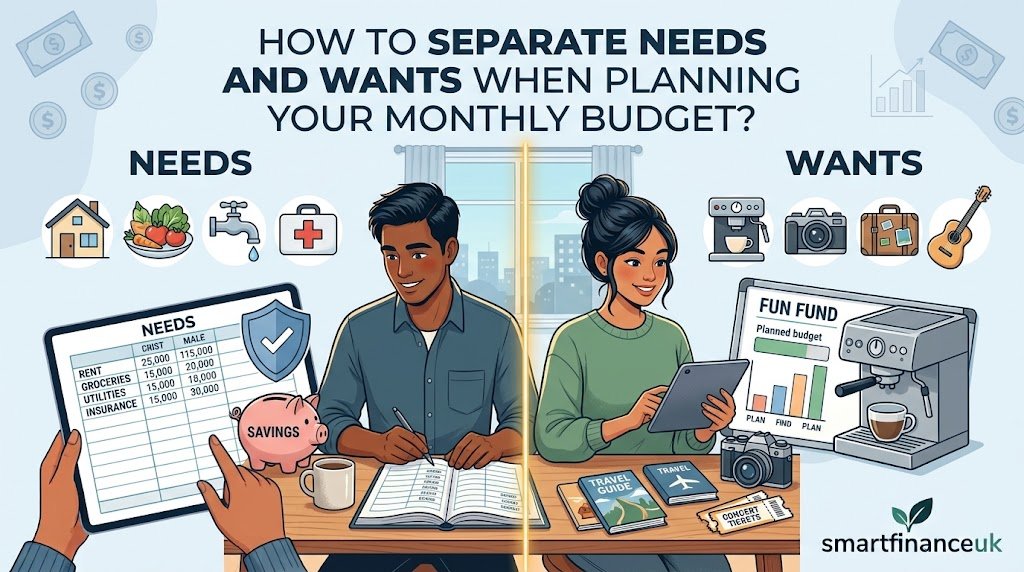
Creating a monthly budget becomes much easier when you know which expenses are essential and which ones are optional. But the distinction is not always as simple as it sounds. Some costs that look like wants can be necessary in certain households, while some spending that feels essential may actually be flexible.
The aim is not to remove everything enjoyable from your budget. It is to understand where your money is going so you can decide what deserves priority, especially when income is limited or you are trying to save.
For UK households, this means looking at costs such as rent or mortgage payments, Council Tax, energy, food, transport, insurance, debt repayments, subscriptions and personal spending. Once these expenses are separated into useful groups, you can see which costs need protecting and where there may be room to adjust.
This guide explains how to separate needs and wants in a practical way without making your monthly budget unnecessarily complicated.
What Are Needs and Wants?
A need is generally an expense required to maintain basic living, meet an important financial obligation or avoid a serious problem.
A want is usually something that improves convenience, enjoyment or lifestyle but is not essential to meeting your basic needs or financial commitments.
Some obvious examples are:
Potential needs:
- Housing costs
- Basic food
- Essential household bills
- Council Tax or domestic rates
- Essential transport
- Insurance required for your circumstances
- Minimum debt repayments
- Essential communication costs
Potential wants:
- Takeaways
- Entertainment
- Unused subscriptions
- Non-essential shopping
- Upgrades to existing products
- Some hobbies
- Luxury versions of everyday items
However, these categories are not universal.
A car might be unnecessary for someone living close to work and public transport but essential for someone who has to travel to work in an area with limited public transport.
Similarly, broadband may be considered a basic household requirement for someone who works remotely or studies from home.
The useful question is not simply, “Is this a need or a want?”
Ask:
“What would happen if I stopped paying for this?”
That question gives you more useful information.
Why Separating Needs and Wants Helps With Budgeting
When money is available for everything, the distinction may not seem particularly important.
It becomes much more useful when your income is under pressure.
Suppose your monthly income is £2,000 and your essential expenses take up £1,750. You have limited room for discretionary spending and saving.
Knowing which expenses are flexible helps you decide what to change.
If you need to reduce spending by £100, you would probably look at optional expenses before cutting money needed for housing, food or essential bills.
This approach also helps when setting savings goals.
Instead of randomly cutting spending, you can identify expenses that matter less to you and redirect some of that money towards savings or another financial priority.
MoneyHelper’s budgeting guidance recommends looking closely at your actual income and spending when building a budget. Its Budget Planner can help organise expenses and identify where money is going.
Not Every Expense Fits Neatly Into One Category
One of the biggest problems with the needs-versus-wants approach is assuming that every expense belongs completely to one side.
Some expenses are somewhere in between.
Take a mobile phone.
A basic phone and some level of mobile service might be necessary for communication, work or emergencies. But an expensive handset with a premium contract may contain a significant discretionary element.
The same applies to food.
Food is a need. But a particular takeaway, premium ingredient or restaurant meal is generally a want.
Transport is another example.
Getting to work may be essential. Paying for a more expensive method of transport when a practical lower-cost option exists could involve a discretionary choice.
Instead of asking whether the entire expense is a need or want, separate the essential part from the optional part.
That makes your budget much more realistic.
Start With Your Essential Monthly Costs
Before deciding what to cut, identify the expenses that need to be paid first.
For many UK households, this could include:
Housing
Rent or mortgage payments are usually among the largest household expenses.
If you have a mortgage, remember that the total cost of owning a home can involve more than the monthly mortgage payment. Insurance, maintenance and other property-related expenses may also need to be considered.
Council Tax or Domestic Rates
Most households in England, Scotland and Wales pay Council Tax, although arrangements and local charges differ. Northern Ireland uses domestic rates instead.
Do not assume that your household’s local tax or rates bill will be identical to someone else’s.
Household Bills
These can include energy, water, broadband and other services.
Some bills are fixed or relatively predictable, while others can change.
Food
Basic food is a need, but the amount spent can vary considerably between households.
The goal is not to decide that all food spending beyond the cheapest possible option is unnecessary.
Instead, distinguish between essential groceries and discretionary food spending.
Transport
Transport needed to get to work, education, medical appointments or other essential commitments may be a need.
The exact cost depends heavily on where you live and your circumstances.
Debt Repayments
Required repayments on loans, credit cards and other borrowing should be included in your budget.
Missing contractual repayments can have financial consequences, so they should not be treated like optional spending.
Then Identify Your Wants
Once essential expenses are clear, look at discretionary spending.
This might include:
- Restaurants and takeaways
- Cinema and other entertainment
- Streaming subscriptions
- Games and hobbies
- Non-essential clothing
- Premium versions of everyday products
- Impulse purchases
- Frequent convenience spending
- Some holidays and leisure activities
This does not mean you need to eliminate these expenses.
A sustainable budget can include wants.
In fact, removing every enjoyable expense can make a budget difficult to maintain.
The important thing is knowing what you are choosing to spend rather than accidentally spending money that you intended to save.
Use Three Categories Instead of Two
For many people, a strict needs-versus-wants system is too simplistic.
A three-category system can work better:
Needs
Expenses required for basic living and important financial commitments.
Wants
Expenses that are enjoyable or convenient but could reasonably be reduced or postponed.
Flexible essentials
Expenses that are necessary but where you have some control over the amount.
For example, groceries could be a flexible essential.
You need food, but you may have choices about where you shop, what you buy, how often you eat out and how much food is wasted.
Transport can work the same way.
You may need to travel, but there could be different options with different costs.
This third category helps prevent you from treating every essential expense as completely fixed.
A Simple Hypothetical Example
Imagine a household has £2,400 of monthly take-home income.
Its expenses might look like this:
| Expense | Monthly amount | Category |
|---|---|---|
| Rent | £900 | Need |
| Council Tax | £150 | Need |
| Energy and water | £180 | Need |
| Groceries | £300 | Flexible essential |
| Transport | £160 | Flexible essential |
| Insurance | £70 | Need |
| Debt repayments | £120 | Need |
| Streaming services | £30 | Want |
| Eating out | £100 | Want |
| Hobbies | £60 | Want |
| Clothing | £70 | Flexible/want |
These figures are entirely hypothetical and are not representative of typical UK household costs.
The value of the example is the classification.
If the household needs to reduce spending, cancelling a useful insurance policy would not normally be the first place to look.
Reducing takeaway spending, reviewing subscriptions or changing some discretionary purchases may offer more flexibility.
Ask Yourself Five Questions About Each Expense
When you are unsure whether something is a need or want, ask:
1. What happens if I stop paying for it?
Would stopping the expense affect housing, food, safety, employment or an important financial obligation?
If yes, it may be a need.
2. Is there a cheaper version that still meets the need?
If there is, the underlying expense may be necessary but the current amount may be partly discretionary.
3. How often do I use it?
An unused subscription is easier to question than something your household relies on every day.
4. Can I delay the purchase?
If you can comfortably postpone it for several weeks or months, it may be a want rather than an immediate need.
5. Does this expense support an important priority?
Your priorities matter.
Someone saving for a house deposit may make different choices from someone rebuilding an emergency fund or paying down expensive debt.
A budget should reflect your circumstances rather than follow someone else’s lifestyle.
Look at the Difference Between “Need” and “Preference”
This distinction can reveal hidden spending.
You might need:
A mobile phone.
But you may prefer:
A premium handset with the latest features.
You might need:
Food for the household.
But you may prefer:
Regular restaurant meals.
You might need:
Transport to work.
But you may prefer:
A more expensive travel option because it is more convenient.
Preferences are not bad.
They simply need to fit within the amount of money available after essential commitments.
This way of thinking avoids labelling ordinary enjoyment as irresponsible while still making discretionary spending visible.
Review Subscriptions and Recurring Payments
Recurring payments deserve particular attention because they can continue without requiring a new decision every month.
Look through your bank statement for:
- Streaming services
- Apps
- Gym memberships
- Software
- Clubs
- Memberships
- Delivery subscriptions
- Digital services
For each one, ask whether you still use it.
If you use a service regularly and value it, it may be worth keeping.
If you forgot you were paying for it, that is a different situation.
The same principle applies to insurance and other financial products, although these should not be cancelled simply because they are recurring. Consider what protection you would lose and whether the policy is important for your circumstances.
Be Careful With “Small” Wants
Small purchases are easy to dismiss.
A £4 coffee is unlikely to transform your finances by itself.
The issue is repetition.
If a small discretionary purchase happens frequently, the total can become significant.
Suppose someone spends a hypothetical £5 on an optional purchase three times a week.
That is around £60 over four weeks.
Again, the point is not that the person should automatically stop spending the money.
It is to make the cost visible.
Once you see the monthly total, you can decide whether that spending is worth the trade-off.
Do Not Cut Needs Just Because They Are Expensive
A high-cost item is not automatically a want.
Housing is an obvious example.
If your rent or mortgage payment is large, it may be one of your biggest monthly expenses, but that does not make it discretionary.
The same can apply to childcare, disability-related costs, transport for work or certain healthcare-related expenses.
Instead of deciding that an expensive need should simply be eliminated, ask whether there are realistic ways to reduce the cost without creating a more serious problem.
For example, some households may be able to review energy usage, transport arrangements or insurance options.
But cost-cutting should not create a false economy.
Choosing a cheaper option that no longer meets your actual needs is not necessarily a saving.
Include Wants in Your Budget
A common budgeting mistake is treating wants as though they should not exist.
That can create an unrealistic plan.
If you normally spend £60 a month on hobbies and know that you value them, include that amount in the budget if it is affordable.
Then you know exactly what the spending costs.
You can make an informed choice:
“I am spending £60 a month on hobbies, and I am comfortable with that.”
That is different from spending £60 without noticing and then wondering why your savings target was missed.
A good budget gives discretionary spending a place instead of pretending it will disappear.
Separate Wants From Impulse Purchases
Not every want is an impulse purchase.
A planned holiday is a want, but it may be something you have deliberately saved for over many months.
An impulse purchase is different.
You did not plan for it, but something encouraged you to spend immediately.
When trying to save money, impulse spending can be worth reviewing.
Before making a non-essential purchase, consider waiting.
For larger purchases, you might give yourself a longer cooling-off period.
If you still want the item later and the purchase fits your budget, you can make the decision with more information.
What If Your Needs Take Up Almost All Your Income?
This is where the distinction becomes especially important.
If your essential expenses consume nearly all your income, cutting wants may help, but there may be a limit to what it can achieve.
You cannot normally eliminate rent, food or essential bills simply because you want to save more.
If there is consistently not enough money left after essential expenses, look at the bigger picture.
Consider whether there are:
- Bills that can realistically be reduced
- Unused services that can be cancelled
- Available support or benefits
- More affordable arrangements
- Debt repayments that need attention
- Changes in income
- Free or impartial debt advice that could help
MoneyHelper provides budgeting, benefits and debt guidance for people dealing with financial difficulties.
If debt repayments are becoming difficult, do not rely on additional borrowing simply to make the monthly budget appear balanced.
How to Use Needs and Wants When Saving Money
Once your expenses are classified, you can make savings decisions more logically.
Start with needs.
Make sure essential bills and contractual financial commitments are accounted for.
Then look at flexible essentials.
Can you reduce waste, compare costs or change habits without affecting the underlying need?
Finally, review wants.
Ask which ones matter most.
You may decide that one subscription is worth keeping but another is not.
You might prefer cooking at home more often while still allowing some money for eating out.
You might reduce impulse shopping but continue saving for a planned holiday.
The objective is not to make every discretionary expense disappear.
It is to create enough room for your financial priorities.
Common Mistakes to Avoid
Calling everything a need
If every expense is treated as essential, there is no useful way to identify where savings might be possible.
Calling everything enjoyable a waste
Enjoyment has a legitimate place in a household budget.
Using someone else’s budget categories
Your circumstances may be very different from those of a friend, influencer or finance website.
Ignoring flexible essentials
Some necessary expenses can still be managed more efficiently.
Cutting essential costs without considering the consequences
A cheaper option is not always better if it creates another financial or practical problem.
Setting a savings target before understanding your expenses
Work out what your budget can realistically support first.
A Practical Monthly Needs-and-Wants Review
You can review your expenses in about 15 minutes.
Start by checking your latest bank transactions.
Mark each expense as:
Need
Flexible essential
Want
Then total each group.
Look at the wants and ask which ones still provide enough value to justify their cost.
Next, review flexible essentials and identify realistic opportunities to reduce spending.
Finally, check whether the amount you are saving is realistic.
If the budget leaves you short every month, change the plan rather than repeatedly trying to force the same numbers to work.
Frequently Asked Questions
Is food a need or a want?
Basic food is a need, but not every food purchase is essential. Groceries needed to feed your household would generally be treated as a need or flexible essential. Takeaways, restaurant meals and premium purchases may be discretionary. The exact boundary depends on your circumstances. The useful approach is to separate the cost of feeding the household from optional food-related spending.
Is a mobile phone a need or a want?
It can be either, depending on how it is used. Communication may be essential for work, family responsibilities or emergencies. However, an expensive handset or premium contract may include optional features. Consider the minimum service you genuinely require and then decide whether additional features are worth the extra cost.
Should I stop spending money on wants to save more?
Not necessarily. Completely eliminating discretionary spending can make a budget difficult to maintain. Instead, decide which wants matter most to you and give them a realistic place in your budget. If you need to increase your savings, reducing lower-priority discretionary spending may be more sustainable than removing everything enjoyable.
What if I cannot afford to save after paying for my needs?
First, check that your needs and essential costs have been calculated accurately. Look for realistic reductions in flexible expenses and check whether you may be entitled to additional support. If debt or essential bills are causing persistent financial difficulty, consider seeking free and impartial guidance. You should not rely on further borrowing simply to create room for savings.
Is a car a need or a want?
It depends on your circumstances. If you rely on a car to get to work because there is no practical alternative, it may be an essential expense. If public transport or another realistic option meets your needs, owning a car may be more discretionary. Even when a car is necessary, there may still be choices around the vehicle, insurance, fuel and maintenance costs.
How can I tell if something is an impulse purchase?
Ask whether you planned for the purchase, whether you actually need it now and whether you would still buy it after waiting. If the purchase was triggered by a sale, advertisement or sudden desire rather than a genuine need or planned goal, it may be an impulse purchase. Waiting before buying can give you time to decide whether it belongs in your budget.
Can separating needs and wants help me build savings?
Yes. It can show you which expenses have the greatest flexibility. Once essential costs are covered, you can review discretionary spending and decide whether some money could be redirected towards savings. However, the amount you can save depends on your income, essential expenses, debt and other circumstances. There is no universal savings amount that works for every household.
Final Thoughts
Separating needs and wants is not about deciding that everything enjoyable is irresponsible.
It is about understanding the difference between what your household genuinely needs and what you choose to spend money on.
Start with essential commitments such as housing, basic food, household bills, necessary transport and debt repayments. Then look at flexible essentials and discretionary spending.
Some expenses will sit between the two categories, and that is perfectly normal.
The most useful budget is one that reflects real life. It should protect important expenses, leave reasonable room for enjoyment and give you a clear idea of where savings could realistically come from.
If you can identify your priorities without pretending that wants do not exist, your budget becomes easier to understand and potentially easier to maintain.
This article provides general financial education for UK readers and is not personalised financial advice. Your appropriate budgeting and saving decisions depend on your individual circumstances.
Sources and Further Reading
- MoneyHelper — Budget Planner
- MoneyHelper — Beginner’s guide to managing your money
- MoneyHelper — Help with the cost of living
Suggested Internal Links
Suggested internal article: How to Create a Simple Monthly Budget You Can Actually Follow
Suggested anchor text: create a simple monthly budget
Suggested internal article: How to Track Your Monthly Spending Without Making It Complicated
Suggested anchor text: track your monthly spending
Suggested internal article: Simple Ways to Save Money on Everyday Household Expenses
Suggested anchor text: save money on everyday household expenses
Suggested internal article: How to Build an Emergency Fund From a Small Monthly Income
Suggested anchor text: build an emergency fund
Suggested internal article: Common Budgeting Mistakes That Can Make Saving Money Harder
Suggested anchor text: common budgeting mistakes
SEO Information
SEO Title: How to Separate Needs and Wants in Your Budget
Meta Description: Learn how to separate needs and wants in a UK monthly budget, identify flexible spending and create more room for realistic savings.
URL Slug: separate-needs-and-wants-budget
Primary Keyword: needs and wants budget
Secondary Keywords:
- needs vs wants budgeting
- how to budget for needs and wants
- monthly budget UK
- budgeting tips UK
- how to save money
- household budgeting
Search Intent: Informational / Educational / Practical
Suggested Featured Image Concept:
An original editorial image showing a UK household organising monthly expenses at a kitchen table. A notebook could show three simple columns labelled “Needs”, “Flexible Essentials” and “Wants”, with a calculator, receipts and a subtle pound symbol nearby. Avoid real bank logos or identifiable financial brands.