
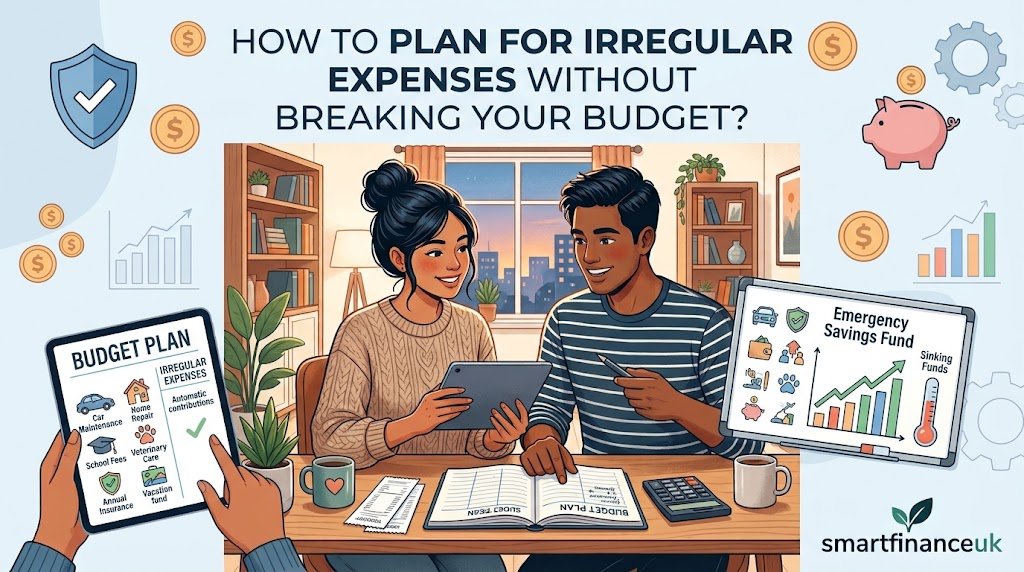
Irregular expenses can make an otherwise sensible monthly budget feel unreliable. You may manage your regular bills comfortably, only to face an annual insurance payment, car repair, Christmas spending or a home maintenance bill that was not included in your normal monthly plan.
The problem is often not that these expenses are genuinely unexpected. Many of them happen at roughly predictable times, even if they do not arrive every month.
A better approach is to turn irregular costs into planned costs. By identifying them, estimating what they may require and setting money aside gradually, you can reduce the chance of a large bill disrupting your everyday finances.
For UK households, this can include expenses such as car insurance, MOT and servicing, Council Tax-related changes, school costs, birthdays, Christmas, annual memberships and household repairs. Some costs will remain genuinely unpredictable, so an emergency fund can also play an important role.
This guide explains how to build irregular expenses into a monthly budget without making the process complicated.
What Are Irregular Expenses?
Irregular expenses are costs that do not occur at the same amount every month.
Some happen once or twice a year. Others may occur only occasionally.
Examples include:
- Car insurance
- MOT and servicing
- Boiler servicing
- Home repairs
- Appliance replacement
- Christmas gifts
- Birthdays
- Holidays
- Annual memberships
- School-related expenses
- Professional fees
- Dental or optical costs
- Seasonal clothing
- Pet-related expenses
- Home maintenance
The important distinction is that irregular does not always mean unexpected.
If you know your car insurance is renewed every year, the payment may be irregular but it is not really a surprise.
That makes it possible to plan for.
Why Irregular Expenses Cause Budget Problems
A monthly budget can look healthy when you only consider expenses that leave your account every month.
Imagine a hypothetical household earning £2,500 a month.
After regular bills and everyday spending, it appears to have £200 left.
That sounds positive.
But suppose the household also faces:
- £600 of annual car insurance
- £400 of Christmas spending
- £300 of annual home maintenance
- £300 of other occasional costs
Those expenses total £1,600 over the year.
Dividing £1,600 by 12 gives roughly £133 per month.
The household does not necessarily have a genuine £200 of spare money each month. Some of that money needs to be reserved for future costs.
The figures above are purely hypothetical. The point is to show why a monthly budget can give a misleading picture when irregular expenses are ignored.
Create an Irregular Expense List
Start by making a list of expenses that do not appear every month.
Look through your bank statements from the previous 12 months if you can. This can reveal expenses that are easy to forget.
Look for payments relating to:
Transport
- Car insurance
- MOT
- Servicing
- Tyres
- Repairs
- Vehicle tax where applicable
- Railcards or annual travel costs
Home
- Boiler servicing
- Repairs
- Appliance replacement
- Garden maintenance
- Decorating
- Pest control
- Other property-related costs
Family and Personal
- Birthdays
- Christmas
- School expenses
- Children’s activities
- Clothing
- Professional memberships
- Annual subscriptions
Health and Wellbeing
Depending on your circumstances:
- Dental treatment
- Optical costs
- Prescriptions
- Private appointments
- Other planned healthcare expenses
Some healthcare costs may be covered or partly covered through NHS services or other arrangements, so do not assume every expense applies to every household.
Leisure and Travel
- Holidays
- Accommodation
- Travel
- Annual memberships
- Events
Once you have the list, you can start turning occasional expenses into monthly budget categories.
Separate Predictable Costs From Genuine Emergencies
This is one of the most useful distinctions you can make.
Suppose your washing machine breaks unexpectedly.
That is an emergency or unexpected expense.
Your annual car insurance renewal is different.
You know the expense is coming, even if you do not know the exact price months in advance.
The two expenses should therefore be handled differently.
Planned irregular expenses can be funded through dedicated savings pots or sinking funds.
Genuine emergencies can be covered by an emergency fund when appropriate.
MoneyHelper describes sinking funds as money set aside for known future expenses, which can help prevent these costs from disrupting your normal budget.
Estimate the Annual Cost
Once you have identified an irregular expense, estimate how much you may need over a year.
Use previous bills where available.
For example, if your previous car insurance payment was £600, you could use £600 as a starting planning figure.
That does not mean your next renewal will definitely cost £600.
Insurance prices can change, so you may want to allow some flexibility rather than budgeting to the exact previous amount.
The same applies to home repairs.
You cannot know exactly when something will break or how much a repair will cost.
Instead of pretending you can predict the future, create a reasonable maintenance allowance.
Divide the Cost Across the Year
Once you have a reasonable estimate, divide it by the number of months until you need the money.
If a hypothetical annual expense is £720 and you have 12 months to prepare:
£720 ÷ 12 = £60 per month.
You could therefore set aside £60 each month.
If you have only six months before the expense is due:
£720 ÷ 6 = £120 per month.
This simple calculation can turn a large future payment into a series of smaller contributions.
It is one of the easiest ways to make irregular expenses feel more manageable.
Use Separate Savings Pots
You do not necessarily need a separate bank account for every expense.
But separating money mentally or physically can help prevent you from spending it accidentally.
Depending on the savings account or banking service you use, you may be able to create separate savings pots or accounts for goals such as:
Car
For insurance, servicing, MOT and repairs.
Christmas
For gifts, food, travel and other seasonal expenses.
Home
For maintenance and replacement costs.
Holidays
For planned travel and accommodation.
Annual bills
For expenses that occur once or twice a year.
The exact setup is less important than being able to tell which money is already committed to a future purpose.
A Simple Hypothetical Example
Imagine a household identifies four annual expenses:
| Expense | Estimated annual amount | Monthly amount |
|---|---|---|
| Car costs | £720 | £60 |
| Christmas | £600 | £50 |
| Home maintenance | £360 | £30 |
| Annual memberships | £240 | £20 |
| Total | £1,920 | £160 |
These are hypothetical figures, not estimates of typical UK household costs.
The household could aim to set aside £160 per month for these planned expenses.
When the payments arrive, the money is already available.
That is the main advantage of planning irregular expenses.
What If You Cannot Set Aside the Full Amount?
This is where budgeting needs to reflect reality.
Suppose your calculated irregular-expense contribution is £160 per month, but your budget only has £80 available.
Do not simply enter £160 and assume the problem has been solved.
You have several things to review.
First, check whether your estimates are realistic.
Second, look at whether any expenses can be reduced or delayed.
Third, consider whether some costs can be spread differently.
Fourth, review your wider budget.
If there is simply not enough income to cover essential costs and planned future expenses, the issue may be larger than a budgeting problem.
Do not rely on expensive borrowing to make an unrealistic budget appear to work.
If you are struggling with debt or essential household bills, free and impartial guidance may be available through MoneyHelper.
Start With the Expenses That Matter Most
You do not have to fund every future expense equally.
Prioritise costs that are:
- Necessary
- Predictable
- Difficult to postpone
- Likely to create financial problems if unpaid
For example, preparing for an important insurance renewal may take priority over saving for an optional purchase.
The right order depends on your circumstances.
The purpose is to make your available money work towards the expenses that could cause the greatest difficulty if you were unprepared.
Build Irregular Expenses Into Your Monthly Budget
Your monthly budget should show more than your regular bills.
A simple structure could look like this:
Income
Your expected take-home income.
Regular essential expenses
Rent or mortgage, Council Tax, household bills, food, transport and other regular commitments.
Irregular expense savings
Money reserved for annual and occasional planned costs.
Emergency savings
Money for genuinely unexpected financial problems.
Discretionary spending
Money for entertainment, hobbies, eating out and other wants.
This gives you a more realistic picture of what your income is actually available for.
Do Not Confuse an Emergency Fund With a Sinking Fund
These two types of savings have different jobs.
A sinking fund is for something you expect.
Examples:
- Annual insurance
- Christmas
- Holiday
- MOT
- Planned home maintenance
An emergency fund is for something you did not reasonably plan for.
Examples could include:
- Unexpected essential repairs
- Sudden loss of income
- An urgent expense that cannot reasonably be delayed
Keeping these purposes separate can make your savings easier to manage.
MoneyHelper notes that emergency savings can provide a financial buffer when unexpected costs arise.
Allow for Costs to Change
One common mistake is budgeting for an irregular expense using an old price and assuming it will remain unchanged.
That can create a shortfall.
Insurance premiums, travel costs, repairs and services can all change.
When setting aside money, consider whether your estimate has enough flexibility.
For example, if an annual expense previously cost £500, setting aside exactly £500 may leave no room if the next bill is higher.
You do not need to guess the future perfectly.
A reasonable estimate and periodic review are more useful than false precision.
Review Your Estimates Every Few Months
Your sinking funds should not be completely static.
Every few months, check:
- How much you have saved
- When the expense is due
- Whether your estimate is still realistic
- Whether the cost has changed
- Whether you need to increase or reduce the monthly contribution
If your insurance renewal is six months away and you receive a renewal quote, you can update your plan based on the new information.
The same applies to holidays, school expenses and other planned costs.
Use Previous Spending to Make Better Estimates
Your own financial history can be more useful than a generic online estimate.
Look at previous bank statements.
Suppose you spent £420 on Christmas last year.
You might use that as your starting point for the next Christmas budget.
But ask what was included.
Perhaps £420 covered only presents, while food and travel were paid separately.
If so, your actual Christmas budget needs to account for those additional costs.
This is why reviewing transactions is valuable.
You are not simply guessing what irregular expenses cost. You are learning from your own household’s spending.
Include Seasonal Expenses
Some expenses are particularly easy to forget because they happen around the same time every year.
Christmas is the obvious example.
But households may also face:
- Summer holidays
- School uniform purchases
- Winter clothing
- Heating-related costs
- Birthday celebrations
- Annual travel
- Seasonal activities
Instead of treating December or September as unusually expensive months, spread some of the expected cost across the year.
If you know a large expense is coming, saving gradually can reduce the pressure when the date arrives.
Plan for Home Repairs Without Predicting Every Repair
Home maintenance is difficult because you cannot know exactly what will fail.
That does not mean you should ignore it.
If you own a property, consider creating a general home-maintenance fund.
The amount depends on the property, its age, your finances and the types of maintenance you expect to handle.
You could use this money for smaller repairs and maintenance costs, while keeping your separate emergency fund for genuinely unexpected or more serious financial problems.
If you rent, responsibilities for repairs are different. Do not automatically assume that you are responsible for every property repair. Check your tenancy agreement and the relevant rules for your part of the UK.
Consider Irregular Expenses When Setting Savings Goals
Suppose your budget says you can save £300 per month.
Before setting that entire £300 towards a long-term goal, check whether some of it is already needed for annual expenses.
If £100 per month needs to be reserved for future costs, your genuinely available long-term savings amount may be closer to £200.
This distinction prevents you from setting an unrealistic savings target.
It also reduces the temptation to withdraw long-term savings whenever an annual bill arrives.
What If an Expense Arrives Before You Have Saved Enough?
This can happen, especially when you first start using sinking funds.
Do not assume the system has failed.
Instead, record what happened.
Perhaps you underestimated the cost.
Perhaps you started saving too late.
Perhaps an unexpected price increase occurred.
Once you know the reason, you can adjust your future contribution.
If the expense is unavoidable and there is not enough money available, consider your options carefully rather than immediately turning to high-cost borrowing.
If you are already struggling with debt repayments, seek appropriate support before taking on additional borrowing.
Common Mistakes to Avoid
Only budgeting for monthly bills
This makes your available income look higher than it really is.
Treating every irregular expense as an emergency
Many annual expenses can be predicted and planned for.
Using old prices without reviewing them
Costs can change.
Saving too little for known expenses
A small monthly contribution may not be enough if the payment is approaching quickly.
Saving too much for low-priority expenses
Your budget still needs to cover current essentials and more important financial priorities.
Mixing all savings together
If possible, make it clear which money is for future bills and which is for emergencies.
Forgetting about annual renewals
Check your calendar and previous bank statements for payments that happen once a year.
A Simple Monthly Routine
You can manage irregular expenses without spending hours on them.
At the beginning of each year, list your known annual and occasional costs.
For each expense, record:
What is it?
When is it due?
How much might it cost?
How much have I already saved?
How much do I need to set aside each month?
Then review the list every few months.
This gives you a simple system that can be maintained alongside your normal monthly budget.
Questions to Ask Before Adding an Irregular Expense
Before committing money to a future expense, ask:
- Is this cost genuinely necessary?
- When will I need the money?
- What did it cost previously?
- Could the price change?
- Can I reduce or postpone it?
- Have I already saved anything towards it?
- Does this money need to remain easily accessible?
- Would paying for it affect my essential bills?
- Is this a planned expense or a genuine emergency?
These questions can help you distinguish between expenses that need preparation and expenses that can be reconsidered.
Frequently Asked Questions
What is an irregular expense?
An irregular expense is a cost that does not occur at the same amount every month. It may happen once a year, occasionally or at unpredictable intervals. Examples include annual insurance, car servicing, Christmas spending and home repairs. Some irregular expenses can be predicted and planned for, while genuinely unexpected costs are usually better handled through an emergency fund.
How much should I save each month for irregular expenses?
There is no universal amount. Add up your estimated annual expenses and divide the total by the number of months you have to prepare. For example, a hypothetical £600 annual expense would require £50 a month if you were saving for it over 12 months. Review the estimate periodically because actual costs can change.
Should irregular expenses be included in a monthly budget?
Yes. Even though the bills themselves may not arrive monthly, the financial cost still needs to be accounted for. Setting aside a monthly amount can prevent a large annual payment from consuming money intended for everyday expenses. Including these costs gives you a more realistic view of how much income is genuinely available.
What is the difference between a sinking fund and an emergency fund?
A sinking fund is normally used for a known future expense, such as Christmas, car insurance or an annual membership. An emergency fund is intended for unexpected financial problems. Keeping these purposes separate can help you avoid using money reserved for known bills when an unrelated emergency occurs.
What if I cannot afford to save enough for all my irregular expenses?
Start by prioritising essential and unavoidable costs. Review your estimates and look for expenses that can genuinely be reduced or postponed. If your income does not cover essential costs and future bills, cutting discretionary spending alone may not solve the problem. If debt or essential bills are becoming difficult to manage, consider seeking free and impartial debt guidance.
Should I keep money for irregular expenses in a savings account?
Keeping planned-expense money somewhere separate from everyday spending can make it easier to avoid spending it accidentally. The appropriate account depends on your circumstances and how quickly you need access to the money. Check any account’s terms, interest conditions and access arrangements before choosing where to keep your savings.
What expenses should I include in an irregular-expense budget?
Think beyond obvious annual bills. Include car maintenance, insurance, Christmas, birthdays, holidays, home maintenance, school-related expenses, annual subscriptions and other costs you know occur periodically. Reviewing your bank statements from the previous year can help reveal expenses that you may otherwise overlook.
Final Thoughts
Irregular expenses are easier to manage when you stop treating every large occasional bill as a surprise.
Start by reviewing the previous 12 months of spending and identifying costs that occur annually or occasionally. Estimate what they may cost, divide the amount into manageable monthly contributions and keep those savings clearly separated from money intended for everyday spending.
Remember that estimates will not always be perfect. Prices change, unexpected expenses happen and your circumstances can change. Review your figures periodically rather than expecting your original budget to remain accurate forever.
The goal is not to predict every pound you will spend. It is to make foreseeable costs less disruptive.
With a simple sinking-fund approach, your monthly budget can reflect both today’s expenses and the bills that are likely to arrive later.
This article provides general financial education for UK readers and is not personalised financial advice. If you are experiencing serious financial difficulty or are unsure about a particular financial decision, consider seeking guidance from an appropriate regulated or free impartial service.