
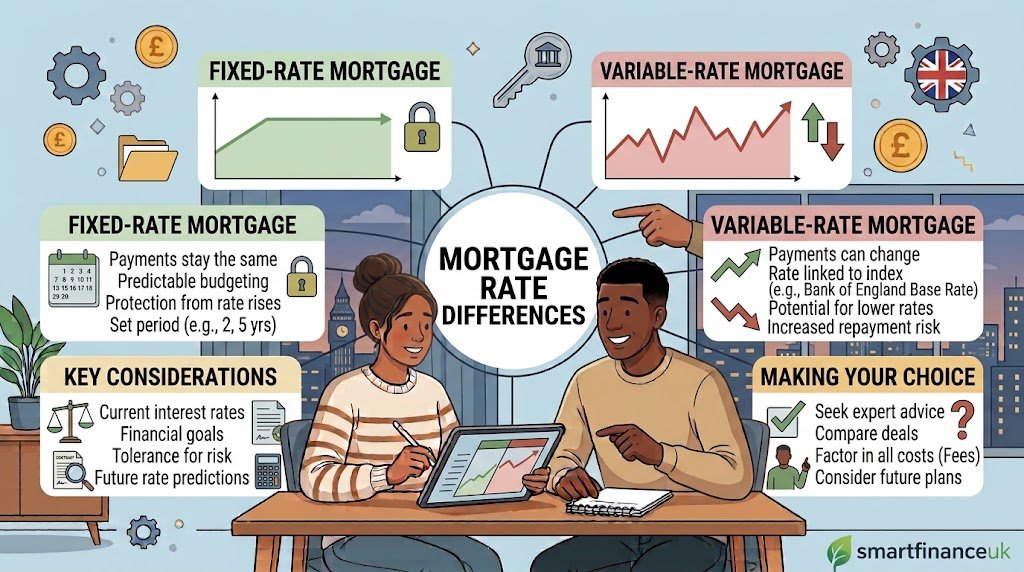
Choosing a mortgage involves more than deciding how much you want to borrow. You also need to consider how the interest rate will be charged and whether your monthly payments could change over time.
Two of the main mortgage rate options in the UK are fixed-rate mortgages and variable-rate mortgages. With a fixed-rate mortgage, the interest rate stays the same for an agreed period. With a variable-rate mortgage, the rate can change according to the terms of the mortgage. Variable mortgages include tracker, discounted-rate and standard variable rate (SVR) mortgages.
The difference can have a noticeable effect on your household budget. A fixed rate can make payments easier to predict, while a variable rate may allow your payments to fall when relevant interest rates fall, but they can also increase when rates rise.
Neither option is automatically right for everyone. The better choice depends on factors such as your budget, how comfortable you are with changing payments, how long you expect to keep the mortgage and the costs attached to the particular deal.
This article explains the differences in straightforward UK terms so you can understand what to look for when comparing mortgage options.
This article provides general educational information and is not personalised mortgage or financial advice.
What Is a Fixed-Rate Mortgage?
A fixed-rate mortgage is a mortgage where the interest rate remains unchanged for a specified period.
You may see products described as a:
- two-year fix
- three-year fix
- five-year fix
- ten-year fix
The exact periods available depend on the lender and the mortgage market. MoneyHelper says fixed-rate deals commonly run for between two and ten years.
If your mortgage rate is fixed, changes in wider interest rates do not normally change your contractual mortgage rate during the fixed period.
For example, imagine a fictional borrower has a five-year fixed-rate mortgage. If the Bank of England changes Bank Rate during those five years, the borrower’s fixed mortgage rate would not normally change simply because of that decision.
This gives the household greater certainty about its mortgage payment during the fixed period.
However, a fixed rate does not usually mean that the rate is fixed for the entire mortgage term.
That distinction is important.
What Is a Variable-Rate Mortgage?
A variable-rate mortgage is one where the interest rate can change according to the mortgage’s terms.
There are several types of variable mortgage, including:
Tracker mortgages
The rate normally follows another reference rate, commonly the Bank of England Bank Rate, plus or minus a specified margin.
Standard variable rate mortgages
The lender sets the SVR and can change it according to its terms. It is not necessarily tied directly to Bank Rate.
Discounted-rate mortgages
These offer a discount from the lender’s SVR for a specified period, meaning the payment can change if the SVR changes.
This means “variable-rate mortgage” is a broad category rather than one single mortgage product.
When someone says they have a variable mortgage, it is worth finding out exactly which type they mean.
Fixed vs Variable Mortgages at a Glance
| Feature | Fixed-rate mortgage | Variable-rate mortgage |
|---|---|---|
| Interest rate | Stays fixed for the agreed period | Can change according to the mortgage terms |
| Monthly payment | Usually more predictable during the fixed period | Can rise or fall |
| Effect of rate increases | Usually delayed until the fixed period ends | May affect payments during the deal |
| Effect of rate reductions | You normally do not benefit during the fixed period | Your rate may fall, depending on the product |
| Budget certainty | Higher during the fixed period | Lower |
| Early repayment charges | May apply | Depends on the product |
| What happens when the deal ends | You may need a new deal or move to the lender’s reversion rate | Depends on the product |
The precise terms vary between lenders, so this table is a general comparison rather than a description of every mortgage available in the UK.
How Does a Fixed-Rate Mortgage Work?
Suppose a fictional borrower takes a £250,000 repayment mortgage with a five-year fixed interest rate.
During those five years, the agreed mortgage rate stays the same.
The borrower still needs to make the required payments, and the mortgage balance should reduce over time if it is a standard repayment mortgage.
The important point is that the interest rate itself does not change during the fixed period.
This can make household budgeting easier.
If energy bills, food costs or other household expenses change during the year, knowing that the mortgage payment is not going to change because of an interest-rate movement can provide some financial predictability.
But the fixed-rate period eventually ends.
At that point, you need to consider what happens next.
What Happens When a Fixed Rate Ends?
When an initial fixed-rate deal ends, you normally need to arrange another mortgage deal if you do not want to remain on the lender’s reversion rate.
The reversion rate is the rate that applies after the initial deal ends if you have not moved to another arrangement. The FCA says this is often a lender’s standard variable rate and will typically be higher than the initial fixed rate.
For example, imagine someone has a five-year fixed mortgage.
The five years are not the end of the mortgage itself. They are simply the end of the initial fixed-rate period.
The borrower may then:
- arrange a new deal with the same lender
- remortgage with another lender
- move onto the lender’s applicable variable or reversion rate
- consider other options depending on their circumstances
This is why the end date of a fixed-rate mortgage should be treated as an important financial date.
MoneyHelper advises homeowners coming to the end of a fixed or discounted deal to start reviewing their options before the existing deal finishes.
How Does a Tracker Mortgage Work?
A tracker mortgage is a type of variable-rate mortgage.
It normally tracks a reference rate, most commonly the Bank of England Bank Rate, with a margin added.
For example, a hypothetical tracker could be:
Bank Rate + 1.25 percentage points
If the relevant Bank Rate increased by 0.25 percentage points, the tracker rate would normally increase by the same amount, assuming the mortgage terms work in the usual way.
If Bank Rate fell, the tracker rate could fall as well.
MoneyHelper explains that tracker mortgages normally follow the Bank of England base rate plus a specified margin.
This makes tracker mortgages particularly sensitive to movements in the rate they follow.
What Is a Standard Variable Rate?
A standard variable rate, or SVR, is a variable rate set by the mortgage lender.
It is different from a tracker mortgage because it is not simply calculated by adding a fixed margin to Bank Rate.
The lender decides its SVR according to its own pricing and terms.
MoneyHelper explains that each lender sets its own SVR and that it can change at any time.
Many borrowers move onto an SVR when their initial fixed, tracker or discounted deal ends if they do not arrange another mortgage.
An SVR can therefore become relevant even if you originally chose a fixed-rate mortgage.
What Is a Discounted-Rate Mortgage?
A discounted-rate mortgage is another form of variable-rate mortgage.
The lender provides a discount from its SVR for an agreed period.
For example, a hypothetical mortgage might offer:
SVR minus 1 percentage point
If the lender’s SVR changes, the discounted mortgage rate can change too.
The discount itself may remain the same while the underlying SVR moves.
This means the mortgage payment can rise or fall.
MoneyHelper explains that discounted rates are set below the lender’s SVR for a specified period and can increase when the SVR increases.
Why Do People Choose Fixed-Rate Mortgages?
The biggest attraction is predictability.
If your rate is fixed, you generally know what interest rate will apply during the fixed period.
That can make it easier to plan your household budget.
For example, a household with a tight monthly budget may value knowing that the mortgage payment will not increase simply because market interest rates rise during the fixed period.
A fixed rate can also protect borrowers from increases in interest rates during the deal.
But that protection comes with a trade-off.
If rates fall significantly, a borrower on a fixed rate will normally not benefit from those lower rates until they can move to a new deal, subject to the mortgage terms.
MoneyHelper identifies payment certainty as one of the main advantages of fixed-rate mortgages, while also noting that borrowers do not benefit from rate reductions during the fixed period.
Why Do People Choose Variable-Rate Mortgages?
The main attraction is the possibility of benefiting when relevant interest rates fall.
For example, if you have a tracker mortgage and the Bank of England Bank Rate falls, your mortgage rate may fall as well, subject to the terms of your mortgage.
This could reduce your monthly payment.
Some variable mortgages can also offer more flexibility around switching or making overpayments, although this varies by product.
MoneyHelper notes that tracker mortgages often have fewer restrictions on leaving or making additional payments than fixed-rate deals, but borrowers should always check the specific mortgage terms.
The downside is uncertainty.
If the relevant rate rises, your mortgage payment can rise too.
That can be difficult if your household budget has little room for higher costs.
What Happens If Interest Rates Rise?
The effect depends heavily on your mortgage type.
With a fixed-rate mortgage, your payment normally remains unchanged during the fixed period.
With a tracker mortgage, an increase in the reference rate will normally feed through to the mortgage rate.
With an SVR mortgage, the lender can change the rate according to its terms.
MoneyHelper explains that variable and tracker mortgage payments can rise when interest rates increase, while fixed-rate payments normally remain unchanged until the fixed period ends.
This creates an important budgeting question:
Could you still afford the mortgage if the payment increased?
You do not need to predict exactly where interest rates will go. Nobody can reliably know that in advance.
Instead, consider whether your household budget has enough room to cope with a higher payment.
What Happens If Interest Rates Fall?
The opposite can happen.
A borrower on a variable or tracker mortgage may see their mortgage rate and payment fall when the relevant rate falls.
A fixed-rate borrower generally will not see their payment fall during the fixed period.
This can be one of the frustrating aspects of fixing your mortgage rate.
You have exchanged some exposure to rising rates for greater payment certainty.
MoneyHelper explains that variable and tracker borrowers may see payments fall when interest rates fall, while fixed-rate borrowers generally wait until their fixed period ends before benefiting from a new lower rate.
Which Mortgage Has the Lower Interest Rate?
There is no permanent answer.
Mortgage rates change over time, and lenders price their products according to market conditions and their own lending criteria.
At any particular point, a fixed-rate deal might have a higher initial rate than a variable or tracker deal. At another point, the difference could be smaller or reversed.
It is therefore unhelpful to assume that fixed mortgages are always more expensive or variable mortgages are always cheaper.
You also need to consider fees and the length of the initial deal.
A mortgage with a lower headline rate could still cost more overall if it has significant fees.
MoneyHelper recommends comparing the full figures associated with a mortgage rather than looking at the interest rate alone.
Why Mortgage Fees Matter
Suppose two hypothetical mortgages are available.
Mortgage A: 4.5% fixed rate with a £500 product fee.
Mortgage B: 4.3% fixed rate with a £2,500 product fee.
Mortgage B has the lower interest rate.
That does not automatically mean it is cheaper.
The difference in interest could be outweighed by the additional fee, depending on the amount borrowed and how long you keep the deal.
This is why you should look at the mortgage illustration and the overall cost rather than selecting a mortgage based on the headline rate alone.
MoneyHelper recommends comparing fees, early repayment charges and APRC when assessing mortgage deals.
What Is APRC?
You may see APRC, or Annual Percentage Rate of Charge, when looking at mortgage information.
It is designed to express the annual cost of the mortgage, taking certain fees and charges into account and using assumptions about the mortgage remaining in place for its full term.
Lenders must provide an APRC for mortgage deals.
However, APRC is not a guarantee of what you personally will pay.
For example, you may remortgage before the original mortgage term ends, make overpayments, sell the property or experience changes in the interest rate.
Use APRC as one comparison tool rather than treating it as a forecast of your exact future cost.
Fixed-Rate Mortgage Advantages
A fixed-rate mortgage may appeal to someone who values payment certainty.
Easier Budgeting
Your mortgage payment normally remains stable during the fixed period, making it easier to plan monthly spending.
Protection From Rate Rises
If interest rates rise during the fixed period, your fixed mortgage rate normally does not change.
Greater Predictability
You can plan household expenses knowing the mortgage payment should remain at the agreed level during the deal.
These advantages can be particularly useful for households that would struggle to absorb a significant increase in mortgage payments.
Fixed-Rate Mortgage Disadvantages
A fixed mortgage also has limitations.
You May Miss Out on Falling Rates
If market rates fall, your fixed mortgage rate generally remains unchanged until the deal ends.
Early Repayment Charges May Apply
Some fixed-rate mortgages charge a fee if you repay the mortgage or leave the deal early.
Refinancing Can Require Planning
You need to pay attention to the date when your fixed period ends and consider your options before then.
The Initial Rate Is Not the Whole Story
A low fixed rate can still involve fees or other conditions that affect the overall cost.
Variable-Rate Mortgage Advantages
Variable mortgages can have some useful features.
You May Benefit From Falling Rates
If the rate your mortgage follows falls, your mortgage payment may fall.
Some Products Offer More Flexibility
Certain variable products may allow easier switching or overpayments than fixed-rate deals.
You Are Not Locked Into the Same Rate Forever
The rate can change as the relevant market or lender rate changes.
Again, the precise features depend on the mortgage agreement.
Variable-Rate Mortgage Disadvantages
The main issue is uncertainty.
Payments Can Increase
If the relevant interest rate rises, your monthly mortgage cost can increase.
Budgeting Can Be More Difficult
You cannot always know exactly what your mortgage payment will be several months from now.
Rate Changes Can Happen at Inconvenient Times
A higher mortgage payment could arrive while you are also dealing with increases in energy, food, insurance or other household costs.
The Rate May Not Follow Bank Rate Directly
This is particularly important with an SVR.
A lender’s SVR is set by the lender and is not simply Bank Rate plus a fixed percentage.
A Simple UK Example
Imagine two households each have a hypothetical £250,000 repayment mortgage.
Household A chooses a fixed-rate mortgage.
Household B chooses a tracker mortgage.
Suppose Bank Rate then rises.
Household A’s mortgage rate would normally remain unchanged during its fixed period.
Household B’s mortgage rate could rise in line with the tracker terms, increasing the monthly payment.
Now imagine Bank Rate subsequently falls.
Household A would normally continue paying the fixed rate until its deal ends.
Household B could see its mortgage rate fall, subject to the tracker terms.
Neither household has necessarily made a “right” or “wrong” decision.
They have accepted different types of interest-rate risk.
The example is hypothetical and does not represent a current mortgage offer.
What Should You Consider Before Choosing?
There are several questions worth asking.
How Stable Is Your Monthly Budget?
If your finances are already tight, a significant increase in mortgage payments could be difficult to absorb.
How Comfortable Are You With Uncertainty?
A variable mortgage means accepting that payments can change.
A fixed mortgage provides more certainty during the fixed period.
How Long Do You Expect to Keep the Mortgage?
If you expect to move or refinance relatively soon, early repayment charges and other fees may become particularly important.
What Happens When the Initial Deal Ends?
Find out the reversion rate and when it applies.
Do not wait until the last minute to understand your options.
Can You Afford a Higher Payment?
Even if you choose a fixed rate, consider what might happen when the deal ends.
For a variable mortgage, consider how your budget would cope with higher rates.
What Are the Fees?
Compare product fees, adviser fees where applicable, valuation costs and early repayment charges.
Can You Make Overpayments?
If reducing your mortgage balance early is important to you, check the rules before choosing a product.
Common Mistakes to Avoid
Assuming Fixed Means Fixed Forever
The rate is normally fixed only for the specified deal period.
Assuming Variable Means Tracker
Tracker, SVR and discounted mortgages all work differently.
Comparing Only the Interest Rate
Fees and other conditions can change the overall cost.
Ignoring the End of the Initial Deal
A fixed or discounted mortgage can move to a reversion rate if you do not arrange another deal.
Assuming Rates Will Definitely Fall
Future interest rates are uncertain.
Do not choose a mortgage based entirely on a prediction about what rates might do.
Forgetting About Early Repayment Charges
Leaving a mortgage early can sometimes result in significant charges.
Borrowing Based on the Maximum Available
A lender’s maximum mortgage amount is not necessarily the amount that feels comfortable within your household budget.
What If You Are Worried About Rising Mortgage Payments?
If you already have a mortgage and believe your payments could become difficult to manage, contact your lender as early as possible.
The FCA says that speaking to your lender does not itself affect your credit file, and lenders may be able to discuss support options with you.
Do not wait until you have missed several payments before asking about your options.
If your fixed-rate mortgage is approaching its end, start reviewing your choices before the current deal expires.
MoneyHelper recommends contacting your lender and comparing available deals when a fixed or discounted mortgage is approaching its end.
Questions to Ask Before Choosing a Mortgage Rate
Before accepting a mortgage deal, consider asking:
How long is the initial rate fixed or discounted?
What rate applies after the initial period?
What is the mortgage’s APRC?
What product or arrangement fees apply?
Are there early repayment charges?
Can I make overpayments without a penalty?
If this is a tracker, exactly which rate does it follow?
If this is an SVR, how can the lender change the rate?
What would happen to my monthly payment if rates increased?
When should I start reviewing my next mortgage deal?
These questions can help you understand the mortgage beyond the headline rate.
Frequently Asked Questions
Is a fixed-rate mortgage safer than a variable mortgage?
A fixed-rate mortgage provides greater certainty about the mortgage payment during the fixed period, which can make household budgeting easier. However, “safer” depends on what risks matter to you. A variable mortgage can become more expensive if rates rise, while a fixed mortgage may prevent you from benefiting from falling rates during the fixed period. Both have advantages and disadvantages that should be considered alongside the specific mortgage terms.
Can a variable mortgage payment go down?
Yes. A variable mortgage payment can fall when the relevant interest rate falls, although the exact effect depends on the type of mortgage and its terms. Tracker mortgages are usually linked to a reference rate such as Bank Rate, while an SVR is set by the lender. MoneyHelper explains that variable and tracker mortgage payments can fall when interest rates fall.
Can a fixed mortgage payment increase?
The mortgage payment normally remains unchanged during the agreed fixed-rate period, assuming the mortgage terms and repayment structure remain the same. However, the payment can change after the fixed period ends if you move onto a different rate. Other changes, such as certain changes to the mortgage balance or account arrangements, may also affect payments. Always check the mortgage agreement for the exact terms.
What happens to a fixed-rate mortgage when the deal ends?
When the initial fixed period ends, you normally need to arrange another mortgage deal if you do not want to remain on the lender’s reversion rate. The FCA says the reversion rate is often the lender’s SVR and is typically higher than the initial fixed rate.
Is a tracker mortgage the same as a variable mortgage?
A tracker mortgage is a type of variable-rate mortgage, but not all variable mortgages are trackers. A tracker normally follows a reference rate, commonly Bank Rate, plus or minus a specified margin. An SVR is set by the lender and does not necessarily move in direct proportion to Bank Rate. Understanding the exact mechanism is important before choosing a variable mortgage.
Which is cheaper, fixed or variable?
There is no permanent answer because mortgage rates and fees change. A variable mortgage could cost less if relevant interest rates fall, but it could become more expensive if rates rise. A fixed mortgage may provide greater payment certainty but could have a higher initial rate or additional charges. Compare the full cost, including fees and early repayment conditions, rather than assuming one type is always cheaper.
How far in advance should I review my fixed-rate mortgage?
It is sensible to start reviewing your options before the current deal ends. MoneyHelper suggests contacting your lender around six months before the end of a fixed or discounted deal to understand what options may be available. The exact timing for arranging a new deal can depend on the lender and circumstances, so check your mortgage documents and seek appropriate guidance.
Final Thoughts
The main difference between fixed-rate and variable-rate mortgages is how the interest rate can change.
A fixed-rate mortgage provides greater certainty during the agreed fixed period. You know that changes in wider interest rates should not alter your mortgage rate during that period.
A variable-rate mortgage gives you less certainty because the rate can change. Depending on the product, you could benefit when relevant rates fall, but you could also face higher payments when rates rise.
Neither option should be judged by the initial interest rate alone. Look at the mortgage term, fees, early repayment charges, overpayment rules, the rate that applies after the initial deal and the effect a higher payment could have on your household budget.
Most importantly, remember that a mortgage is a long-term commitment. The right question is not simply which rate looks cheapest today, but which arrangement you understand and can realistically manage under different circumstances.
This article provides general educational information and is not personalised financial advice.
Sources and Further Reading
- MoneyHelper — Understanding mortgages and interest rates — Explains fixed, tracker, discounted and standard variable-rate mortgages and how to compare mortgage deals.
- MoneyHelper — How will interest rates affect my mortgage? — Updated guidance on how rate changes can affect fixed, tracker and variable mortgages.
- Financial Conduct Authority — Support available for mortgages as interest rates rise — Information about affordability, stress testing and mortgage reversion rates.
- MoneyHelper — If you’re worried about rising mortgages — Guidance for borrowers approaching the end of a fixed or discounted mortgage deal.
- MoneyHelper — First-time home buyer guide — Background information on mortgage terms, repayment types and interest rates.