
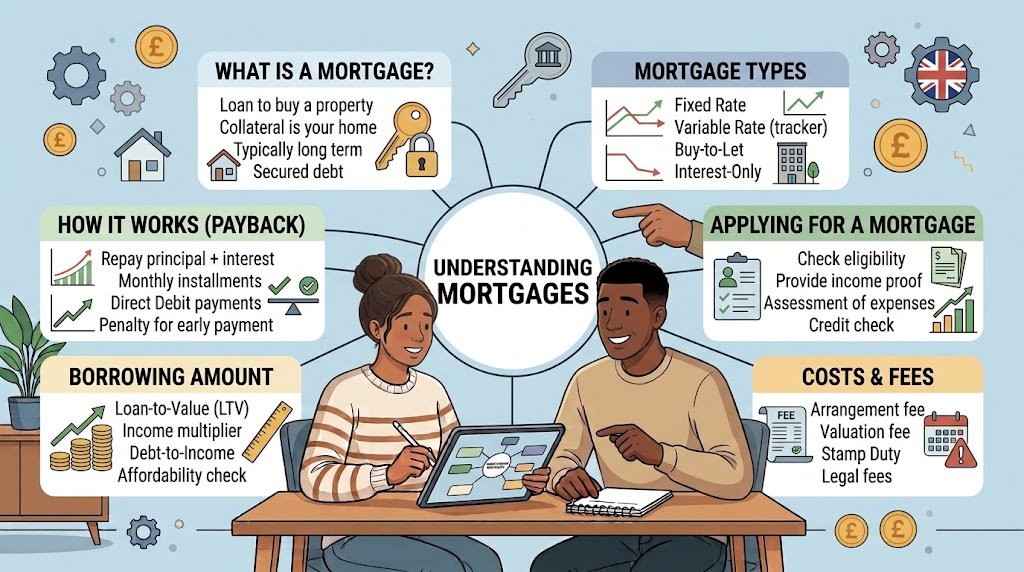
For many people in the UK, buying a home involves borrowing a substantial amount of money through a mortgage. Because a mortgage can last for decades and involve a large amount of interest, understanding how it works before making an application is important.
A mortgage is a loan secured against a property. You normally contribute some of the purchase price yourself through a deposit and borrow the remaining amount from a bank, building society or other mortgage lender. You then repay the borrowing, usually through monthly payments, together with interest.
The amount you can borrow is not based simply on the property’s price. Lenders look at your income, regular spending, existing debts and whether you could continue making the payments if your circumstances changed.
This guide explains the basic mortgage process in the UK, the main types of mortgages, deposits, affordability, mortgage costs and some important differences between England, Wales, Scotland and Northern Ireland.
This article provides general educational information and is not personalised mortgage or financial advice.
What Is a Mortgage?
A mortgage is a loan used to purchase property or land.
Unlike an unsecured personal loan, a mortgage is secured against the property. The home provides security for the lender.
For example, imagine a fictional property costing £300,000.
A buyer has a £60,000 deposit and needs to borrow £240,000.
The £240,000 mortgage represents 80% of the property’s purchase price, while the buyer has contributed the remaining 20%.
The lender then provides the mortgage subject to its lending criteria and the terms of the mortgage agreement.
The buyer makes the required repayments over the agreed mortgage term.
If the borrower fails to maintain repayments and the situation cannot be resolved, the lender can ultimately seek possession and sale of the property to recover the debt. Repossession is generally a serious last-resort situation, but it is one of the most important risks to understand when taking a secured loan.
How Does Home Financing Work in the UK?
The basic process is relatively straightforward.
You contribute a deposit and borrow the rest.
Suppose a hypothetical home costs £250,000 and you have £25,000 available as a deposit.
You would need to borrow £225,000 to cover the remaining purchase price.
The mortgage lender charges interest on the amount borrowed, and you repay the mortgage according to the agreed terms.
Your monthly payment depends on factors including:
- the amount borrowed
- the interest rate
- the mortgage term
- the type of mortgage
- whether the rate is fixed or variable
- the repayment method
MoneyHelper says mortgages can commonly run from 2 to 40 years, although the available term depends on the lender and borrower’s circumstances.
A longer term can reduce the required monthly payment, but it can also mean paying interest over a longer period.
What Is a Mortgage Deposit?
A deposit is the portion of the property’s purchase price you contribute yourself rather than borrowing through the mortgage.
MoneyHelper says buyers will usually need a deposit of around 5% to 10% or more, depending on the mortgage and circumstances.
For example, on a hypothetical £250,000 property:
5% deposit: £12,500
10% deposit: £25,000
20% deposit: £50,000
A larger deposit generally means you need to borrow less.
It can also affect the loan-to-value ratio, or LTV, which is an important figure lenders use when assessing mortgage products.
However, saving a larger deposit is not the only consideration. You also need enough money to cover other costs associated with buying and moving into a home.
What Is Loan-to-Value?
Loan-to-value, usually shortened to LTV, compares the mortgage amount with the property’s value or purchase price, depending on the circumstances.
For example, if you buy a £300,000 property with a £60,000 deposit, you need a £240,000 mortgage.
The calculation is:
£240,000 ÷ £300,000 × 100 = 80% LTV
That means the mortgage represents 80% of the property’s value in this simplified example.
A lower LTV generally means you are borrowing a smaller proportion of the property’s value.
Mortgage products are often grouped around different LTV bands, although the specific products, rates and eligibility criteria change over time.
Do not assume that a particular LTV automatically guarantees a particular mortgage rate.
How Do Mortgage Lenders Decide How Much You Can Borrow?
A lender will assess whether the proposed mortgage is affordable.
This involves more than looking at your salary.
GOV.UK says mortgage affordability assessments can take account of income and current outgoings such as utility bills, insurance and Council Tax, as well as potential changes that could affect your ability to make repayments.
MoneyHelper also explains that lenders can consider household income, regular bills, spending and existing debts such as loans and credit cards.
The lender may therefore ask for information about:
- employment and income
- regular household spending
- existing borrowing
- credit commitments
- dependants
- financial circumstances
- the property being purchased
If you are self-employed, have variable income or receive income from several sources, the lender may require additional evidence.
The amount a lender is prepared to offer should not automatically be treated as the amount you can comfortably afford.
Your personal budget matters too.
What Is a Repayment Mortgage?
A repayment mortgage involves paying towards both the capital you borrowed and the interest charged by the lender.
If you maintain the required payments throughout the agreed term, the intention is that the mortgage balance will eventually be reduced to zero.
For example, suppose you take out a hypothetical £200,000 repayment mortgage.
Your monthly payment covers the interest due under the mortgage and also contributes towards reducing the outstanding capital.
As the balance falls, the amount of interest charged can change depending on the mortgage’s terms and calculation method.
A repayment mortgage therefore gives you a clear objective: repay the mortgage balance over the agreed term.
What Is an Interest-Only Mortgage?
With an interest-only mortgage, your scheduled payments generally cover the interest rather than repaying the capital during the interest-only period.
This means the original amount borrowed remains outstanding unless you make separate arrangements to repay it.
For example, if you borrowed £200,000 on an interest-only basis, you would still owe the £200,000 capital at the end of the relevant period unless it had been repaid through another arrangement.
This makes the repayment plan particularly important.
MoneyHelper identifies repayment and interest-only mortgages as two main mortgage types and warns that borrowers need a plan for repaying the capital with an interest-only mortgage.
Interest-only borrowing is therefore not simply a way of making a mortgage permanently cheaper.
The capital still needs to be dealt with.
What Is a Fixed-Rate Mortgage?
A fixed-rate mortgage has an interest rate that remains fixed for a specified period.
For example, a mortgage might have a fixed rate for two, three or five years.
The exact periods and products available change over time.
The main attraction of a fixed rate is payment certainty during the fixed period.
If the mortgage rate remains fixed, changes in the wider market do not normally change your contractual interest rate during that period.
However, fixed-rate mortgages have limitations.
When the fixed period ends, you may need to move to another mortgage deal or be transferred to the lender’s applicable follow-on rate, depending on the agreement.
You should therefore know when the fixed period ends and what could happen afterwards.
What Is a Tracker Mortgage?
A tracker mortgage normally follows a reference rate, often the Bank of England’s Bank Rate, plus or minus a specified margin.
Because the underlying rate can change, the mortgage interest rate and monthly payment can also change.
For example, a hypothetical tracker could be set at:
Bank Rate + 1%
If the reference rate changes, the mortgage rate can change according to the terms.
This can work in the borrower’s favour when rates fall, but repayments can also rise when rates increase.
MoneyHelper lists tracker mortgages among the main mortgage options available to borrowers.
If you are considering a variable-rate mortgage, it is sensible to think about whether your budget could cope with higher repayments.
What Is a Variable-Rate Mortgage?
A variable-rate mortgage has an interest rate that can change according to the terms of the mortgage.
Not all variable-rate mortgages work in exactly the same way.
For example, a lender’s standard variable rate may be set by the lender, while a tracker normally follows a specified reference rate.
This distinction matters.
Do not assume that every variable mortgage will move in exactly the same way as Bank Rate.
Read the product information carefully to understand what causes the rate to change.
How Does the Mortgage Term Affect Your Payments?
The mortgage term is the length of time over which you plan to repay the mortgage.
Suppose you borrow £250,000.
A longer term generally spreads the capital and interest payments over more months.
That can reduce the monthly repayment compared with a shorter term, assuming other factors are the same.
However, the mortgage may cost more in total because interest is charged over a longer period.
A shorter term can mean higher monthly payments but may reduce the total interest paid.
There is therefore a trade-off between:
monthly affordability
and
overall borrowing cost.
Do not select a mortgage term based solely on the lowest monthly payment.
What Costs Come With Buying a Home?
The mortgage is only one part of the cost of buying property.
GOV.UK identifies additional costs that can include taxes, surveys, solicitor’s fees, mortgage fees, searches and land registration fees.
You may also need to budget for:
- moving costs
- buildings insurance
- contents insurance
- repairs
- furniture and appliances
- service charges for some leasehold properties
- ground rent where applicable
- ongoing Council Tax
- energy and water bills
Some costs occur before completion, while others continue after you move in.
This is why a buyer should avoid putting every available pound into the deposit without considering the other expenses involved.
What Is Stamp Duty?
Stamp Duty Land Tax, commonly called Stamp Duty, applies to property transactions in England and Northern Ireland when the relevant conditions and thresholds are met.
Scotland and Wales have different property transaction taxes.
In Scotland, the equivalent is Land and Buildings Transaction Tax (LBTT).
In Wales, it is Land Transaction Tax (LTT).
GOV.UK specifically confirms that SDLT applies in England and Northern Ireland, while Wales and Scotland have their own systems.
Because tax thresholds and reliefs can change, buyers should check the current government guidance applicable to the country where the property is located before budgeting for the purchase.
For example, HMRC’s current guidance for England and Northern Ireland sets out different SDLT rates and reliefs depending on factors such as purchase price, whether you are a first-time buyer and whether you own another property.
Do not use an old stamp-duty calculation from another property purchase as a guide for a current transaction.
What Is a Mortgage Agreement in Principle?
A mortgage agreement in principle, also called a decision in principle or mortgage in principle, is an indication from a lender of how much it may be prepared to lend based on information available at that stage.
It is not the same as a final mortgage offer.
GOV.UK explains that a decision in principle can provide an indication of your budget and show sellers that you are serious about buying.
The lender can still carry out further checks before approving the actual mortgage.
It is also worth checking whether obtaining an agreement in principle involves a soft or hard credit search, because lenders use different processes. GOV.UK notes that some lenders use soft enquiries while others may use hard enquiries.
What Happens During a Mortgage Application?
Once you have found a property and decided to apply, the lender will assess the application in more detail.
You may need to provide documents relating to:
- identity
- income
- employment
- bank accounts
- existing debts
- regular spending
- deposit funds
- the property
The lender will also usually arrange a valuation of the property for lending purposes.
A mortgage valuation is not the same as a detailed home survey.
The lender’s valuation is primarily concerned with the property and its suitability as security for the mortgage. If you want a more detailed assessment of the property’s condition, you may need an appropriate survey.
MoneyHelper’s mortgage application guidance explains that affordability checks consider income, regular household bills, spending and existing debts.
What Is a Mortgage Offer?
If the lender is satisfied with the application and its checks, it can issue a formal mortgage offer.
The offer sets out the mortgage terms.
Read it carefully before proceeding.
Check:
- amount borrowed
- interest rate
- mortgage term
- monthly repayment
- fixed or variable period
- fees
- early repayment conditions
- what happens when a deal ends
- other conditions attached to the mortgage
If anything is unclear, ask your mortgage adviser, lender or solicitor to explain it.
A mortgage is a major long-term financial commitment, so it is reasonable to take time to understand the paperwork.
What Happens When Buying a Home in England and Wales?
The exact home-buying process varies across the UK.
For England and Wales, GOV.UK explains that the process involves steps including choosing a mortgage lender, choosing a property, making an offer, arranging searches and surveys, exchanging contracts and completing the purchase.
An accepted offer is not legally binding in England and Wales until contracts have been exchanged.
The process in Scotland is different.
Scotland has its own property system and terminology, including the use of the Home Report and a different legal process.
Northern Ireland also has its own property-buying arrangements.
If you are buying outside England, make sure you use guidance that applies specifically to the country where you are purchasing.
What Is a Mortgage Repayment?
A mortgage repayment normally consists of money paid towards the mortgage according to the agreement.
With a repayment mortgage, the payment generally covers interest and reduces the capital balance.
The exact amount depends on the mortgage’s interest rate, term and other terms.
For example, a fictional £250,000 mortgage over one term will have different monthly payments from the same amount borrowed over a shorter or longer term.
If the mortgage rate changes, the repayment may also change depending on the product.
This is why you should not judge affordability solely from today’s payment.
Consider what could happen if your mortgage rate increases after a fixed or introductory period ends.
What Happens If You Cannot Pay the Mortgage?
A mortgage is secured against your home.
If you fall behind with repayments, contact the lender as soon as possible rather than ignoring the problem.
The lender may have support options or discuss ways of managing the situation.
Do not wait until arrears have become severe before asking for help.
If the mortgage cannot be maintained and the situation is not resolved, repossession can ultimately become a possibility.
MoneyHelper explains that the lender can take back the home if mortgage repayments are not maintained, although repossession is generally a last resort.
If you are struggling with mortgage payments, seek appropriate debt or mortgage support promptly.
A Simple UK Mortgage Example
Consider a fictional first-time buyer looking at a £300,000 home.
They have saved £45,000.
If they use £45,000 as the deposit, they would need a hypothetical £255,000 mortgage.
The deposit would represent 15% of the purchase price, making the mortgage 85% LTV.
The buyer then needs to consider much more than whether a lender will offer £255,000.
They should review:
The monthly mortgage payment.
The mortgage term.
The interest rate.
Whether the rate is fixed or variable.
What happens when the initial deal ends.
Mortgage and legal fees.
Property taxes applicable in their part of the UK.
Survey and search costs.
Buildings insurance.
Council Tax and household bills.
Maintenance and repair costs.
The buyer also needs to check that the monthly payment remains affordable alongside their existing commitments.
The figures in this example are entirely hypothetical and are not a recommendation or current mortgage offer.
Common Mortgage Mistakes to Avoid
Borrowing the Maximum Amount a Lender Offers
A lender’s maximum is not necessarily a comfortable household budget.
You should consider your own income, expenses and financial plans.
Looking Only at the Monthly Payment
A longer mortgage term can reduce monthly payments while increasing the amount of interest paid over the life of the mortgage.
Forgetting About the End of a Fixed Rate
A mortgage payment can change when a fixed-rate period ends.
Check what rate would apply afterwards and when you need to review your options.
Using All Your Savings for the Deposit
Buying a home involves other costs and unexpected expenses can arise after moving in.
Leaving no accessible money for emergencies can create financial pressure.
Ignoring Existing Debt
Credit cards, loans and overdrafts can affect mortgage affordability assessments.
They also affect your own ability to manage the monthly mortgage payment.
Assuming the Mortgage Covers All Buying Costs
Your mortgage is primarily funding the property purchase. Taxes, legal work, surveys, searches, moving costs and other expenses may require separate funds.
Treating a Decision in Principle as Guaranteed
A decision in principle is not the same as a final mortgage offer.
The lender can carry out further checks before making the final decision.
Questions to Ask Before Taking a Mortgage
Before proceeding, consider asking:
How much am I actually comfortable borrowing?
Do not rely solely on the lender’s maximum figure.
What will my monthly payment be?
Check the payment under the actual mortgage terms.
How much will I repay in total?
A longer term can affect the overall cost significantly.
What happens if interest rates rise?
Consider whether your household budget could withstand higher payments.
When does the initial rate end?
Record the date and understand what happens afterwards.
What fees apply?
Check mortgage fees, valuation costs and other charges.
Can I make overpayments?
Check whether there are limits or early repayment charges.
What other costs will I have after buying?
Include Council Tax, insurance, utilities, maintenance and any leasehold charges.
Which rules apply where I live?
Property and tax systems differ across England, Wales, Scotland and Northern Ireland.
Frequently Asked Questions
What is a mortgage in simple terms?
A mortgage is a loan used to buy a property or land. You normally provide a deposit and borrow the remaining amount from a lender. The property is used as security for the borrowing. You then make repayments according to the mortgage agreement, usually over many years. The lender charges interest on the amount borrowed, so the total amount repaid will normally be greater than the original mortgage.
How much deposit do I need for a UK mortgage?
There is no single deposit amount that applies to every mortgage. MoneyHelper says you will usually need at least around 5% to 10% of the property’s price, although requirements vary by lender and product. A larger deposit means you borrow a smaller proportion of the property’s value. This can affect the available mortgage options, but you should also keep enough money available for buying costs and unexpected expenses.
What is the difference between a repayment and interest-only mortgage?
With a repayment mortgage, your regular payments are intended to cover interest and gradually reduce the capital you borrowed. With an interest-only mortgage, the scheduled payments generally cover the interest while the original capital remains outstanding. An interest-only borrower needs a suitable plan for repaying the capital. The two arrangements can therefore have very different risks and repayment requirements.
Is a fixed-rate mortgage always better than a variable-rate mortgage?
Neither type is automatically better for every borrower. A fixed-rate mortgage provides greater payment certainty during the fixed period, while a variable or tracker mortgage can change when the relevant rate changes. A fixed rate can become less attractive if rates subsequently fall, while a variable rate can become more expensive if rates rise. Compare the full terms and consider how much payment uncertainty your budget can tolerate.
What other costs should I budget for when buying a home?
The mortgage deposit is only one part of the purchase budget. Depending on your circumstances and location, you may need to allow for property taxes, solicitor or conveyancing costs, searches, surveys, mortgage fees, registration costs, moving expenses and insurance. After moving, you also need to budget for Council Tax, utilities, maintenance and potentially service charges or ground rent.
Does mortgage tax work the same across the UK?
No. Property transaction taxes differ across the UK. Stamp Duty Land Tax applies in England and Northern Ireland, while Scotland uses Land and Buildings Transaction Tax and Wales uses Land Transaction Tax. Rates, thresholds and reliefs can change, so buyers should check the current government guidance for the country where the property is located.
Can I get a mortgage if I already have other debts?
Having existing debts does not automatically mean you cannot get a mortgage. However, lenders consider existing financial commitments when assessing affordability. Loans, credit cards and other debts can reduce the amount of income available for mortgage payments and may therefore affect the amount a lender is willing to offer. Your own budget should also account for these repayments rather than focusing only on the proposed mortgage payment.
Final Thoughts
A mortgage is much more than a monthly payment.
It is a long-term financial commitment secured against your home, so it is worth understanding how the deposit, interest rate, mortgage term, repayment method and fees work before committing to one.
Start with a realistic budget rather than the maximum amount a lender says you could borrow. Then consider the costs of buying and running the property, not just the purchase price.
Pay particular attention to what happens when an introductory or fixed-rate period ends. A mortgage that appears affordable today still needs to remain manageable if your circumstances or borrowing costs change.
Finally, remember that property-buying rules and taxes are not identical across the UK. Always check current guidance for England, Wales, Scotland or Northern Ireland as appropriate.
This article provides general educational information and is not personalised mortgage or financial advice.
Sources and Further Reading
- GOV.UK — Preparing to buy a home — Official guidance on mortgage affordability, deposits and additional home-buying costs.
- MoneyHelper — What is a mortgage? — Explains mortgage basics, repayment and interest-only mortgages and the security provided by the property.
- MoneyHelper — How to apply for a mortgage — Covers affordability checks, application information and the role of income, spending and existing debts.
- MoneyHelper — Mortgage affordability calculator — Provides guidance on mortgage borrowing, deposits and affordability.
- GOV.UK — Buying a home — Explains the home-buying process and notes differences between parts of the UK.
- GOV.UK — Stamp Duty Land Tax rates — Current official guidance for residential SDLT in England.