
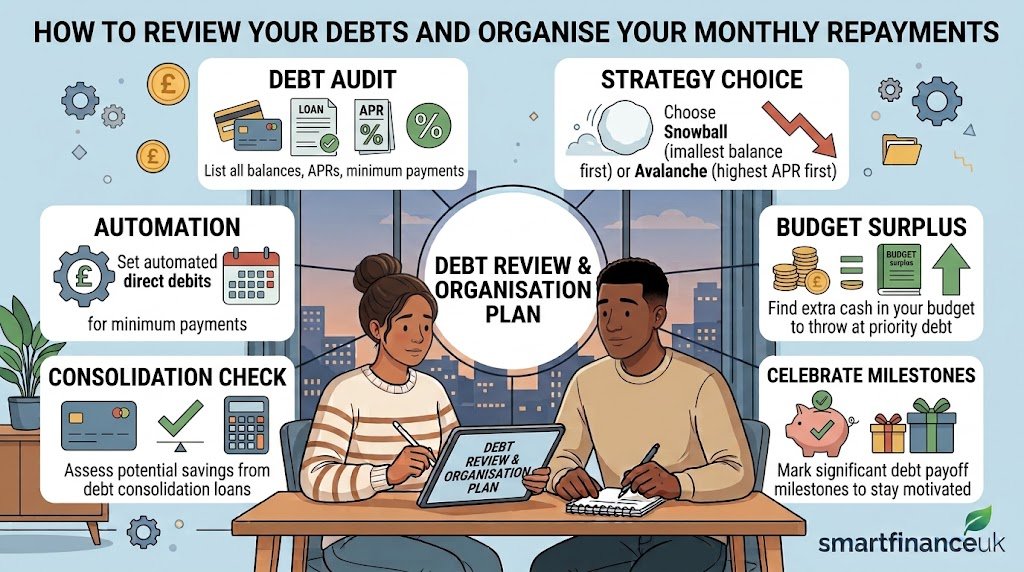
When you have several debts, it can be difficult to see exactly how much you owe, when each payment is due and which balances are costing you the most. A credit card payment may leave your account on one date, an overdraft can fluctuate throughout the month, and a loan may have a fixed repayment that continues for several years.
Without a clear picture, it is easy to miss a payment or underestimate how much of your monthly income is committed to borrowing.
Reviewing your debts does not necessarily mean making a complicated financial plan. The first step is simply to gather accurate information and organise it in one place. From there, you can see which debts need attention, how much you are paying each month and whether your current repayments are affordable.
This guide explains a practical way for UK readers to review their debts and organise monthly repayments. It provides general educational information rather than personalised financial advice.
Why Should You Review Your Debts Regularly?
Debt can become harder to manage when you only think about each account separately.
For example, a person might know that they owe money on a credit card but overlook a personal loan, overdraft and store account. Each individual payment may seem manageable, but together they could take up a significant part of the household budget.
A debt review brings everything together.
It can help you understand:
- how much you owe in total
- how much you pay each month
- which debts have the highest interest rates
- when payments are due
- whether any promotional rates are ending
- whether your repayments are affordable
- how your debts are changing over time
The Financial Conduct Authority advises consumers who are struggling with debt to seek help early rather than allowing problems to develop further.
Even when you are not experiencing financial difficulty, regularly checking your debts can make your finances easier to understand.
Start by Listing Every Debt
The first practical step is to make a complete list.
Do not rely on memory.
Check your online banking, statements, credit-card accounts, loan documents and other relevant records.
Your list could include:
- credit cards
- personal loans
- overdrafts
- car finance
- store credit
- catalogue credit
- buy-now-pay-later balances
- mortgages
- other outstanding borrowing
You do not necessarily need to include every household bill in your debt list. Electricity, council tax and mobile phone bills are regular commitments, but they are different from a credit agreement unless you have fallen behind and owe arrears.
The aim is to identify money that you have borrowed or amounts you are required to repay because of previous borrowing.
Record the Important Details for Each Debt
Once you have listed your debts, gather the key information for each one.
A simple table can make this much easier.
| Debt | Balance | Interest rate | Monthly payment | Due date |
|---|---|---|---|---|
| Credit card | £2,400 | Check statement | £80 | 15th |
| Personal loan | £5,500 | Check agreement | £210 | 25th |
| Overdraft | £600 | Check account | Varies | N/A |
These figures are purely illustrative.
For your own records, use the current figures shown by your lender.
Also record the type of interest rate, if relevant, and whether the rate is due to change.
For a credit card, check whether a promotional interest rate is currently applying and when it ends.
For a loan, check the remaining term and whether early repayment conditions apply.
For an overdraft, record the arranged limit and current amount owed.
The more accurate your list is, the more useful the review will be.
Find Out How Much You Owe in Total
After recording each balance, add them together.
Suppose your fictional debts are:
£2,400 on a credit card
£5,500 on a personal loan
£600 on an overdraft
The total is £8,500.
This number can be uncomfortable to see, but it gives you something valuable: a starting point.
You can now track whether your overall debt is increasing, staying roughly the same or falling.
Do not worry if your calculation differs slightly from a lender’s figure because interest may continue to accumulate or transactions may still be pending. For an exact settlement figure, contact the relevant lender.
Work Out Your Total Monthly Debt Repayments
Next, add the minimum or required payments for each debt.
Using the fictional example above:
£80 credit-card payment
£210 personal-loan payment
£50 towards the overdraft
That would be £340 per month.
Again, these are example figures rather than recommendations.
Compare the total with your monthly income and essential household spending.
This is important because a debt payment that looks affordable by itself can become difficult when several repayments are combined with rent or mortgage costs, council tax, energy bills, food, transport and other regular expenses.
Check When Each Payment Is Due
Knowing how much you owe is only half the job.
You also need to know when the money leaves your account.
Create a monthly repayment calendar.
For example:
5th: Credit card payment
12th: Car finance payment
20th: Personal loan payment
28th: Other credit payment
This can help you identify weeks when several payments are leaving your account close together.
If your income arrives at a different time, the timing itself can create cash-flow pressure even when your monthly income is sufficient overall.
Some lenders may allow you to change a payment date, but this depends on the agreement and provider. Do not assume a change will be available or cost-free.
Check Your Direct Debits and Standing Orders
Automatic payments can make debt repayments easier to remember, but they can also cause problems if your account does not contain enough money when a payment is due.
Review your current account and identify which payments relate to debt.
Make sure you recognise each Direct Debit and standing order.
If you see a payment you do not recognise, contact your bank or the relevant organisation rather than cancelling it without understanding what it relates to.
MoneyHelper provides guidance on Direct Debits and standing orders and explains the differences between them.
Separate Required Payments From Optional Overpayments
When reviewing debts, distinguish between the payment you are required to make and any extra amount you choose to pay.
For example, suppose a credit card statement requires a minimum payment of £60 and you voluntarily pay £120.
Your required repayment is £60.
The additional £60 is an overpayment.
This distinction matters because your budget needs to cover required payments first.
Only after essential expenses and required debt payments are accounted for should you consider whether additional repayments are affordable.
Do not reduce an essential bill or miss another debt payment simply to make a larger payment towards one balance.
Identify Which Debts Have the Highest Interest Rates
Not all debt costs the same.
One credit card might have a different interest rate from another. An overdraft may have a different rate again, while a fixed personal loan may have its own agreed rate.
Write down the interest rate for each debt.
Then identify which borrowing is currently the most expensive.
This information can help you understand where interest is having the greatest effect.
However, the highest interest rate does not automatically mean that you should ignore every other consideration. You still need to maintain required payments on your other debts.
If you are considering making additional repayments, check the terms of the relevant agreements first.
Be Careful With Credit Card Minimum Payments
Credit cards deserve particular attention because the minimum payment can be much lower than the outstanding balance.
That can make a debt appear manageable while allowing it to remain outstanding for a long time.
For example, imagine a hypothetical credit-card balance of £3,000.
A relatively small required monthly payment may keep the account up to date, but if interest continues to be charged and you do not make significant repayments, the balance can take a long time to clear.
MoneyHelper warns that paying only the minimum on a credit card can mean taking much longer to clear the balance and paying more interest.
Check your statement for information about how long repayment could take under the current payment arrangement.
Review Promotional Interest Rates
Some credit products offer introductory or promotional rates.
These can be useful, but they have an end date.
If you have a credit card with a promotional rate, record:
- when the offer ends
- what rate applies afterwards
- whether different balances are treated differently
- whether fees apply to transfers or other transactions
- what minimum payment remains required
Put the end date somewhere you will notice it.
A common mistake is to organise a budget around today’s interest rate and forget that the cost can change later.
Check Whether Any Debts Are in Arrears
Your review should also identify whether you have missed any payments.
Look at your statements and correspondence for terms such as:
- missed payment
- arrears
- default
- overdue amount
- late payment
- payment arrangement
Do not ignore these terms.
If you have missed a payment, contact the lender and ask what the current position is.
The consequences of missed payments depend on the type of agreement and circumstances, but they can affect your credit record and may lead to additional costs.
If you are struggling to make essential repayments, getting help early is generally better than waiting until several payments have been missed.
Create a Monthly Debt Payment Calendar
Once you know the amounts and dates, put them into a calendar.
You can use a spreadsheet, banking app, budgeting app or simple paper planner.
For each repayment, record:
Lender: Name of provider
Payment: Required amount
Date: When it is due
Balance: Current amount owed
Rate: Current interest rate
Status: Paid or unpaid
After each payment is made, mark it as completed.
This simple habit can reduce the chance of forgetting a repayment.
It also gives you a record that can be reviewed at the end of each month.
Build Debt Payments Into Your Monthly Budget
Debt repayments should be included alongside your normal household expenses.
A basic monthly budget might look like this:
Monthly income: £2,500
Essential spending: £1,650
Required debt repayments: £350
Remaining amount: £500
These numbers are hypothetical.
The remaining £500 is not automatically available for debt overpayments because you may still have irregular expenses, savings goals and other commitments.
The purpose of this calculation is to see whether your required repayments fit within your overall financial position.
If your essential spending and required debt repayments regularly exceed your income, the issue needs more attention than simply rearranging payment dates.
Decide Whether Extra Repayments Are Affordable
If your budget leaves money available after essential expenses and required debt payments, you may consider making additional repayments.
There are different approaches to prioritising debts.
One common approach is to focus extra payments on the debt with the highest interest rate while continuing to make required payments on all other debts.
Another approach is to focus on a smaller balance first to create a sense of progress.
Neither method should involve ignoring contractual payments on other debts.
Before making an overpayment, check whether the lender applies any early repayment charges or restrictions.
This is particularly relevant to certain loans and finance agreements.
Consider the Snowball and Avalanche Approaches
Two commonly discussed debt repayment methods are the debt snowball and debt avalanche.
The snowball method generally involves paying extra towards the smallest balance first, while maintaining required payments on the other debts.
The avalanche method generally involves directing extra money towards the debt with the highest interest rate first.
The avalanche approach can reduce interest costs in situations where the other terms are comparable.
The snowball approach can provide visible progress because smaller balances may be cleared sooner.
The best approach depends on the debts involved, their terms and your circumstances.
These methods are planning frameworks, not guarantees of a particular financial outcome.
Do Not Ignore Small Debts
A small balance can seem unimportant compared with a large loan.
But small debts still require attention.
A £200 balance can have a different interest rate, payment date or promotional deadline from a £5,000 balance.
It may also be tempting to ignore a small account after making a payment, particularly if the balance is not shown prominently in your main banking app.
Keep every debt on your master list until the lender confirms that the balance has been cleared.
Keep an Emergency Buffer in Mind
Putting every available pound towards debt may appear attractive, but an unexpected expense can then force you to borrow again.
For example, imagine someone uses all available spare money to make a large credit-card payment and then faces an unexpected essential car repair the following week.
If they have no accessible money available, they may need to use credit again.
The appropriate balance between debt repayment and keeping some emergency savings depends on individual circumstances.
The important point is to avoid building a repayment plan that is so tight that one unexpected expense immediately causes new borrowing.
Review Your Credit Report
A debt review can be complemented by checking your credit report.
Credit reference agencies hold information about your borrowing and repayment history, although the information can differ between agencies.
Checking your report can help you identify accounts you do not recognise, outdated information or potential errors.
You can request your statutory credit report from the UK’s main credit reference agencies, including Experian, Equifax and TransUnion.
Checking your own credit report does not mean you are applying for credit.
If you find incorrect information, contact the organisation that supplied the information and ask for it to be investigated.
What If You Have Several Debts and Cannot Keep Up?
If your review shows that you cannot afford your required repayments, do not simply move money between credit cards or take out another loan without considering the consequences.
Contact your lenders as soon as possible.
Explain that you are having difficulty meeting your repayments and ask what support may be available.
You can also seek free debt advice from organisations such as MoneyHelper, Citizens Advice or StepChange.
MoneyHelper explains that free debt advice can help people understand their options when debt becomes difficult to manage.
If you are struggling with priority debts such as rent, mortgage payments, council tax or essential household bills, these should not be treated in exactly the same way as ordinary unsecured borrowing.
Getting advice can help you understand which debts need urgent attention.
A Simple Hypothetical Debt Review
Consider a fictional household with three forms of borrowing:
Credit card: £2,800 balance, £90 required monthly payment
Personal loan: £6,000 balance, £225 monthly payment
Overdraft: £400 currently used
The household therefore owes £9,200 in total.
The known scheduled payments total £315 per month, excluding any variable overdraft cost.
The next step is not simply to throw every spare pound at the largest balance.
The household should first check:
Whether all required payments are affordable.
Whether the overdraft is becoming a permanent balance.
Which debt has the highest interest rate.
Whether the credit card has a promotional rate ending soon.
Whether the personal loan has early repayment conditions.
Whether there are any missed payments or arrears.
Once those details are known, the household has a much clearer basis for deciding how to organise repayments.
Common Debt-Management Mistakes
Keeping Debt Information in Your Head
Memory is not a reliable debt-management system.
Write down balances, dates, rates and payments.
Focusing Only on the Largest Balance
The largest debt is not necessarily the most expensive debt.
Interest rates and other terms matter.
Paying One Debt and Ignoring Others
Making an extra payment to one account does not remove the requirement to make payments on your other debts.
Forgetting Promotional Rate End Dates
A low introductory rate can expire.
Record the relevant date and review what happens afterwards.
Taking New Credit to Cover Existing Credit
This can sometimes be part of a structured debt strategy, but taking new borrowing without understanding the total cost can make matters worse.
Ignoring Letters From Lenders
If you receive correspondence about arrears or missed payments, do not put it aside indefinitely.
Contact the lender and find out what the letter means.
Building a Repayment Plan That Leaves No Flexibility
A plan that uses every pound of spare income may become difficult to maintain when an unexpected expense appears.
Questions to Ask When Reviewing Your Debts
Before deciding how to organise repayments, ask:
How much do I owe altogether?
Use current balances rather than old statements.
How much must I pay each month?
Separate contractual payments from voluntary overpayments.
Which debt has the highest interest rate?
This can help you understand where borrowing costs are accumulating most quickly.
When is every payment due?
Put the dates into one calendar.
Are any interest rates about to change?
Pay particular attention to promotional credit-card rates.
Am I regularly using an overdraft?
If so, check whether it has become part of your normal spending pattern.
Are any accounts in arrears?
Identify missed payments as early as possible.
Can I afford my current repayments?
Look at your complete household budget rather than considering each debt separately.
Could I make extra repayments without creating another cash shortage?
Debt reduction needs to be sustainable.
Do I need professional debt advice?
If you cannot keep up with payments or essential bills, free debt advice can help you understand your options.
Frequently Asked Questions
How often should I review my debts?
There is no single schedule that works for everyone, but reviewing your debts at least every few months can help you keep track of balances, interest rates and repayment dates. You should also review them whenever your income, expenses, interest rates or borrowing arrangements change. If you are struggling with repayments, do not wait for a routine review. Contact your lender or seek appropriate debt advice sooner.
Should I pay off the highest-interest debt first?
One commonly used approach is to make required payments on every debt while directing additional money towards the debt with the highest interest rate. This is often called the debt avalanche approach. However, the best strategy depends on the specific terms of your debts and your circumstances. Check for early repayment charges and other conditions before making significant additional payments.
Should I pay more than the minimum on a credit card?
If you can afford to do so, paying more than the minimum can reduce the balance more quickly and may reduce the amount of interest you pay over time. However, you should still keep up with essential household costs and required payments on other debts. Check your credit-card agreement for the applicable interest rate and repayment information before deciding how much extra you can sustainably pay.
Is it better to clear a small debt or a high-interest debt first?
These are the principles behind two common repayment approaches. The snowball method focuses on smaller balances, while the avalanche method focuses on higher-interest debt. Clearing a small balance can provide visible progress, while targeting a high-interest balance can reduce borrowing costs. The right approach depends on your debts and circumstances, and you should continue making required payments on every account.
What should I do if I cannot afford all my debt repayments?
If you cannot afford your required repayments, contact your lenders as soon as possible rather than waiting for the situation to deteriorate. You can also seek free debt advice through organisations such as MoneyHelper, Citizens Advice or StepChange. Avoid taking additional credit simply to make existing payments unless you have properly assessed the consequences and obtained appropriate guidance.
Does checking my credit report help with debt management?
Yes, checking your credit report can be useful as part of a wider review. It can help you identify accounts, balances and repayment information recorded by a credit reference agency. You may also spot information that appears incorrect or accounts you do not recognise. Remember that different credit reference agencies may hold different information, so checking more than one report can sometimes provide a fuller picture.
Should I keep savings while paying off debt?
There is no universal answer because the appropriate balance depends on your circumstances, debt costs and ability to handle unexpected expenses. Having no accessible money at all can mean relying on new credit when something goes wrong. At the same time, expensive debt can continue accumulating interest. Consider your complete financial position and, where necessary, seek independent guidance rather than following a fixed rule.
Final Thoughts
Reviewing your debts is much easier when everything is in one place.
Start by listing every balance, interest rate, required payment and due date. Then calculate your total monthly repayments and compare them with your household budget.
Once you have the full picture, you can identify which debts are costing the most, whether any promotional rates are ending and whether your current repayment plan is sustainable.
Do not overlook small balances, overdrafts or payments that are made automatically. And if your review shows that you cannot afford your repayments or essential household bills, seek help rather than relying on additional borrowing to keep going.
A clear debt list will not remove the money you owe, but it can turn a collection of confusing payments into something you can understand and monitor.
This article provides general educational information and is not personalised financial advice.
Sources and Further Reading
- MoneyHelper — Managing credit well: Guidance on understanding credit commitments, repayment costs and managing borrowing.
- MoneyHelper — Dealing with debt: Information about getting help when debt becomes difficult to manage.
- MoneyHelper — Credit cards: Guidance on minimum payments, interest and managing credit-card borrowing.
- Citizens Advice — Debt and money: General guidance for people experiencing debt problems.
- Financial Conduct Authority: Information and rules relating to consumer credit and firms providing regulated credit services.