
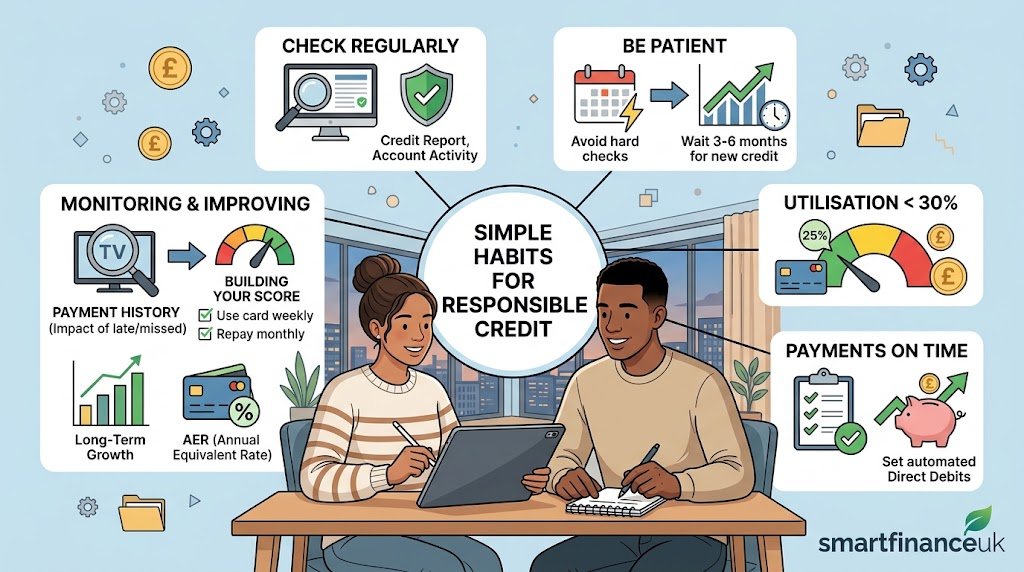
Credit can be a useful part of everyday financial life. A credit card can help spread the cost of a purchase, an arranged overdraft can provide short-term flexibility, and borrowing can sometimes help people pay for significant expenses. But credit also creates an obligation to repay what you borrow, usually with interest or other charges.
Managing credit responsibly is less about having a perfect credit score and more about developing sensible habits. Knowing what you owe, making repayments on time, understanding the cost of borrowing and avoiding commitments you cannot comfortably afford can all help you stay in control.
For UK households, this can be particularly useful when managing several financial commitments at once. A credit card balance, overdraft, car finance agreement or personal loan can each have different terms. Understanding those terms before borrowing, and keeping track of them afterwards, can prevent small problems from becoming harder to manage.
This guide explains practical habits that can help you use credit carefully, understand your commitments and recognise when borrowing may be becoming difficult to manage.
What Does Managing Credit Responsibly Mean?
Managing credit responsibly means using borrowed money with a clear understanding of how much you owe, what it costs and when repayments are due.
It does not mean that you must never borrow money. Credit can have legitimate uses, and many people use financial products such as credit cards, loans and mortgages as part of their normal household finances.
The important issue is whether you understand the commitment you are taking on.
Before using credit, consider the total amount you will have to repay, the interest rate or APR, any fees, the repayment schedule and what would happen if your circumstances changed.
Once you have borrowed, responsible management means keeping track of the balance and meeting the agreed repayments where you can.
It also means recognising warning signs early. If you regularly rely on one credit account to pay another bill, repeatedly use an overdraft to cover ordinary living costs or find yourself borrowing more simply to meet existing repayments, it may be time to review your finances.
Know Exactly What You Owe
One of the simplest habits is also one of the easiest to overlook: keep a clear record of your borrowing.
If you have one credit card, this might be straightforward. If you have several accounts, however, it becomes easier to lose track of balances, interest rates and payment dates.
Your list might include a credit card, personal loan, car finance, overdraft and any other borrowing you currently have.
For each account, record the outstanding balance, interest rate or APR, minimum repayment, usual payment date and any important fees or charges.
You do not need complicated software. A spreadsheet, notebook or budgeting app can be enough.
The purpose is to make your borrowing visible.
A £1,000 balance on one account can feel manageable when considered by itself. Several smaller balances can look very different when added together.
Knowing the total also makes it easier to understand how much of your monthly income is already committed.
Check Your Credit Agreements Before Borrowing
It is easy to concentrate on the amount you are receiving and overlook the cost of receiving it.
Before accepting credit, read the agreement and understand the key terms.
For a credit card, look at the interest rate, minimum repayment rules, fees and any promotional terms. If a promotional interest rate applies for a limited period, check when it ends and what rate may apply afterwards.
For a loan, look at the APR, total amount repayable, repayment period and any applicable fees.
For an arranged overdraft, check the interest rate and charges and understand how the facility works.
The APR, or annual percentage rate, is designed to help consumers compare the cost of borrowing because it takes account of the interest rate and certain compulsory charges. However, the way different products work can vary, so do not rely on one number alone.
If you do not understand a term in a credit agreement, find out what it means before accepting the borrowing.
Make Repayments On Time
Keeping up with agreed repayments is one of the most important credit-management habits.
Missing a payment can lead to charges or other consequences depending on the agreement. Payment information can also be reported to credit reference agencies, meaning missed or late payments may appear on your credit history.
Setting up a Direct Debit for a required repayment can reduce the risk of forgetting a payment, provided there is enough money in the account when the payment is due.
However, do not assume that a Direct Debit solves every problem. You still need to monitor your account and make sure the payment amount and date are correct.
If your income varies from month to month, reviewing upcoming payments before payday can also help you identify periods when your account balance may be tight.
Pay More Than the Minimum When You Can Afford To
Credit cards commonly allow you to make a minimum monthly repayment rather than clearing the full balance.
Paying the minimum can keep the account within the agreed terms, but it may take considerably longer to repay a balance and can increase the total interest paid when interest is charged.
For example, imagine a hypothetical credit card balance of £1,500. If the cardholder makes only small required payments and continues adding new purchases, the balance may take a long time to clear.
The exact repayment period and interest cost would depend on the card’s terms, interest rate, minimum-payment calculation and future spending.
The practical lesson is not that everyone must clear a credit card immediately. It is that you should understand what the minimum repayment actually means and consider paying more when your budget allows.
If you are struggling to make more than the minimum, focus first on maintaining required payments and understanding your wider financial position rather than taking on additional borrowing simply to make the numbers look better.
Keep Credit Card Spending Within Your Budget
A credit card can make spending feel less immediate because the money does not leave your current account at the moment you make the purchase.
That can make it easier to spend more than planned.
One useful habit is to treat credit card spending as part of your normal monthly budget rather than as extra money.
For example, if your household budget allows £150 for discretionary spending, putting £150 of purchases on a credit card does not create an additional £150 of spending capacity. It simply changes when the money leaves your bank account.
This approach can help prevent a cycle in which the credit card balance grows because each month’s income is being used to pay for previous spending.
If you cannot comfortably explain how you will repay a planned purchase, pause before putting it on credit.
Avoid Using One Form of Credit to Cover Another Without a Plan
Using new borrowing to cover an existing debt is not automatically wrong. In some circumstances, people may consider options such as balance transfers or consolidation loans.
The problem arises when new borrowing simply postpones the underlying problem.
Imagine that someone repeatedly uses a credit card to cover an overdraft and then uses another source of credit to pay the credit card. The total debt may continue increasing even though each individual payment is being made.
Before using new credit to deal with existing debt, work out the total cost, interest rate, fees, repayment period and whether the new arrangement actually improves the position.
If debt is becoming difficult to manage, free debt advice may be more useful than taking out another credit product.
MoneyHelper provides guidance on dealing with debt and finding appropriate support. (moneyhelper.org.uk)
Check Your Credit Report Regularly
Your credit report contains information that credit reference agencies receive about your credit history.
Checking your own report is a useful habit because it allows you to see whether information appears accurate and whether there are accounts or applications that you do not recognise.
Checking your own credit report does not harm your credit score. MoneyHelper explains that you can check your credit report without affecting your ability to obtain credit. (moneyhelper.org.uk)
It can be useful to check your reports before making a major application, such as applying for a mortgage.
Remember that there is more than one credit reference agency in the UK and the information held by different agencies can vary. A lender may also use its own assessment rather than simply relying on the score you see.
Be Careful With Multiple Credit Applications
When you need credit, it can be tempting to apply to several lenders to see which one accepts you.
However, formal applications can create hard searches on your credit report. Several applications within a short period can potentially be viewed negatively by some lenders.
That does not mean you should never compare products.
Where available, an eligibility checker can be a useful alternative because it may use a soft search to estimate whether you are likely to meet a provider’s criteria without creating the same type of visible hard search.
Always check the terms of the eligibility service and understand whether it uses a soft or hard search.
The Financial Conduct Authority has also warned consumers to consider the cost of borrowing and understand the terms before taking credit. (fca.org.uk)
Keep Your Personal Details Secure
Responsible credit management also includes protecting the information that allows someone to apply for credit in your name.
Be cautious about unexpected messages asking for passwords, banking information or other sensitive details.
Review your credit report for accounts or applications you do not recognise. If you find something suspicious, contact the relevant organisation and credit reference agency promptly.
Do not assume an unfamiliar account is automatically fraud. A lender’s trading name may differ from the brand you remember, so check the details first.
If you believe you have been a victim of identity fraud, take appropriate action rather than ignoring the issue.
Review Your Credit Before a Major Financial Decision
If you expect to apply for a mortgage, loan or another significant form of credit, give yourself time to review your finances beforehand.
Look at your existing debts, monthly repayments, income and regular household costs.
Check your credit reports for errors and make sure you understand any outstanding balances.
This does not guarantee that an application will be accepted. Lenders have their own criteria and can consider factors such as income, expenditure, affordability and existing commitments.
The benefit of preparing early is that you may discover a problem before submitting a formal application.
For example, finding an incorrect account or missed-payment marker gives you an opportunity to investigate it rather than discovering it after a lender has already assessed your application.
Build a Budget That Includes Credit Repayments
Credit repayments should be treated as part of your normal household budget.
Start with your regular income and essential expenses such as housing costs, council tax, utilities, food and transport.
Then include your required debt repayments.
After that, consider flexible spending and savings.
This gives you a clearer picture of how much money is genuinely available for optional spending or additional debt repayments.
A budget can also reveal when borrowing is being used to fill a recurring gap.
For example, if your income covers essential expenses but leaves very little for unexpected costs, repeatedly putting emergencies on a credit card may indicate that your budget needs a separate provision for irregular expenses.
The answer will not be the same for every household, but identifying the pattern is valuable.
Keep an Emergency Buffer Where Possible
Unexpected costs are one reason people turn to credit.
A broken appliance, urgent home repair or sudden essential expense can be difficult when there is no money available outside the normal monthly budget.
Building some savings can reduce the need to rely on credit for every unexpected expense.
The amount needed will depend on your circumstances. You do not need to wait until you have a large emergency fund before starting.
Even a modest accessible savings balance can give you another option when an unexpected cost appears.
However, do not prioritise building savings in a way that causes you to miss required debt repayments. The right balance depends on your circumstances, interest rates, financial commitments and available income.
Watch for Signs That Borrowing Is Becoming Difficult
Credit problems do not always begin with a missed payment.
There can be earlier warning signs.
You might find that you are regularly using an overdraft before payday, relying on credit cards for groceries or household bills, making only minimum repayments for long periods, taking out new credit to repay existing balances or feeling uncertain about how much you owe altogether.
One sign by itself does not prove that someone has a serious debt problem.
A pattern, however, deserves attention.
If you are struggling with debt, do not wait until you have missed several payments before seeking help. Free and confidential debt guidance is available through organisations such as MoneyHelper and StepChange. (moneyhelper.org.uk)
A Simple UK Example
Consider a hypothetical household with a credit card balance, an arranged overdraft and a personal loan.
The household knows the minimum payments but has never added them together. During the month, the credit card is also used for everyday purchases.
At the end of the month, the household discovers that much of its next month’s income is already committed to previous borrowing.
A more responsible approach would be to list each balance, interest rate, repayment and due date. The household could then review its budget and identify whether it can reduce new credit-card spending, make additional repayments when affordable or seek debt guidance if the commitments are becoming difficult.
The example does not suggest one solution is suitable for everyone. Its purpose is to show why understanding the complete picture matters.
Common Credit Management Mistakes to Avoid
One mistake is treating the available credit limit as though it were available income. A credit limit tells you how much a provider may allow you to borrow; it does not tell you what you can afford to repay.
Another mistake is ignoring small balances because they seem insignificant. Several small debts can collectively create a meaningful monthly repayment commitment.
Some people also concentrate entirely on their credit score. While credit history can matter, lenders can consider many other factors when deciding whether to approve an application.
It is also risky to assume that transferring or consolidating debt automatically makes it cheaper. A new arrangement may have fees, a different interest rate or a longer repayment period. The total cost needs to be considered.
Finally, avoid waiting until a payment is missed before looking at your finances. If you can see that next month’s commitments may not be affordable, getting help early can give you more options.
Practical Steps for Managing Credit Responsibly
A simple routine can make credit easier to control.
At the start of each month, check your credit balances and upcoming repayments. Compare those commitments with your expected income and essential household spending.
During the month, keep an eye on new credit-card spending and overdraft use. If you are using credit for everyday costs more frequently than planned, investigate why.
Once a month, review your credit accounts and check whether anything has changed, such as an interest rate, fee or promotional period ending.
Periodically check your credit reports for errors or unfamiliar activity.
Before taking new credit, stop and calculate the full cost rather than looking only at the monthly payment.
These habits are simple, but they can make borrowing more visible and reduce the risk of making decisions based on incomplete information.
Questions to Ask Before Taking New Credit
Before applying for borrowing, ask:
How much will I repay in total?
The monthly payment alone does not show the full cost.
What interest rate or APR applies?
Check whether the rate is fixed, variable or promotional and understand when any introductory period ends.
Can my budget comfortably support the repayments?
Consider what would happen if an essential household cost increased or your income temporarily fell.
Are there fees or other charges?
Look beyond the headline interest rate.
Will the application create a hard search?
If you are comparing products, find out whether an eligibility check or quotation search is available.
What happens if I cannot make a payment?
Understand the consequences before agreeing to the borrowing.
Am I borrowing for a genuine need or because my budget is already short?
If borrowing is repeatedly being used to cover ordinary living costs, reviewing the underlying budget may be more useful than adding another debt.
Frequently Asked Questions
What is the most important habit when managing credit?
Keeping track of what you owe and making required repayments on time are two of the most important habits. It is also useful to understand the cost of each form of borrowing and avoid taking on repayments that your budget cannot reasonably support. Responsible credit management is about maintaining awareness rather than simply focusing on a credit score.
Does using a credit card responsibly improve your credit score?
Responsible use can contribute to a positive credit history, particularly when payments are made according to the agreement. However, there is no universal formula for improving a credit score because credit reference agencies use their own scoring systems and lenders use their own assessment criteria. A particular action should therefore not be treated as a guaranteed way to increase a score.
Should I always pay my credit card balance in full?
If you can comfortably afford to do so and your card charges interest on the balance, paying the balance in full can reduce or avoid interest on purchases depending on the card’s terms. However, circumstances vary. If you have several debts or limited income, consider your wider financial position rather than assuming that one repayment strategy is automatically right for everyone.
Is an overdraft a type of credit?
Yes. An arranged overdraft is a form of borrowing that allows you to spend more than the available balance in your current account, subject to the provider’s terms. It can be useful for short-term cash-flow problems, but it can also become expensive or difficult to manage if used regularly. Check your account’s current interest rate and charges.
Can I have too many credit cards?
There is no universal number of credit cards that is automatically considered too many. The more important issue is whether you can manage the accounts properly, keep track of payments and avoid borrowing beyond what you can afford. Having several accounts can also make your finances harder to monitor, so simplicity may be useful for some households.
What should I do if I am struggling to repay my debts?
Do not ignore the problem or automatically take out another loan to cover existing debts. Start by listing what you owe and reviewing your income and essential expenses. Free debt guidance is available from organisations such as MoneyHelper and StepChange. They can explain possible options based on your circumstances. (moneyhelper.org.uk)
Does checking my own credit report affect my credit score?
No. Checking your own credit report is considered a soft search and does not reduce your credit score. Reviewing your report can actually be a useful part of responsible credit management because it helps you identify incorrect information and unfamiliar accounts or applications. (moneyhelper.org.uk)
Final Thoughts
Managing credit responsibly does not require complicated financial systems. Start by knowing exactly what you owe, understanding the cost of each borrowing arrangement and keeping required repayments under control.
Use credit as part of your budget rather than treating a credit limit as additional income. Check your credit reports periodically, be cautious about making multiple applications and pay attention to signs that borrowing is becoming difficult to manage.
Most importantly, deal with problems early. If your debts are becoming difficult to afford, getting free debt guidance can be more useful than taking on further borrowing.
Credit can be a useful financial tool, but it works best when the costs and repayments are understood before the commitment is made.
This article provides general educational information and is not personalised financial advice.
1 thought on “Simple Habits That Can Help You Manage Credit Responsibly”