
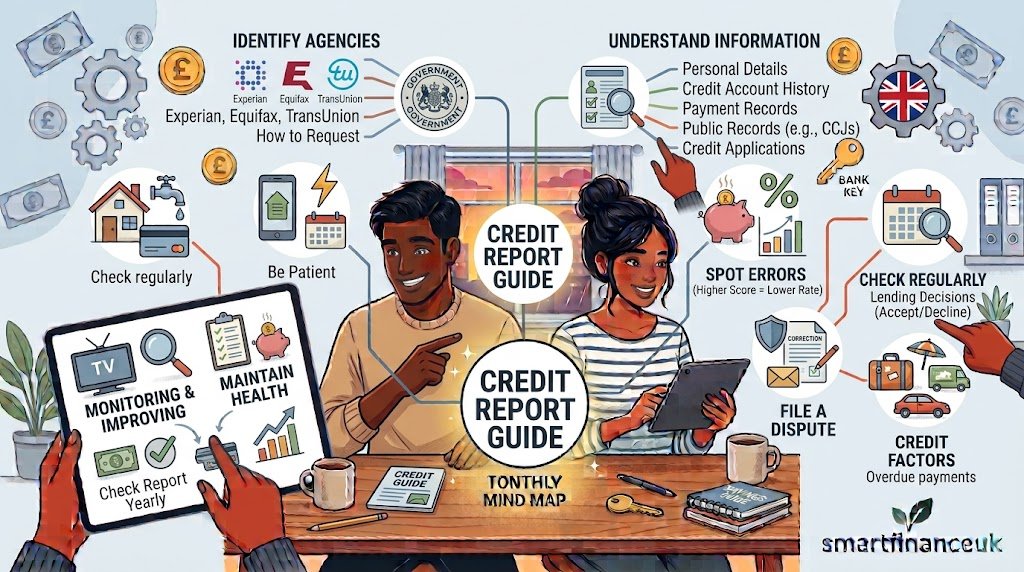
Your credit report can affect important financial decisions, from applying for a credit card or personal loan to arranging a mortgage or mobile phone contract. Yet many people only look at their report after being refused credit or discovering an account they do not recognise.
Checking your credit report before you need to borrow can give you time to spot mistakes, understand your existing commitments and identify anything that needs attention. It is also useful for checking for signs of fraud.
In the UK, credit reference agencies collect information about your credit activity and use it to produce credit reports. There is not one single report or score used by every lender. Different agencies may hold different information, and lenders have their own ways of assessing applications.
This guide explains how to check your credit report, what the different sections mean and what to do if something appears incorrect.
What Is a Credit Report?
A credit report is a record of information relating to your borrowing and credit history. Credit reference agencies, commonly known as CRAs, collect information from sources such as banks, building societies and other organisations that provide credit or financial services.
In the UK, MoneyHelper currently identifies four consumer credit reference agencies: Experian, Equifax, TransUnion and Crediva. The information held by each agency can differ because not every lender reports to every agency.
Your report may contain information about credit accounts, repayment history, credit applications, addresses, financial associations and certain public records.
It is worth separating the terms credit report and credit score.
Your credit report contains the underlying information. A credit score is a number calculated by a particular credit reference agency using information in your report and its own scoring model. A lender does not have to use the score shown to you by a CRA. Instead, it may use its own assessment and criteria.
That means a high score shown by one service does not guarantee that a particular bank or lender will approve your application.
How to Check Your Credit Report in the UK
You have the right to access your statutory credit report for free. Checking your own report does not damage your credit score because it is treated as a soft search.
You can request a report from the credit reference agencies directly. Because the agencies may hold different information, it can be useful to check more than one, particularly if you have never reviewed your reports before or are preparing for an important application.
A sensible approach is to start with the agencies and services you are comfortable using, check what information they hold and make sure you understand whether a service is genuinely free or involves an optional paid subscription.
Be particularly careful with websites that advertise a free credit report but then make a paid membership prominent during registration. Read the terms before entering payment details.
If you are preparing to apply for a mortgage, loan or credit card, checking your reports in advance can give you an opportunity to correct obvious errors before making an application.
What Information Can Appear on Your Credit Report?
The exact layout differs between credit reference agencies, but several types of information are commonly found.
Personal and Address Information
Your report may contain identifying details such as your name, date of birth and address information. Electoral register information can also be included.
Keeping your details accurate matters because lenders need to be able to match your application with the correct credit history. An old address appearing on a report is not automatically a problem, but unexplained or incorrect addresses deserve attention.
If you have moved home recently, check that your accounts and other records are associated with the correct address.
Credit Accounts
This section can show accounts such as credit cards, loans, mortgages and some current accounts with overdraft facilities.
Depending on the agency and account, you may see information such as the date the account was opened, the credit limit or original borrowing amount, outstanding balance and repayment history.
For example, a credit card entry might show a £2,000 credit limit alongside information about the balance and whether payments have been made according to the agreement.
Do not assume that seeing a balance means you have done something wrong. A credit card can quite normally show an outstanding balance. What matters is understanding what the balance represents and whether the repayment information is accurate.
Payment History
Your report can show whether payments were made on time, late or missed.
A missed payment can be important because lenders may consider your recent repayment behaviour when assessing a new application. Late payments and defaults can remain on credit reports for several years, although the effect of older information can change over time.
If you see a late payment that you believe is wrong, do not simply ignore it. Check your bank statements and correspondence, then raise the issue with the relevant lender and credit reference agency.
Credit Applications and Searches
Your report can contain records of searches made by organisations.
There is an important distinction between a hard search and a soft search.
A soft search is generally used for things such as checking your own report or assessing eligibility for certain products. It is not visible to other lenders in the same way as a hard search and does not affect your credit score.
A hard search is normally recorded when you formally apply for credit. Lenders can see hard searches, and several applications within a short period can potentially make you appear more dependent on borrowing.
Before using an eligibility checker or comparison service, check whether it uses a soft search. This can allow you to explore your potential eligibility without automatically creating a hard search.
Financial Associations
Your report may also show financial links with other people.
A joint loan, mortgage or bank account can create a financial association. This means information about the other person’s credit history may be relevant when a lender assesses you.
Being married or living at the same address does not, by itself, mean that you are financially linked to someone.
The important question is whether you have a genuine financial connection, such as joint borrowing.
If a former partner is still incorrectly shown as financially associated with you after the financial connection has ended, you can contact the relevant credit reference agencies about a notice of disassociation.
Public Records and Serious Debt Information
Credit reports can include certain public records, including County Court Judgments, insolvency information and other formal debt-related records.
The terminology can vary across the UK. For example, a County Court Judgment is generally referred to as a Decree in Scotland.
Some serious financial records can remain on a credit file for up to six years, although the exact retention period depends on the type of information and circumstances.
This is one reason it is important not to assume that paying a debt immediately makes every historical record disappear. The underlying record and the current status of the debt are separate matters.
How to Read Your Credit Report
When you receive your report, do not focus only on the headline credit score.
Start by checking the basic information.
Make sure your name and addresses are correct. Look through the list of accounts and ask yourself whether you recognise each one.
Then check the repayment history.
If an account shows a missed payment, default or another adverse entry, compare it with your own records. Look at bank statements, payment confirmations and correspondence from the lender where necessary.
Next, review the searches section.
If you have recently applied for a credit card, loan or other financial product, you may expect to see a search. But an application you do not recognise could be a warning sign that someone has attempted to use your details.
Finally, check the financial associations section and public records.
A credit report is easier to understand when you work through it section by section rather than becoming distracted by the score at the top.
What Should You Do If You Find a Mistake?
Finding an error can be worrying, but there is a process for challenging inaccurate information.
First, identify exactly what appears to be wrong. It could be an incorrect balance, payment status, address, account or financial association.
Next, gather evidence.
For example, if your report says a payment was missed but your bank statement shows it was made on time, keep a copy of the relevant transaction and any supporting correspondence.
You can then contact the organisation that supplied the information and the credit reference agency holding the record.
Credit reference agencies have processes for investigating disputed information. If the information is found to be incorrect, it can be updated.
If you believe information is technically accurate but there are circumstances that you want a lender to understand, there may also be an option to add a notice of correction. GOV.UK guidance explains that consumers can challenge incorrect information with credit reference agencies, while a notice of correction can be used to provide an explanation in appropriate circumstances.
Do not pay a company simply because it claims that it can magically remove accurate negative information from your credit file. A legitimate error should be challenged through the appropriate process.
What If You See an Account You Do Not Recognise?
An unfamiliar account should not automatically be treated as fraud. There may be an innocent explanation, such as a lender using a trading name that you do not recognise.
Check the details carefully first.
If you still cannot identify the account, contact the organisation named on the report and the relevant credit reference agency.
If you believe someone has used your identity to apply for credit, act promptly. Checking your credit reports regularly can help you notice suspicious activity earlier.
Do not ignore an unfamiliar credit application simply because you have not received a bill. An application can be an early indication that someone has attempted to use your personal information.
How Often Should You Check Your Credit Report?
There is no fixed legal schedule requiring you to check your report every month.
However, checking it periodically is a sensible habit, particularly before making a major credit application.
MoneyHelper confirms that checking your own report does not affect your credit score and that you can check it as often as you like.
You may want to check it when you are preparing for a mortgage, considering a major loan application, after moving home or if you suspect fraud.
Regular checks can also help you become familiar with your own financial records. That makes unusual information easier to spot.
A Simple UK Example
Imagine that Sarah is considering applying for a mortgage in the future.
Before speaking to lenders, she checks her credit reports and notices that an old credit card is showing an incorrect address. She also finds a late-payment marker that she believes is wrong.
Rather than immediately applying for a mortgage, Sarah checks her bank statements and contacts the credit card provider. The provider confirms that the payment was made on time and investigates the record.
This example does not mean that correcting an error guarantees a mortgage approval. A lender will consider many factors when assessing an application.
The useful lesson is simply that checking a credit report early can give you time to identify information that needs clarification before an important financial decision.
Common Credit Report Mistakes to Avoid
One common mistake is checking only one credit reference agency and assuming that every agency holds identical information. Different agencies can receive information from different providers, so reports may vary.
Another mistake is confusing your credit score with a lender’s decision. A score shown by a CRA is only one part of the picture. Lenders use their own criteria and may consider information beyond the score.
Applying for several credit products in quick succession can also create multiple hard searches. If you are comparing options, look for eligibility checkers or quotation searches that use soft searches where available.
It is also a mistake to assume that an old financial association disappears automatically when a joint account is closed. If the financial connection has genuinely ended, you may need to ask the CRAs to update the association.
Finally, do not ignore information simply because it is several years old. Check whether it is still being reported correctly and whether it should remain on the file.
Questions to Ask Before Applying for Credit
Before submitting a formal application, consider whether you have checked your credit reports recently.
Ask yourself whether the personal information and addresses are accurate, whether all the accounts belong to you and whether the payment history looks correct.
If you are comparing several products, check whether the providers offer eligibility checks using soft searches.
If you find something you do not understand, find out what it means before making an application rather than guessing.
For significant borrowing such as a mortgage, remember that a credit report is only one part of the assessment. Lenders can also consider affordability, income, existing commitments and their own lending criteria.
Frequently Asked Questions
Does checking my own credit report lower my credit score?
No. Checking your own credit report is treated as a soft search and does not affect your credit score. MoneyHelper states that you can check your credit report as often as you like without harming your chances of getting credit.
Do I have one credit report in the UK?
Not necessarily. Credit reference agencies maintain their own databases, and the information held by one agency can differ from another. MoneyHelper currently identifies Experian, Equifax, TransUnion and Crediva as consumer credit reference agencies in the UK.
How long do missed payments stay on a credit report?
A missed or late payment can remain on a credit report for up to six years. However, the effect of older information can reduce as it becomes less recent. The precise treatment can depend on the type of entry and the circumstances.
Does having a good credit score guarantee that I will be accepted for a loan?
No. Credit reference agency scores are not universal lender scores. Each lender can use its own criteria and may consider affordability, income, existing debts and other information when making a decision. A strong score can therefore be useful, but it is not a guarantee of acceptance.
What should I do if I find an account I do not recognise?
Check the account details carefully and contact the organisation that supplied the information. If you still cannot identify it, contact the relevant credit reference agency. If you suspect identity fraud, act promptly rather than waiting for another unexplained entry to appear.
Does a joint bank account affect my credit report?
A joint account can create a financial association between the account holders. This means lenders may take the other person’s credit history into account when assessing applications. Simply living with someone or being married does not automatically create a financial association.
Will closing an old account immediately remove it from my credit report?
No. Closing an account does not necessarily make its history disappear immediately. Credit reference agencies can retain information about closed or settled accounts for a period, and many account records are retained for six years after closure or settlement.
Final Thoughts
Knowing how to check your credit report is a useful part of managing your finances, particularly if you expect to apply for credit in the future.
Start by checking your personal details, addresses, credit accounts, repayment history, searches, financial associations and any public-record information. Do not focus solely on the credit score.
If something looks wrong, investigate it and contact the relevant lender and credit reference agency rather than ignoring it. If you are comparing financial products, understand whether a search will be soft or hard before submitting an application.
Most importantly, remember that your credit report is a record of information used in credit assessments, not a guarantee of what a particular lender will decide. For significant financial decisions, consider the full cost and affordability of borrowing and seek regulated financial advice where personalised advice is required.
This article is for general educational purposes and is not personalised financial advice.
Sources and Further Reading
- MoneyHelper — How to check your credit report for free
- MoneyHelper — How to improve your credit score
- MoneyHelper — Joint bank accounts and financial associations
- Financial Conduct Authority — Credit reference agencies
- GOV.UK — Credit reference agency information
- Experian — Credit reference agency information and data retention