
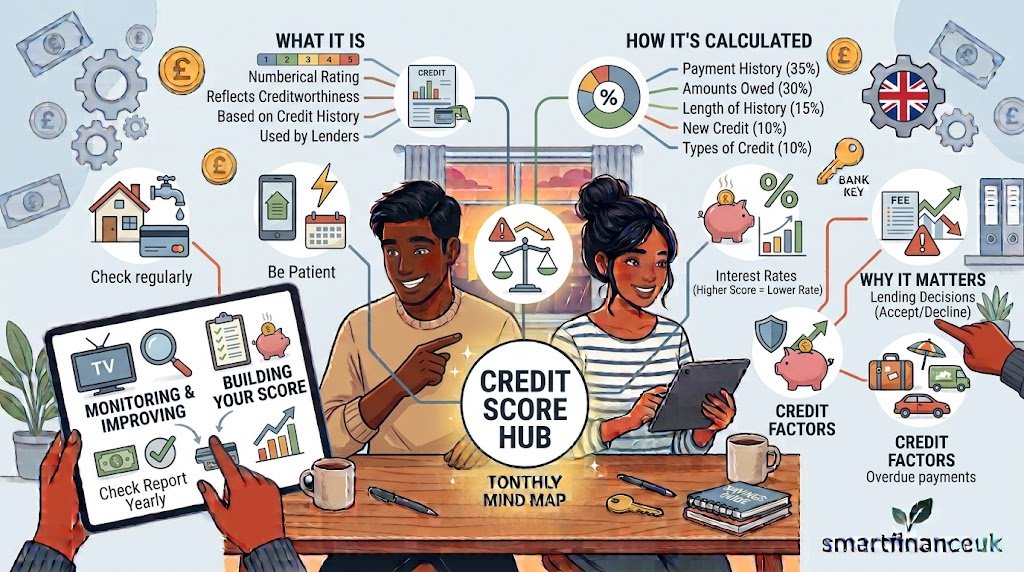
A credit score is a number designed to give an indication of how your credit history may look to lenders and other organisations. In the UK, you may see a credit score when checking your credit information online, but the number itself is not a universal score used by every lender.
What matters is the information behind it.
Your credit report can contain details about your borrowing, payment history, credit applications, financial associations and certain public records. Lenders can use this information, along with their own criteria and affordability checks, when deciding whether to offer credit.
Understanding the difference between a credit score and credit report can make it much easier to manage your finances. It can also help you avoid some common misconceptions, such as believing that a particular score guarantees acceptance for a credit card, loan or mortgage.
What Is a Credit Score?
A credit score is a numerical indication of your credit profile.
Credit reference agencies calculate scores using information contained in your credit report. Different agencies can produce different scores because they may hold different information and use different scoring methods.
In the UK, the main credit reference agencies include Experian, Equifax and TransUnion, while MoneyHelper also identifies Crediva as a credit reference agency.
This means there is no single UK credit score that every lender uses.
You might see one score when using one credit information service and a different score somewhere else. That does not automatically mean one of them is wrong.
Credit Score vs Credit Report: What Is the Difference?
These terms are often used interchangeably, but they are not the same thing.
Your credit report is the underlying record of your credit activity and related information.
Your credit score is a number intended to summarise or indicate how your credit profile may be viewed.
Think of the credit report as the detailed record and the score as a simplified indicator.
Your credit report can include information about credit accounts, repayment history, applications for credit, financial associations and certain public records. Missed payments and defaults can remain on your report for several years.
For this reason, checking only the number shown by an app may not tell you everything you need to know.
Why Does a Credit Score Matter?
Your credit profile can matter when you apply for certain forms of borrowing or credit.
A lender might consider your credit history when assessing an application for:
- A credit card
- A personal loan
- A mortgage
- An overdraft
- A mobile phone contract
- Other forms of credit
However, a credit score does not guarantee that you will be accepted.
MoneyHelper explains that lenders use their own criteria when deciding whether to offer credit. They can consider factors beyond the score displayed by a credit reference agency.
This is an important distinction.
Someone might have what appears to be an excellent credit score and still have a credit application rejected.
Another person with a different score might be accepted by a particular lender.
What Do Lenders Actually Look At?
There is no single checklist that every lender follows.
A lender can use information from your credit report alongside its own assessment criteria.
Depending on the product and lender, factors can include your history of making payments, existing borrowing, recent applications, information on your credit file and whether the lender believes you can afford the proposed repayments.
Affordability is particularly important.
A strong credit history does not necessarily mean that taking on additional borrowing is affordable for you.
For example, someone might have a good record of repaying previous credit but already have substantial monthly financial commitments. A lender may take those commitments into account when assessing a new application.
What Information Is on a UK Credit Report?
Your credit report can contain a range of information.
This may include:
Credit accounts
Your report can show credit products and information about how you have managed them.
This may include credit cards, loans and current accounts with overdrafts.
Payment history
Your history of making payments can be important.
Missed or late payments can appear on your credit report and may affect how lenders assess your application.
Credit applications
Applications for credit can create searches on your credit file.
A hard search is generally recorded when you formally apply for certain credit products. Multiple hard searches within a short period can potentially make you appear more dependent on credit to prospective lenders.
Financial associations
Your report can show financial links with other people.
For example, a joint loan or mortgage can create a financial association.
This does not mean that simply living with another person automatically links your credit files. The financial relationship itself is what matters.
Public records
Certain public records can appear on your credit report, including County Court Judgments in England and Wales and the equivalent Decrees in Scotland, along with insolvency information.
Does Everyone Have the Same Credit Score?
No.
The number you see can depend on which credit reference agency or service you use.
Different agencies can have different information, scoring systems and score ranges.
For example, MoneyHelper notes that the score shown by a credit reference agency is different from the criteria individual lenders use when making lending decisions.
This is why comparing your number with a friend’s number is usually not particularly useful.
Even two people with the same numerical score may have different financial circumstances and receive different decisions from the same lender.
What Is a Good Credit Score?
There is no universal UK definition of a “good” credit score.
Credit reference agencies use their own scoring scales and descriptions.
One provider might display a score out of 999, while another may use a different scale.
The number can therefore be misleading if you do not know which agency produced it.
More importantly, lenders generally do not simply look at whether your score falls above a particular universal UK threshold.
The information contained in your credit report and the lender’s own criteria matter.
Rather than becoming obsessed with reaching a particular number, it is usually more useful to focus on keeping your credit information accurate and managing existing borrowing responsibly.
Does Checking Your Credit Score Damage It?
No.
Checking your own credit report is considered a soft search and does not damage your credit score. MoneyHelper says you can check your credit report as often as you like without affecting your score.
This makes checking your own information a sensible part of financial housekeeping.
It is particularly useful before applying for an important form of credit because you can identify incorrect information or unfamiliar accounts before making an application.
What Is a Hard Credit Search?
A hard search is different from checking your own credit report.
It can occur when you formally apply for credit, such as a loan, mortgage or credit card.
Hard searches can be visible to lenders and may affect your credit profile. MoneyHelper advises limiting unnecessary credit applications and using eligibility or quotation checks where available before making a formal application.
This does not mean you should avoid applying for credit when you genuinely need it.
The point is to avoid making multiple unnecessary applications simply because you are unsure whether you will qualify.
What Is a Soft Credit Search?
A soft search allows a credit provider or other organisation to check certain information without creating the same visible application footprint as a hard search.
Examples can include checking your own credit report and some eligibility checkers.
MoneyHelper explains that eligibility calculators can use soft searches to estimate the likelihood of acceptance without affecting your credit score.
If you are comparing credit products, check whether the service uses a soft search before providing your details.
Does Your Salary Affect Your Credit Score?
Your salary is not normally recorded as part of your credit report in the same way as your borrowing and payment history.
MoneyHelper states that salary or income does not directly affect your credit score, although lenders can consider income and affordability when you apply for credit.
This distinction matters.
Having a high income does not automatically produce a high credit score.
Likewise, a lower income does not automatically mean you have a poor credit history.
Your ability to afford a particular borrowing commitment is a separate question from the information contained in your credit file.
What Can Affect Your Credit Profile?
Several things can influence how your credit history appears.
Missing payments
Late or missed payments can be recorded and may make future borrowing more difficult or expensive.
Defaults
A default indicates that an account has not been maintained according to its agreed terms. Defaults can have a significant impact on your credit history.
Multiple credit applications
Making several formal credit applications within a short period can create multiple hard searches.
High existing borrowing
Existing debts and credit commitments can affect how a lender views a new application.
Incorrect information
An incorrect address, unfamiliar account or other mistake can cause problems if it remains uncorrected.
Financial associations
A joint financial product can link your credit profiles.
MoneyHelper recommends checking your credit reports for mistakes, keeping address information up to date and ensuring your electoral-register information is correct.
Does Being on the Electoral Register Matter?
Being registered to vote at your current address can help credit reference agencies verify your identity and address.
MoneyHelper identifies electoral-register information as one of the things that can appear on your credit report and says registering to vote can help improve your credit score.
This is not a guarantee that registering will result in a particular score or credit decision.
It is simply one part of keeping your credit information accurate and easier for lenders to verify.
How Long Does Negative Information Stay on Your Credit Report?
Some negative information can remain on your credit report for several years.
For example, MoneyHelper states that missed or late payments and defaults can remain for up to six years. Certain public-record information can also remain for around six years, although the precise treatment depends on the type of record and circumstances.
This is one reason why dealing with payment problems early can matter.
If you are struggling to make a payment, contacting the lender before missing it may give you more options than waiting until the account is already in arrears.
A Simple Hypothetical Example
Imagine two fictional applicants.
Person A has a high credit score but already has several substantial monthly borrowing commitments.
Person B has a lower score but has fewer existing commitments and a stable record of making payments.
If both apply for the same loan, the lender does not have to make the same decision for both people.
The lender may consider affordability, credit history and its own lending criteria.
The example is hypothetical, but it demonstrates an important point: a credit score is not a guarantee of acceptance.
How Can You Check Your Credit Report?
You can obtain your statutory credit report for free from the credit reference agencies.
MoneyHelper recommends checking reports from the relevant agencies because the information held by each can differ.
When checking your report, look for:
- Your name and address
- Current and previous accounts
- Payment history
- Credit applications
- Financial associations
- Public records
- Accounts you do not recognise
- Information that appears to be incorrect
You do not need to pay for a subscription simply to obtain your statutory credit report.
Some services also provide free ongoing access to credit information, but check exactly what is included before signing up for a paid service.
What Should You Do If You Find a Mistake?
Do not ignore an error on your credit report.
For example, you might find:
- An old address that has been recorded incorrectly
- A payment marked as late when you believe it was made on time
- An account you do not recognise
- A financial association that should no longer apply
- Incorrect personal information
Contact the relevant credit reference agency and, where appropriate, the organisation that supplied the information.
Keep records of correspondence and supporting evidence.
If you believe an error is contributing to an unfair credit decision, correcting the underlying information can be more useful than simply trying to increase the numerical score.
Should You Pay for a Credit Score Service?
Not necessarily.
Free ways to access your credit information are available in the UK.
Before paying for a subscription, consider what additional service you are actually receiving.
A paid service may offer additional monitoring or features, but you should not assume that paying for a service will improve your creditworthiness.
The FCA has also warned about certain credit-builder products, noting that its 2025 review found little evidence that some products significantly improve credit scores for most consumers.
Be especially cautious about any service that suggests you need to pay simply to have a good credit history.
Does a High Credit Score Guarantee a Better Interest Rate?
No.
A stronger credit profile can help with access to credit and may be associated with better borrowing options, but lenders make their own decisions.
MoneyHelper specifically notes that having a high credit score does not guarantee that a lender will offer credit.
The interest rate you receive can depend on the lender, product, application, affordability assessment and other criteria.
Always look at the actual terms of a credit product rather than assuming that a particular score guarantees a particular rate.
Common Credit Score Mistakes to Avoid
Focusing only on the number
Your credit report contains more useful detail than the score alone.
Applying for credit repeatedly
Multiple hard searches in a short period can potentially make applications more difficult.
Ignoring errors
Incorrect information can affect how lenders assess you.
Assuming a high score guarantees acceptance
It does not.
Paying for unnecessary services
Free credit reports are available, so understand what you are paying for before subscribing to a credit service.
Taking out credit purely to improve your score
Borrowing money you do not need can create unnecessary costs and repayment commitments.
Ignoring affordability
A good credit history does not make unaffordable borrowing sensible.
Questions to Ask When Checking Your Credit
Before applying for credit, consider:
Is all the information on my credit report accurate?
Do I recognise every account?
Are my current address details correct?
Am I financially linked to anyone through joint borrowing?
Have I made several recent credit applications?
Can I comfortably afford the proposed repayments?
Does the application use a hard or soft search?
Am I applying because I genuinely need the credit?
These questions can help you look beyond the headline score.
Frequently Asked Questions
What is a credit score in the UK?
A credit score is a number generated from information relating to your credit history. It is designed to give an indication of your credit profile, but there is no single UK score used by every lender. Different credit reference agencies can calculate different scores, and lenders use their own criteria when assessing applications.
What is the difference between a credit score and credit report?
Your credit report contains detailed information about your credit activity and certain related records. Your credit score is a numerical summary or indication based on information in your report. The report is generally more useful when you want to identify errors, understand your credit history or prepare for an application.
What is considered a good credit score?
There is no universal UK number that defines a good credit score. Different credit reference agencies use different scales and categories. More importantly, lenders have their own criteria, so a particular score does not guarantee acceptance for a loan, credit card or mortgage.
Does checking my own credit report affect my score?
No. Checking your own credit report is treated as a soft search and does not affect your credit score. MoneyHelper recommends checking your report periodically so you can identify mistakes or unfamiliar information.
Can I improve my credit score?
You can take sensible steps to maintain or improve your credit profile, such as making payments on time, checking your credit report for errors, keeping your address information accurate and avoiding unnecessary credit applications. However, improvements can take time and there is no guaranteed timeframe or score increase.
Can I have a good credit score and still be refused credit?
Yes. A credit score does not guarantee acceptance. Lenders can consider affordability, existing commitments, application information and their own lending criteria. MoneyHelper notes that even someone with an excellent credit history can be refused credit.
Do savings improve my credit score?
Having savings does not directly improve your credit score. Credit scores are based primarily on information relating to your credit history rather than the amount of money held in savings. However, having savings can be useful for managing unexpected expenses without needing to rely on additional borrowing.
Final Thoughts
A credit score can be useful, but it is only one part of the picture.
For UK consumers, the more important task is understanding the information contained in your credit reports and how lenders may use it alongside their own criteria and affordability checks.
Check your reports regularly, make sure your personal details are accurate, look for accounts or payments you do not recognise and avoid unnecessary applications for credit.
Most importantly, do not treat a high numerical score as a guarantee of approval or a reason to borrow money you cannot comfortably afford.
Your credit history is there to help lenders assess risk. Your job is to understand what it says about your financial history and make borrowing decisions carefully.
This article provides general financial education for UK readers and is not personalised financial advice. Credit criteria, reporting practices and financial products can change, so check current information with the relevant credit reference agency, lender or authoritative UK source before making an important financial decision.