
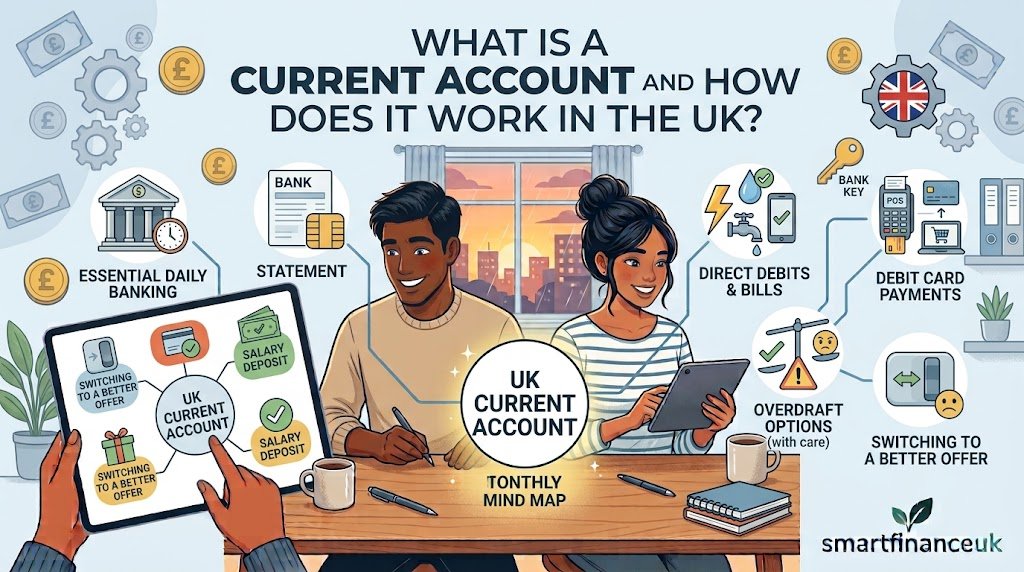
A current account is one of the main tools people in the UK use to manage everyday money. It can be used to receive your salary or benefits, pay household bills, make purchases with a debit card, transfer money and withdraw cash.
Unlike a savings account, which is generally designed for putting money aside, a current account is primarily built around regular payments and day-to-day spending. Some accounts also offer features such as overdrafts, cashback or interest, although these extras can come with conditions or costs.
Understanding how a current account works can make everyday banking much easier, particularly if you are opening your first account or considering switching banks.
This guide explains the main features, costs, types of current accounts and things to check before choosing one in the UK.
What Is a Current Account?
A current account is a bank or building society account designed for everyday financial transactions.
You can generally use one to:
- Receive your salary, pension or benefits
- Pay bills
- Make bank transfers
- Set up Direct Debits and standing orders
- Spend using a debit card
- Withdraw cash
- Manage your money through online or mobile banking
MoneyHelper describes current accounts as accounts that allow you to make and receive payments, including receiving wages and paying bills.
The exact features vary between providers and account types.
For example, one current account may be free and relatively basic, while another may charge a monthly fee in return for additional benefits.
How Does a Current Account Work?
The basic idea is straightforward.
Money is paid into your account, and you use the available balance to make payments or withdraw cash.
For example, imagine a hypothetical household receives £2,500 of income into its current account each month.
The household might then use the account to pay:
- Rent or mortgage
- Council Tax
- Energy bills
- Broadband
- Insurance
- Food
- Transport
- Other everyday expenses
The remaining money can be used for discretionary spending or transferred into savings.
The figures above are purely illustrative. Actual household income and expenses vary considerably.
Your current account therefore acts as a central place for managing money that needs to move in and out regularly.
What Can You Use a Current Account For?
Receiving Your Salary
Many people have their salary paid directly into their current account.
Your employer normally needs the relevant account details so that the payment can be made electronically.
The same type of account can generally be used to receive other payments, such as eligible benefits or pension income.
Paying Bills
A current account can be used to pay regular household expenses.
You can usually set up:
Direct Debits for regular payments where the organisation collects money from your account.
Standing orders for regular payments where you instruct your bank to send a set amount.
For example, you might use a standing order to transfer money to a savings account each month.
The exact payment arrangement depends on the organisation and the type of payment you are making.
Using a Debit Card
Most current accounts come with a debit card.
You can generally use it to pay in shops and online or withdraw cash from cash machines, subject to the account’s terms.
A debit card payment normally takes money from your available bank balance rather than creating borrowing in the way a credit card does.
However, some current accounts also have an overdraft facility, which changes how you can access money when your balance is insufficient.
Making Bank Transfers
You can use a current account to transfer money to another bank account.
For example, you might transfer money to:
- A family member
- A savings account
- A landlord
- A service provider
- Another account belonging to you
Your bank may have limits or security checks for certain transactions, particularly large or unusual payments.
What Is an Overdraft?
An overdraft allows you to borrow money through your current account when there is not enough money in the account to cover a payment.
Some current accounts offer an arranged overdraft, subject to the provider’s eligibility checks and terms.
An overdraft is borrowing, not additional income.
Interest and other charges can apply, depending on the account and circumstances. MoneyHelper currently notes that many overdrafts charge daily interest, with rates varying by provider.
For example, if you have £50 in your account but make a payment of £100 and your arranged overdraft allows it, the account could become £50 overdrawn.
You would then owe the bank that £50, plus any applicable borrowing costs.
Do not treat an overdraft as part of your normal monthly income.
If you regularly depend on one to pay ordinary household expenses, it may be worth reviewing your budget or seeking appropriate debt guidance.
What Happens If You Do Not Have Enough Money?
If there is not enough money in your account to cover a payment, the outcome depends on the type of payment, your account terms and whether you have an arranged overdraft.
A payment may be declined, or the account may become overdrawn if an overdraft arrangement permits it.
Potential costs can include overdraft interest or other charges, depending on the account.
This is one reason it is useful to keep track of your balance and upcoming payments.
Your bank may also provide alerts to help you monitor your account, although the features available vary between providers.
Are Current Accounts Free?
Many standard current accounts do not charge a monthly fee for basic everyday use.
However, “free” does not mean that every possible transaction or service is free.
MoneyHelper identifies several situations where charges can arise, including certain overdraft use, overseas debit-card transactions, some large transfers and requests for additional services.
Some accounts charge a monthly fee in exchange for additional features.
Before opening an account, check:
- Monthly account fee
- Overdraft interest
- Cash withdrawal charges
- Overseas spending fees
- Foreign currency charges
- Minimum monthly deposit requirements
- Fees for additional services
- Conditions attached to rewards or benefits
An account with a monthly fee is not automatically poor value. The question is whether the features you receive justify the cost for your circumstances.
What Is a Standard Current Account?
A standard current account is generally designed for everyday banking.
It may include:
- Debit card
- Online banking
- Mobile banking
- Bank transfers
- Direct Debits
- Standing orders
- Cash withdrawals
- An arranged overdraft, subject to eligibility
Many standard accounts do not have a monthly fee for their core features.
The exact features differ between providers, so check the account’s current terms before applying.
What Is a Packaged Current Account?
A packaged current account charges a monthly fee and provides additional benefits.
Depending on the account, these could include insurance or other services.
MoneyHelper notes that packaged accounts can include benefits such as travel insurance, mobile phone cover, gadget insurance or vehicle breakdown cover.
Do not assume that these benefits automatically make a packaged account worthwhile.
Check whether:
- You actually need the insurance
- You meet the eligibility requirements
- The cover is sufficient
- There are exclusions
- You could obtain equivalent cover elsewhere for less
The value depends on the specific account and your circumstances.
What Is a Basic Bank Account?
A basic bank account is designed for people who may have difficulty obtaining a standard current account.
It generally provides essential everyday banking features but does not offer an overdraft.
The UK Government states that the nine largest personal current-account providers are legally required to offer basic bank accounts that are fee-free for standard operations.
The FCA has also highlighted the role of basic bank accounts in helping people access essential banking services, including those experiencing financial difficulties.
If you are refused a standard account, asking about a basic bank account may be useful.
What Is a Student or Graduate Current Account?
Student and graduate accounts are designed for people who are studying or have recently completed certain courses.
They can have features tailored to students, such as an interest-free overdraft.
However, an interest-free overdraft is still borrowing.
It is important to understand when the terms change and what happens after you finish your course.
Eligibility and features vary between providers, so check the current account terms rather than assuming every student account works in the same way.
Can You Have More Than One Current Account?
Yes.
Provided you meet the relevant eligibility requirements, you can have multiple current accounts.
There can be practical reasons for doing this.
For example, you might use:
Account 1: Salary and household bills
Account 2: Everyday spending
Account 3: Separate household or savings-related purposes
Some people find this approach makes budgeting easier.
However, opening several accounts in a short period can involve multiple applications and credit checks depending on the provider and account.
MoneyHelper notes that applications can leave marks on your credit file and that numerous applications in a short period can affect your credit score.
What Is a Joint Current Account?
A joint current account is held by two or more people.
It can be useful for couples or other people who share household finances.
For example, two people might use one joint account for:
- Rent or mortgage payments
- Council Tax
- Energy
- Food
- Household bills
However, a joint account creates financial links between the account holders.
The other person can generally access money in the account and see transactions.
MoneyHelper also warns that joint accounts can link the holders’ credit files, which can matter when one person has a poor credit history.
Only open a joint account when you understand how both people will use it.
How Do Banks Check Your Application?
When opening a current account, the provider normally needs to establish who you are and where you live.
You may be asked for identification and other information.
MoneyHelper says banks commonly ask for proof of identity and address, although the documents accepted can vary.
Some accounts may also have additional eligibility requirements.
For example, an account may require:
- A minimum monthly payment
- A particular age
- UK residency
- A certain type of customer
- A credit check
Check the eligibility criteria before making an application.
Does Opening a Current Account Affect Your Credit Score?
It depends on the type of account and whether a credit search is involved.
A basic current account without borrowing facilities can be different from applying for an account that includes an overdraft.
The application process may involve a credit search, and multiple applications over a short period can leave several searches on your credit file.
That does not mean opening a current account is automatically harmful to your credit history.
The important point is to understand what type of search the provider will conduct and whether an overdraft facility is included.
How Is a Current Account Different From a Savings Account?
The two accounts serve different everyday purposes.
| Feature | Current account | Savings account |
|---|---|---|
| Main purpose | Everyday money management | Putting money aside |
| Salary payments | Usually suitable | Generally not the main purpose |
| Direct Debits | Usually available | Usually not designed for this |
| Debit card | Common | Depends on account |
| Interest | May be available | Often a key feature |
| Overdraft | May be available | Generally not |
| Everyday spending | Designed for it | Usually not |
The exact features vary, but the basic distinction is simple.
A current account is generally for money you need to use.
A savings account is generally for money you intend to set aside.
Some current accounts may pay interest, so there can be exceptions to this general distinction.
Is Money in a Current Account Protected?
Many UK current accounts are covered by the Financial Services Compensation Scheme, or FSCS.
MoneyHelper currently states that eligible deposits are normally protected up to £120,000 per person, per banking group, with separate rules for joint accounts.
This is important because the limit applies by banking group rather than simply by brand name.
If you have large balances, check the provider’s FSCS status and banking-group structure.
Do not assume that two different brand names necessarily mean two separate banking groups.
What Should You Look For When Choosing a Current Account?
There is no single current account that is right for everyone.
Instead, start with how you actually use your account.
Check the monthly cost
If there is a fee, calculate the annual cost.
A £15 monthly fee, for example, would be £180 over a hypothetical 12-month period.
The calculation is simply illustrative.
Check the overdraft terms
If you may need an overdraft, look carefully at the interest rate, eligibility and conditions.
Do not choose an account simply because it advertises a large overdraft.
Check overseas charges
If you travel or make purchases in foreign currencies, check the account’s foreign transaction and cash withdrawal charges.
Look at additional benefits
Cashback, interest or insurance can sound attractive, but check the conditions.
Check eligibility
An account may require a minimum monthly payment or other conditions.
Consider how you manage money
If you prefer mobile banking, check the app and digital features.
If branch access matters to you, check whether the provider has branches and whether those services are available where you live.
MoneyHelper recommends identifying the features you need, comparing accounts and checking eligibility before applying.
A Simple Hypothetical Example
Imagine that two current accounts are available.
Account A has no monthly fee and provides standard banking features.
Account B charges a monthly fee but includes additional benefits.
If the household does not use the extra benefits attached to Account B, paying the monthly fee may not provide much value.
However, if the household would otherwise pay separately for useful services included with Account B, the calculation could be different.
The important lesson is not that fee-free accounts are always better.
It is that you should compare the total cost and useful features against how you actually use the account.
Common Current Account Mistakes
Choosing an account because of a headline reward
A cashback or switching incentive may look attractive, but check the conditions and ongoing costs.
Ignoring overdraft costs
An overdraft is borrowing. Understand the interest and terms before using it.
Keeping unused accounts indefinitely
Extra accounts can be useful, but they can also make finances harder to manage if you no longer need them.
Forgetting monthly fees
Check whether a fee applies and whether it changes after an introductory period.
Assuming every bank account has the same features
Overdrafts, interest, cash withdrawals, overseas spending and other services can differ considerably.
Applying for many accounts at once
Multiple applications may result in several credit searches, depending on the provider and product.
Ignoring joint-account implications
A joint account can create a financial association between account holders.
How to Switch Current Accounts
You can switch banks if another account better suits your needs.
The Current Account Switch Service can make switching easier for eligible participating accounts.
MoneyHelper explains that switching can normally move regular payments to the new account as part of the process.
Before switching, check:
- Eligibility
- Account fees
- Overdraft arrangements
- Benefits
- Payment dates
- Any account-specific conditions
Do not choose an account solely because of a temporary incentive.
Consider whether the account remains suitable after the introductory offer ends.
What If You Cannot Open a Standard Current Account?
Being refused one account does not necessarily mean you cannot access everyday banking.
Depending on your circumstances, you may be able to consider:
- A basic bank account
- A credit union account
- Other suitable payment-account options
Basic bank accounts generally do not include an overdraft, but they can provide important everyday services.
If you are having difficulty accessing an account, ask the provider why and whether another account type may be available.
The FCA has recently highlighted concerns about access to basic bank accounts and the need for providers to make these options more accessible to people who may benefit from them.
Questions to Ask Before Opening a Current Account
Before applying, consider asking:
Is there a monthly fee?
What happens if I use an overdraft?
Are there minimum monthly deposit requirements?
What fees apply when using the debit card abroad?
Does the account pay interest or cashback?
What conditions apply to those benefits?
Can I access a branch if I need one?
How do I contact customer service?
Is the account covered by the FSCS?
What type of credit search is carried out during the application?
These questions can help you compare accounts based on actual needs rather than advertising features.
Frequently Asked Questions
What is a current account used for?
A current account is primarily used for everyday money management. You can normally receive wages or benefits, pay bills, make bank transfers, use a debit card and withdraw cash. Many accounts also allow you to set up Direct Debits and standing orders. Features vary between providers, so check the terms of the particular account you are considering.
Is a current account the same as a bank account?
A current account is a type of bank account, although the terms are sometimes used interchangeably in everyday conversation. Current accounts are designed mainly for day-to-day payments and money management. Other account types, such as savings accounts, are designed for different purposes.
Do current accounts pay interest?
Some do, but many standard current accounts do not pay interest on the balance. Certain accounts may offer interest or cashback as an additional feature, sometimes subject to conditions. If earning interest is your priority, compare the account’s rate and requirements rather than assuming that every current account provides the same benefit.
Can I have two current accounts?
Yes, you can have multiple current accounts if you meet the providers’ eligibility requirements. Some people use separate accounts for bills and everyday spending. However, applications can involve credit searches, so making numerous applications in a short period may affect your credit file.
Is an overdraft part of a current account?
Some current accounts offer an arranged overdraft, but not all do. An overdraft allows you to borrow through the account when your balance is insufficient. It is not free money and interest or other charges can apply. Basic bank accounts generally do not provide an overdraft.
What is a basic bank account?
A basic bank account provides essential everyday banking services without an overdraft. It can be an option for people who cannot access a standard current account. The nine largest UK personal current-account providers are legally required to offer basic bank accounts under the relevant rules.
Is money in a current account safe?
Eligible deposits held with a bank, building society or credit union covered by the FSCS are normally protected up to £120,000 per person, per banking group under the current limit. Check that your provider is covered and understand how banking groups work, particularly if you hold substantial balances across different brands.
Final Thoughts
A current account is essentially the working account for your everyday finances.
It can receive your income, pay household bills, handle debit-card purchases, move money between accounts and provide access to cash. Some accounts also offer extras such as overdrafts, interest, cashback or insurance-related benefits.
The right account depends on how you actually manage your money.
Before opening one, look beyond promotional features. Check fees, overdraft costs, eligibility requirements, overseas charges, useful benefits and how easy the account is to manage.
If you already have a current account, reviewing its costs and features from time to time can also be worthwhile. Your needs may change, and an account that suited you several years ago may no longer be the most appropriate option.
This article provides general financial education for UK readers and is not personalised financial advice. Account features, eligibility requirements, fees and protection arrangements can change, so check the current terms with the provider and relevant official sources before making a financial decision.