
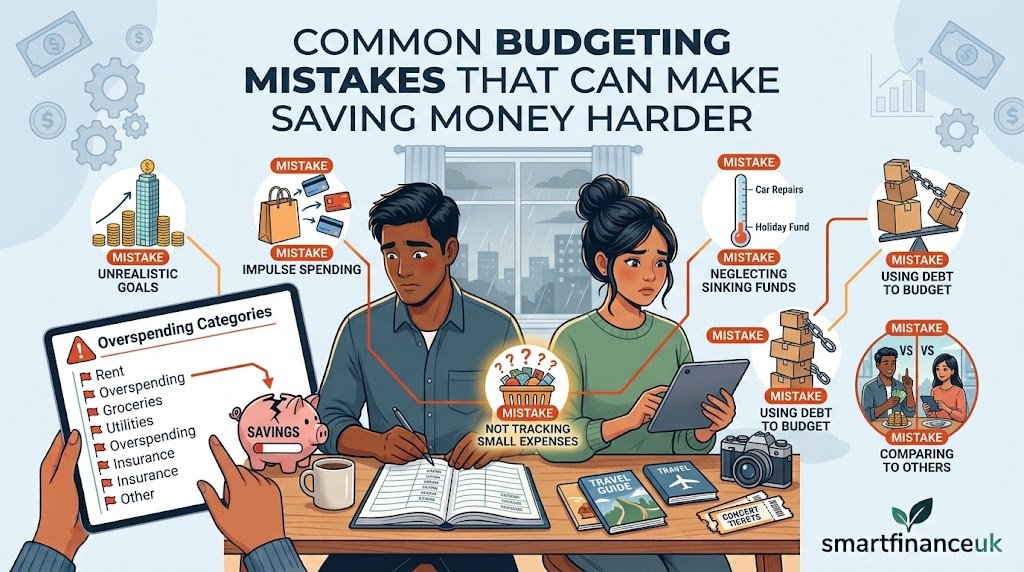
A budget is supposed to make managing money easier. Yet a budget can sometimes have the opposite effect when it is based on unrealistic assumptions, leaves out important expenses or treats every month as though it will be exactly the same.
This is particularly noticeable when you are trying to save money. You may set a savings target, cut several expenses and feel confident about your plan, only to find that an unexpected annual bill or a series of everyday purchases leaves you reaching for your savings again.
The problem is not always a lack of discipline. Sometimes the budget itself needs changing.
For UK households, useful budgeting means accounting for real expenses such as rent or mortgage payments, Council Tax or domestic rates, energy, food, transport, insurance and debt repayments. It also means recognising costs that do not arrive every month.
This guide looks at common budgeting mistakes that can make saving harder and explains how to build a more realistic approach.
Mistake 1: Setting a Budget That Is Too Strict
One of the most common mistakes is creating a budget that looks excellent on paper but is difficult to live with.
For example, someone might decide that they will spend almost nothing on eating out, entertainment, clothing or hobbies so they can save as much as possible.
That approach may work for a short period. But if the budget leaves no room for ordinary discretionary spending, it can become difficult to maintain.
A realistic budget should reflect your actual life.
This does not mean every expense needs to remain unchanged. If you want to save more, reducing unnecessary spending can be useful. The important distinction is between reducing spending and pretending that certain expenses do not exist.
MoneyHelper recommends creating a budget based on your actual income and spending rather than relying on unrealistic estimates. Its Budget Planner allows you to record regular and less frequent expenses so you can get a clearer picture of your finances. (moneyhelper.org.uk)
A smaller savings target that you can maintain may be more useful than a large target that causes you to abandon the plan.
Mistake 2: Forgetting Annual and Irregular Expenses
A monthly budget can appear healthy if it includes only bills that arrive every month.
The problem comes when an annual expense arrives.
Examples include:
- Car insurance
- MOT and servicing
- Christmas spending
- Birthdays
- School costs
- Home repairs
- Annual memberships
- Professional fees
- Certain insurance payments
If you do not account for these costs, they can suddenly consume money you intended to save.
A useful solution is to estimate the annual cost and divide it by 12.
For example, a hypothetical £480 annual expense works out at £40 per month.
Putting £40 aside each month does not make the bill cheaper. It simply spreads the preparation across the year.
MoneyHelper refers to this approach as using a sinking fund for known future expenses. (moneyhelper.org.uk)
This is different from an emergency fund. An emergency fund is intended for unexpected problems, while a sinking fund is designed for expenses you can reasonably anticipate.
Mistake 3: Using Your Best Month as the Normal Month
This can be particularly risky for people whose income changes.
If your monthly income sometimes reaches £2,500, it can be tempting to build your lifestyle around that amount.
But if income falls to £1,900 the following month, the budget may suddenly stop working.
For irregular income, a more cautious approach is to build essential spending around a lower or dependable income level.
MoneyHelper recommends considering your lowest monthly income when budgeting for variable earnings. This can help reduce the risk of committing to regular expenses that only work during stronger months. (moneyhelper.org.uk)
When income is higher, the additional money could potentially be used for savings, irregular expenses or other financial priorities.
The exact approach depends on your circumstances.
Mistake 4: Saving Whatever Is Left at the End
Some people plan to save whatever remains after all spending has been completed.
That can work, but it often creates a problem: there may be nothing left.
Small purchases, unexpected expenses and convenience spending can gradually consume the money that was supposed to become savings.
If saving is an important priority, consider including it as a planned part of the budget.
For example, if £20 per month is genuinely affordable, you could arrange an automatic transfer to a suitable savings account after payday.
MoneyHelper recommends regular saving and suggests that automated transfers can make the habit easier to maintain. (moneyhelper.org.uk)
The amount needs to be realistic. Automating an amount that regularly leaves you short can create a different problem.
Mistake 5: Ignoring Small Recurring Expenses
A £5 or £10 purchase may seem insignificant.
A recurring £5 or £10 payment can be different.
Subscriptions, app payments, convenience spending and frequent takeaway purchases can become meaningful over a full year.
Suppose a hypothetical subscription costs £8 per month.
That is £96 over a year if it continues for all 12 months.
The point is not that every subscription should be cancelled. Some provide genuine value.
Instead, review recurring payments and ask whether you still use them enough to justify their cost.
Your bank statements can be particularly useful because they show what you are actually paying rather than what you think you are paying.
Mistake 6: Confusing Needs With Wants
The distinction between needs and wants is not always obvious.
Housing, basic food and essential energy are generally needs.
A particular brand of food, an upgraded phone or multiple streaming services may be wants.
But circumstances matter.
A reliable internet connection may be essential for someone who works from home. A car may be necessary for someone living in an area with limited public transport.
Rather than putting every expense into a rigid category, ask:
What would happen if I removed this expense?
If removing it would create a genuine problem, it may be an essential cost.
If removing it would simply mean giving up something enjoyable or convenient, it may be discretionary.
This exercise can help identify spending that can be reduced without automatically cutting things that your household genuinely needs.
Mistake 7: Forgetting Debt Repayments
A budget that focuses heavily on saving can sometimes overlook borrowing.
Credit cards, loans and overdrafts all need to be considered.
Minimum repayments should be included in your regular budget. If debt is expensive, the interest can also affect how much money is available for future saving.
There is no universal rule saying that everyone should stop saving and pay off debt immediately, or that everyone should save before making additional repayments.
The type and cost of the debt matter.
MoneyHelper notes that people with expensive debt may need to prioritise dealing with it while still considering the usefulness of having some emergency savings. (moneyhelper.org.uk)
If you are struggling to make repayments, free debt advice may be more appropriate than simply trying to squeeze another category from your budget.
Mistake 8: Making the Savings Target Too Large
A large savings target can look motivating.
It can also be discouraging.
If your income is limited and your essential costs are high, deciding to save £500 every month may not be realistic.
A better approach is to calculate what your budget can actually support.
Suppose you can reliably save £25.
Saving £25 every month would amount to £300 over a year before interest, assuming you make all 12 contributions and do not withdraw the money.
That is a hypothetical illustration, not a recommended target.
The principle is simple: set a target based on your circumstances rather than an arbitrary percentage or figure.
You can increase it when your financial position improves.
Mistake 9: Treating Savings as One Big Pot
Not all savings serve the same purpose.
Money for an annual insurance payment is different from emergency savings.
Money for a holiday is different from money intended for a future house deposit.
Keeping everything in one balance can make it difficult to know what money is genuinely available.
Consider separating savings into purposes where it helps.
For example:
Emergency fund: unexpected financial problems.
Sinking funds: known future expenses.
Short-term goals: planned purchases or events.
Longer-term savings: money intended for a more distant goal.
The exact structure depends on your circumstances.
The purpose is simply to reduce the chance of spending money that has already been allocated to something important.
Mistake 10: Failing to Check the Actual Numbers
A budget based on guesses can quickly become inaccurate.
Suppose you believe you spend £200 per month on groceries.
After reviewing several months of transactions, you discover the actual average is £280.
Continuing to use £200 in the budget does not make the food bill £200.
It simply creates a £80 gap.
MoneyHelper recommends using information such as bank statements, bills and payslips when preparing a budget so that the figures reflect reality. (moneyhelper.org.uk)
This is particularly important for variable spending.
Your first budget does not have to be perfect. It should become more accurate as you collect better information.
Mistake 11: Cutting the Same Category Every Month
If you consistently overspend on food, transport or another essential category, repeatedly cutting the budget may not solve the problem.
It may indicate that the original figure was unrealistic.
For example, setting a grocery budget that is too low could cause you to spend over budget every month.
Instead, examine why the spending is higher.
Could food waste be reduced?
Could shopping be planned differently?
Are prices higher than when the budget was created?
Is the household size different?
If the expense is genuinely necessary, the better solution may be to adjust the budget and find savings elsewhere.
Mistake 12: Not Leaving Room for Unexpected Costs
A budget that allocates every pound has little flexibility.
Even if all regular expenses are predictable, something can still go wrong.
A household appliance might break. A child may need something unexpectedly. A vehicle may need a repair.
This is why an emergency fund can be useful.
MoneyHelper gives three to six months of essential outgoings as a general rule of thumb for a substantial emergency savings cushion, while recognising that this may take time to build and that starting with smaller amounts can still be worthwhile. (moneyhelper.org.uk)
You do not need to reach that level immediately.
If money is tight, a small accessible reserve can be a starting point.
Mistake 13: Using Credit to Make the Budget Look Balanced
This is an important warning sign.
If your monthly income does not cover your spending, using a credit card or overdraft can make the bank balance appear manageable temporarily.
But the spending has not disappeared.
It has been moved into the future, potentially with interest and fees.
If borrowing is repeatedly being used to cover ordinary household expenses, the budget needs closer attention.
The Financial Conduct Authority advises people struggling with repayments to contact lenders and seek appropriate support rather than ignoring the problem. (fca.org.uk)
Free debt advice may also help you understand your options.
Mistake 14: Assuming Every Saving Requires Sacrifice
Saving money does not have to mean removing everything enjoyable from your life.
Some of the most effective changes can come from reducing waste rather than reducing quality of life.
For example, reviewing unused subscriptions may have little effect on your daily routine.
Planning meals can reduce food waste without requiring you to eat less.
Comparing insurance at renewal can potentially reduce a recurring cost without changing the protection you need, although the cover should always be compared carefully.
The goal is to spend deliberately.
Mistake 15: Never Updating the Budget
A budget created twelve months ago may no longer reflect your circumstances.
Income can change.
Rent can change.
Household bills can change.
A subscription may end.
A new debt repayment may begin.
Your household may grow or shrink.
Review your budget regularly and update figures when circumstances change.
This does not mean rebuilding the entire budget every week.
A short monthly review can identify important changes, while a more detailed review every few months can help you assess whether your overall plan remains realistic.
A Hypothetical Example of Fixing a Difficult Budget
Consider a hypothetical household with £2,000 of monthly take-home income.
Its original budget includes £200 for groceries, £100 for transport, £50 for entertainment and £100 for savings.
After three months, the household notices that groceries are actually averaging £270 and transport is closer to £120.
The original budget therefore creates a £90 monthly shortfall.
Instead of continuing to pretend that the original figures work, the household reviews its spending.
It might reduce an unused subscription, lower discretionary spending and adjust the savings target temporarily.
The revised budget could allocate realistic amounts to essential categories while maintaining a smaller savings contribution.
The lesson is important: a budget should describe your financial reality, not an ideal version of it.
How to Fix a Budget That Keeps Failing
If your budget repeatedly goes wrong, start again using actual figures.
Review several months of bank statements.
Separate fixed and variable costs.
Add annual and irregular expenses.
Include debt repayments.
Check whether your income is stable.
Then set a savings amount that fits what remains.
If the result is still negative, do not simply reduce every category until the spreadsheet turns positive.
Ask whether the problem is structural.
If essential spending consistently exceeds income, you may need to explore additional income, available support, lower-cost arrangements or professional debt guidance.
MoneyHelper offers a Budget Planner, benefits calculator and debt advice tools that can help people assess their position. (moneyhelper.org.uk)
A Simple Budgeting Check Each Month
You can avoid many of these mistakes with a short monthly review.
Check your income.
Review essential bills.
Look at variable spending.
Check upcoming annual expenses.
Review debt repayments.
Check your savings contribution.
Compare planned spending with actual spending.
Then choose one or two changes for the following month.
There is no need to make dozens of changes at once.
A budget should help you make better decisions, not become another source of pressure.
Frequently Asked Questions
Why does my budget keep failing?
A budget can fail because its figures do not match reality. Common causes include underestimating food or transport costs, forgetting annual expenses, ignoring irregular income or setting an unrealistic savings target. Review several months of actual transactions and adjust the budget based on what you discover. If essential spending consistently exceeds income, the problem may require more than simply reducing discretionary spending.
How much should I save each month?
There is no single amount suitable for every UK household. Your savings target should reflect your income, essential costs, debts and financial priorities. Starting with a smaller amount can be sensible if money is tight. MoneyHelper recommends starting small if necessary and building savings gradually rather than setting an amount that your budget cannot sustain. (moneyhelper.org.uk)
Should I save money or pay off debt first?
It depends on the type and cost of the debt. Expensive borrowing can become increasingly costly through interest and charges, while having no accessible savings can leave you vulnerable to unexpected expenses. MoneyHelper recommends considering both factors rather than following a universal rule. If you are struggling with debt repayments, free debt advice can help you assess your options. (moneyhelper.org.uk)
How often should I review my budget?
A quick monthly review is useful for most households. You can compare planned spending with actual spending, check upcoming bills and adjust categories where necessary. A more detailed review every few months can also help when your income, housing costs, debt or household circumstances change. You do not need to rebuild the budget every time you check it.
Is it a mistake to spend money on entertainment?
No. Entertainment and other discretionary spending can have a legitimate place in a household budget. The issue is whether the spending fits within your income and priorities. A budget that completely removes enjoyable activities may be difficult to maintain. Instead, set a realistic amount and monitor it. If you need to save more, consider which discretionary expenses provide the least value to you.
What should I do if I cannot save anything?
Do not force a savings payment that causes essential bills or debt repayments to be missed. First, review your income and spending carefully. Check whether any expenses can realistically be reduced and whether you may qualify for additional support. If debt or essential bills are becoming unaffordable, consider seeking free debt advice. MoneyHelper provides tools for budgeting, benefits and debt support. (moneyhelper.org.uk)
Should I use a budgeting app?
You do not need one. A spreadsheet, notebook or existing banking app may be sufficient. If you choose a third-party budgeting service, check its fees, privacy information, security arrangements and the financial data it requests. The best system is the one that provides useful information without becoming difficult to maintain.
Final Thoughts
Budgeting mistakes are often less about arithmetic and more about unrealistic expectations.
A budget that ignores annual bills, underestimates everyday spending or assumes your highest income will continue can make saving unnecessarily difficult. So can a savings target that leaves you short of money before the end of the month.
Start with your actual numbers. Include predictable future expenses, keep savings realistic and review your spending regularly.
If the budget does not balance, do not simply make the figures look better on paper. Find out why.
Sometimes the answer is reducing unnecessary spending. Sometimes it is adjusting an unrealistic budget. And if essential costs are consistently higher than income, the right next step may be to seek impartial support rather than relying on further borrowing.
A good budget is not the one with the most aggressive savings target. It is the one that accurately reflects your circumstances and helps you make informed decisions about your money.
This article provides general financial education for UK readers and is not personalised financial advice. Your appropriate budgeting, saving and debt decisions depend on your individual circumstances.
Sources and Further Reading
- MoneyHelper — Budget Planner
- MoneyHelper — How to budget for an irregular income
- MoneyHelper — Sinking funds explained
- MoneyHelper — Emergency savings: how much is enough?
- MoneyHelper — Help with the cost of living
- Financial Conduct Authority — Financial impact of rising costs
Suggested Internal Links
Suggested internal article: How to Create a Simple Monthly Budget You Can Actually Follow
Suggested anchor text: create a simple monthly budget
Suggested internal article: How to Track Your Monthly Spending Without Making It Complicated
Suggested anchor text: track your monthly spending
Suggested internal article: Simple Ways to Save Money on Everyday Household Expenses
Suggested anchor text: save money on everyday household expenses
Suggested internal article: How to Build an Emergency Fund From a Small Monthly Income
Suggested anchor text: build an emergency fund
Suggested internal article: How to Manage Debt and Savings When Money Is Tight
Suggested anchor text: manage debt and savings
SEO Information
SEO Title: Common Budgeting Mistakes That Make Saving Harder
Meta Description: Learn about common budgeting mistakes that can make saving money harder, and discover practical ways to create a more realistic UK household budget.
URL Slug: common-budgeting-mistakes
Primary Keyword: budgeting mistakes
Secondary Keywords:
- common budgeting mistakes
- budgeting mistakes to avoid
- how to save money
- UK budgeting tips
- monthly budget mistakes
- saving money on a budget
Search Intent: Informational / Educational / Practical
Suggested Featured Image Concept:
An original editorial-style image showing a UK household reviewing a monthly budget at a kitchen table, with a notebook showing simple income, bills and savings figures, alongside a calculator and bank statement. Include subtle pound symbols and avoid real bank branding.