
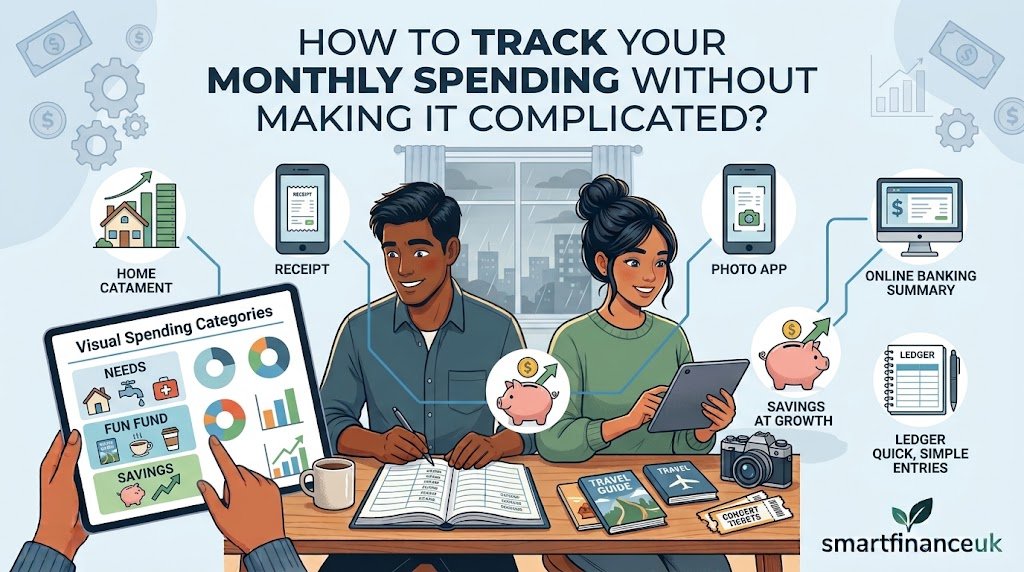
Tracking your monthly spending can sound like a task that requires spreadsheets, complicated categories and constant checking of your bank account. It does not.
A useful spending system can be as simple as knowing how much money comes in, what bills need to be paid, what you spend on everyday needs and how much remains. The goal is not to record every transaction perfectly forever. It is to understand your spending well enough to make sensible decisions about your money.
For UK households, this can include checking payments for rent or mortgage, Council Tax or domestic rates, energy, food, transport, insurance, subscriptions and debt repayments. It can also reveal smaller purchases that are easy to overlook.
MoneyHelper recommends using accurate information from bank statements, bills and banking records when working out a budget. Its Budget Planner can also help organise income and spending into categories. (moneyhelper.org.uk)
This guide explains a straightforward way to track monthly spending without turning money management into a daily chore.
What Does Tracking Your Spending Actually Mean?
Tracking spending simply means recording or reviewing where your money goes.
You do not necessarily need to write down every purchase manually. Your bank account may already contain most of the information you need.
For example, during one month you might receive £2,100 into your current account and make payments for housing, utilities, food, transport, subscriptions and other expenses.
By reviewing those transactions, you can work out how much went towards each type of spending.
The purpose is to answer practical questions:
How much did I spend?
What did I spend it on?
Which costs are fixed?
Which costs change from month to month?
How much money is left after essential spending?
Once you know the answers, creating or adjusting a monthly budget becomes much easier.
Why Track Spending If You Already Have a Budget?
A budget tells you what you plan to spend.
Tracking tells you what you actually spent.
Those two figures can be very different.
Suppose someone plans to spend £250 on groceries but repeatedly spends £310. The problem may not be that the person lacks discipline. The budget may simply be unrealistic for their household.
Similarly, a person might allocate £50 a month to entertainment but discover that several smaller purchases push the real amount closer to £90.
Without tracking, these differences are easy to miss.
MoneyHelper’s budgeting guidance recommends looking at actual income and spending rather than relying on estimates. (moneyhelper.org.uk)
The purpose is not to judge yourself. It is to replace assumptions with useful information.
The Simplest Way to Start
You can begin with three numbers:
Money coming in
Essential bills
Everyday and optional spending
For example, imagine a hypothetical household receives £2,400 after tax.
Its regular essential costs might total £1,700.
That leaves £700 for variable spending, savings, irregular costs and other priorities.
The exact figures are not important. The structure is.
Once you understand these three areas, you can add more detail only where it is useful.
There is no need to create 40 categories if five or six broad categories give you enough information to make decisions.
Step 1: Check Your Income
Start by identifying how much money you receive during the month.
For someone paid a regular salary, this may simply be the amount shown on their payslip that reaches their bank account.
Depending on your circumstances, income may include employment earnings, benefits, pension payments, self-employment income or other regular sources.
If your income changes, avoid assuming that your highest monthly income is normal.
MoneyHelper recommends considering your lowest monthly income when budgeting if your earnings vary. This can help reduce the risk of committing to spending that becomes unaffordable during a weaker month. (moneyhelper.org.uk)
Your spending tracker should therefore reflect the income you can reasonably expect rather than an unusually good month.
Step 2: List Your Fixed Bills
Next, identify expenses that are relatively predictable.
These might include:
- Rent or mortgage
- Council Tax
- Energy
- Water
- Broadband
- Mobile phone
- Insurance
- Childcare
- Debt repayments
- Regular subscriptions
Some bills can change even though you pay them regularly, so check actual statements rather than assuming the amount is always identical.
It is also useful to identify payment dates.
Knowing that a large payment leaves your account near the beginning of the month can make it easier to understand why your available balance changes sharply.
For households in Northern Ireland, remember that domestic rates apply instead of Council Tax. In England, Scotland and Wales, Council Tax arrangements apply, although details can vary between nations and local authorities.
Step 3: Track Variable Spending
Variable expenses are where spending can become difficult to see.
Food, petrol, public transport, clothing, entertainment and personal purchases can change from week to week.
This does not mean you need to record every transaction manually.
At the end of each week, you could simply check your bank transactions and note the total for a few broad categories.
For example:
| Category | Hypothetical monthly spending |
|---|---|
| Food and household shopping | £320 |
| Transport | £140 |
| Eating out | £70 |
| Entertainment | £45 |
| Personal spending | £60 |
These figures are purely illustrative.
The point is to create a useful overview without turning the process into bookkeeping.
Step 4: Use Your Bank Account to Do Much of the Work
Your current account may already provide useful transaction information.
Many banking apps allow customers to search transactions, view spending categories or review payments over a selected period.
Features vary between providers, so do not assume every bank offers the same tools.
If your bank’s app does not provide the information you need, you can use a spreadsheet, budgeting app or simple notes.
You do not need a specialist tool to start.
A basic spreadsheet with columns for date, description, category and amount can be enough.
For privacy and security, avoid entering unnecessary banking credentials into third-party services. If you use a budgeting app, understand what information it requests and how your financial data is handled before connecting an account.
Step 5: Keep Your Categories Simple
One of the easiest ways to make spending tracking unnecessarily complicated is to create too many categories.
You probably do not need separate categories for every type of supermarket purchase.
Instead of:
- Bread
- Milk
- Fruit
- Cleaning products
- Snacks
- Toiletries
you could use:
Food and household
Likewise, instead of creating separate categories for every streaming service, use:
Subscriptions
A simple system might contain:
- Housing
- Household bills
- Food
- Transport
- Debt
- Savings
- Personal spending
- Other
You can add a category if you notice a recurring expense that needs closer attention.
The best categories are the ones that help you make decisions.
Step 6: Track Spending Weekly
Checking your spending once a week can be easier than trying to reconstruct an entire month at the end.
Choose a regular day.
Review your transactions and ask whether anything looks unusual.
You might discover that your food spending is already higher than expected or that several small payments have accumulated.
A weekly review also gives you time to adjust.
If you have spent more than expected on one category, you may decide to be more careful with discretionary spending for the rest of the month.
This is easier than discovering the problem after your account balance has become very low.
Step 7: Compare Actual Spending With Your Budget
Once you have tracked a month, compare the results with your original plan.
For example:
| Category | Budget | Actual | Difference |
|---|---|---|---|
| Food | £280 | £310 | +£30 |
| Transport | £150 | £135 | -£15 |
| Entertainment | £60 | £85 | +£25 |
| Personal | £70 | £55 | -£15 |
Again, these are hypothetical figures.
The table shows something useful: the household spent £30 more on food and £25 more on entertainment, but spent less than expected in transport and personal spending.
The next step is not necessarily to cut food by £30.
Instead, ask why the difference happened.
Was there a special occasion? Did food prices change? Was there extra household spending that month?
Understanding the reason is more useful than simply reacting to the number.
Track Irregular Expenses Too
Monthly spending can look under control while occasional expenses create problems.
Examples include:
- Car insurance
- MOT
- Vehicle servicing
- Christmas
- Birthdays
- School costs
- Home repairs
- Professional fees
- Annual memberships
- Holiday expenses
If you only track money leaving your account in a particular month, these costs can appear to be sudden surprises.
A better approach is to record them as annual or irregular expenses and work out how much they represent on a monthly basis.
For example, a hypothetical £600 annual expense is equivalent to £50 per month.
Setting aside £50 every month does not reduce the total cost. It simply spreads the preparation across the year.
MoneyHelper describes this approach as using sinking funds for known future expenses. (moneyhelper.org.uk)
Do Not Forget Cash Spending
Cash purchases can disappear from your digital records unless you deliberately track them.
If you regularly withdraw £50 and spend it over several days, your bank statement may only show the £50 cash withdrawal.
The individual purchases are no longer visible.
If you use cash, record the withdrawal and make a quick note of what it was spent on.
You do not necessarily need to list every small purchase. You could simply record totals such as £20 for food, £15 for transport and £15 for personal spending.
The purpose is to prevent cash from becoming an untracked category.
How to Track Spending With a Spreadsheet
A spreadsheet can be useful if you want more control.
You only need a few columns:
| Date | Description | Category | Amount |
|---|---|---|---|
| 3 August | Supermarket | Food | £54 |
| 5 August | Bus | Transport | £12 |
| 7 August | Subscription | Entertainment | £9 |
| 9 August | Pharmacy | Household | £8 |
At the end of the month, add the amounts in each category.
You can then compare the totals with your budget.
Do not feel pressure to build a complicated financial dashboard. A simple spreadsheet that you actually maintain is more useful than an impressive template you stop using after two weeks.
How to Track Spending Without Writing Everything Down
If manual tracking feels like too much work, use a lighter system.
Your bank statements can provide the raw information.
You could simply review your transactions once a week and record totals for the categories that matter most.
For example, if housing and household bills are already predictable, you may not need to analyse them every week.
Instead, focus your attention on categories that regularly change, such as food, entertainment and personal spending.
This is a useful principle:
Track the areas where information can change your decisions.
If knowing that you spent £18 rather than £17 on a particular bill will not change anything, there may be little value in spending time analysing it.
What About Budgeting Apps?
Budgeting apps can automate some aspects of spending tracking.
Depending on the service, an app may categorise transactions, create spending summaries or help you monitor budgets.
However, you do not need an app to manage your money.
Before using one, consider its cost, privacy arrangements, security features and the financial information it requests.
Some services may require access to account information to provide automated features. Read the provider’s terms and privacy information before connecting your bank account.
For some people, their existing banking app is sufficient.
For others, a spreadsheet provides more control.
The right choice is the one that gives you useful information without creating unnecessary work or privacy concerns.
Find the Spending That Surprises You
After tracking your transactions for a month, look for patterns rather than isolated purchases.
You may discover:
- Several subscriptions you rarely use
- More takeaway spending than expected
- Frequent small convenience purchases
- Higher-than-expected transport costs
- Regular cash withdrawals
- Repeated online purchases
- Annual bills you forgot to plan for
These discoveries are often more valuable than knowing the exact amount spent on every category.
For example, if you discover that several small takeaway purchases total £90 in one month, you can decide whether that spending reflects your priorities.
The purpose is awareness, not guilt.
What If You Spend More Than Planned?
Overspending in one category does not mean you need to abandon the entire budget.
First, work out why it happened.
If groceries cost more because you had visitors, that is different from consistently underestimating your food budget.
If transport spending increased because of an unexpected journey, it may not happen again.
If the same category exceeds the budget every month, however, your original figure may need changing.
A realistic budget is based on real life.
It is better to set a realistic food budget and find another area to reduce than to repeatedly set an artificially low food budget and label yourself as having failed.
Use Spending Tracking to Make Better Decisions
Once you have several months of information, your spending history can become useful for planning.
You may be able to estimate:
- Average food spending
- Typical transport costs
- Annual insurance expenses
- Subscription costs
- Average discretionary spending
- How much you usually save
- How much money remains after essential bills
This can make future budgeting easier.
It can also help you prepare for changes.
If you know that your car insurance is usually a significant annual expense, you can create a sinking fund before renewal.
If you know that food spending rises during certain months, you can account for that rather than being surprised.
The goal is to turn past spending into useful information for future decisions.
Common Mistakes When Tracking Spending
Trying to track everything perfectly
You do not need perfect records.
If the system takes too much time, simplify it.
Creating too many categories
More categories do not automatically mean better information.
Start broad and add detail only when it helps.
Ignoring small purchases
Individual small transactions can become significant when repeated.
Review totals rather than dismissing every purchase because it is inexpensive.
Forgetting cash
Cash withdrawals can hide where money is going.
Include cash in your system.
Tracking spending but never reviewing it
Recording numbers is only useful if you occasionally use them to make decisions.
Compare actual spending with your budget and adjust where necessary.
Treating overspending as a personal failure
Unexpected costs happen.
The purpose of tracking is to identify patterns and improve your plan, not to create guilt.
A Simple 15-Minute Monthly Spending Review
You can keep the process short.
At the end of the month:
Check your income.
Confirm how much money came into your accounts.
Review fixed bills.
Make sure major payments were recorded correctly.
Review variable spending.
Look at food, transport, personal spending and other categories that change.
Check irregular expenses.
Record annual or occasional costs that occurred during the month.
Compare actual spending with your budget.
Look for meaningful differences.
Choose one or two changes.
Do not try to redesign your entire financial life every month.
This process can be enough to keep your spending visible without making money management feel like a second job.
When Spending Tracking Reveals a Bigger Problem
Sometimes tracking spending shows that the problem is not a lack of organisation.
You may discover that your essential expenses are consistently higher than your income.
If that happens, cutting a few optional purchases may not be enough.
MoneyHelper provides budgeting tools and information about benefits, bills and debt advice. (moneyhelper.org.uk)
If you are struggling to pay essential bills or debt repayments, consider seeking free and impartial debt advice rather than relying on additional borrowing to cover the shortfall.
The Financial Conduct Authority also advises consumers who are struggling financially to contact lenders and seek appropriate support rather than ignoring the problem. (fca.org.uk)
Tracking your spending cannot solve an income shortfall by itself, but it can give you the information needed to understand what is happening.
Frequently Asked Questions
What is the easiest way to track monthly spending?
Start with your bank statements and banking app. Review transactions once a week and group them into a small number of categories such as household bills, food, transport, debt, savings and personal spending. You can record the totals in a notebook, spreadsheet or budgeting app. There is no requirement to track every purchase manually if your existing banking records already provide enough information.
How often should I track my spending?
A weekly check is often enough for everyday spending, followed by a more complete review at the end of the month. Checking too frequently can become tiring, while checking only once every few months may allow problems to go unnoticed. The best frequency is one you can maintain consistently. If your finances are changing rapidly, you may benefit from checking more often.
Do I need a budgeting app to track my spending?
No. A budgeting app can be convenient, but a spreadsheet, notebook or your existing banking app may be enough. Choose a method based on how much detail you need and how comfortable you are using it. If you connect a third-party budgeting service to your bank account, check its security, privacy arrangements, costs and data-access requirements before using it.
Should I track every small purchase?
Not necessarily. Tracking every purchase can be useful when you are first trying to understand your spending, but it may become unnecessary over time. Broad categories can be sufficient. The main exception is spending that repeatedly causes your budget to run short. In that situation, looking more closely at smaller transactions can help reveal a pattern.
How do I track spending when I use cash?
Record the amount of cash you withdraw and make a simple note of the main categories where it goes. You do not necessarily need to record every individual cash purchase. The important thing is to prevent cash withdrawals from becoming an unexplained expense in your budget.
What should I do if I keep spending more than my budget?
First, compare your planned figure with your actual spending and identify the reason for the difference. If the same category is consistently higher, your budget may be unrealistic. Look for genuine ways to reduce the cost, but also consider whether the planned amount needs to be changed. A realistic budget is generally more useful than repeatedly setting a target that does not match your household’s circumstances.
Can tracking spending help me save money?
Yes, because it can show where money is going and identify recurring expenses you may want to change. However, tracking itself does not create savings. Once you identify an opportunity, you need to decide what action is appropriate. For example, you might cancel an unused subscription or redirect part of a reduced household expense into savings.
Final Thoughts
Tracking your monthly spending does not need to become a complicated financial project.
Start with your income, regular bills and everyday spending. Use your bank statements to do much of the work, keep categories broad and review the numbers regularly.
The most useful information is usually not the exact amount spent on every individual transaction. It is the pattern that emerges over time.
You may discover that your food budget is too low, that subscriptions have accumulated or that irregular expenses need to be planned more carefully. Once you know what is happening, you can make decisions based on your actual finances rather than assumptions.
Keep the system simple enough that you will continue using it. A basic monthly review that you maintain is far more useful than a complicated tracking system that you abandon.
This article provides general financial education for UK readers and is not personalised financial advice. Your appropriate budgeting and spending decisions depend on your income, household costs, debts and individual circumstances.
Sources and Further Reading
- MoneyHelper — Budget Planner
- MoneyHelper — Beginner’s guide to managing your money
- MoneyHelper — How to budget for an irregular income
- MoneyHelper — Sinking funds explained
- MoneyHelper — Help with the cost of living
- Financial Conduct Authority — Help with the financial impact of rising costs
Suggested Internal Links
Suggested internal article: How to Create a Simple Monthly Budget You Can Actually Follow
Suggested anchor text: create a simple monthly budget
Suggested internal article: Simple Ways to Save Money on Everyday Household Expenses
Suggested anchor text: save money on everyday household expenses
Suggested internal article: How to Build an Emergency Fund From a Small Monthly Income
Suggested anchor text: build an emergency fund from a small income
Suggested internal article: How to Manage Household Bills When Money Is Tight
Suggested anchor text: manage household bills
Suggested internal article: Simple Ways to Reduce Unnecessary Monthly Spending
Suggested anchor text: reduce unnecessary monthly spending
SEO Information
SEO Title: How to Track Monthly Spending Without Making It Complicated
Meta Description: Learn how to track monthly spending simply, review UK household expenses, spot spending patterns and make your budget easier to manage.
URL Slug: track-monthly-spending
Primary Keyword: track monthly spending
Secondary Keywords:
- how to track spending
- monthly spending tracker
- track household expenses
- UK budgeting
- spending tracker
- how to manage monthly spending
Search Intent: Informational / Educational / Practical
Suggested Featured Image Concept:
An original editorial-style image showing a UK household reviewing monthly transactions at a kitchen table, with a laptop or tablet displaying simple spending categories, a notebook and calculator nearby. Include subtle pound symbols and realistic household receipts without showing any real bank branding.